
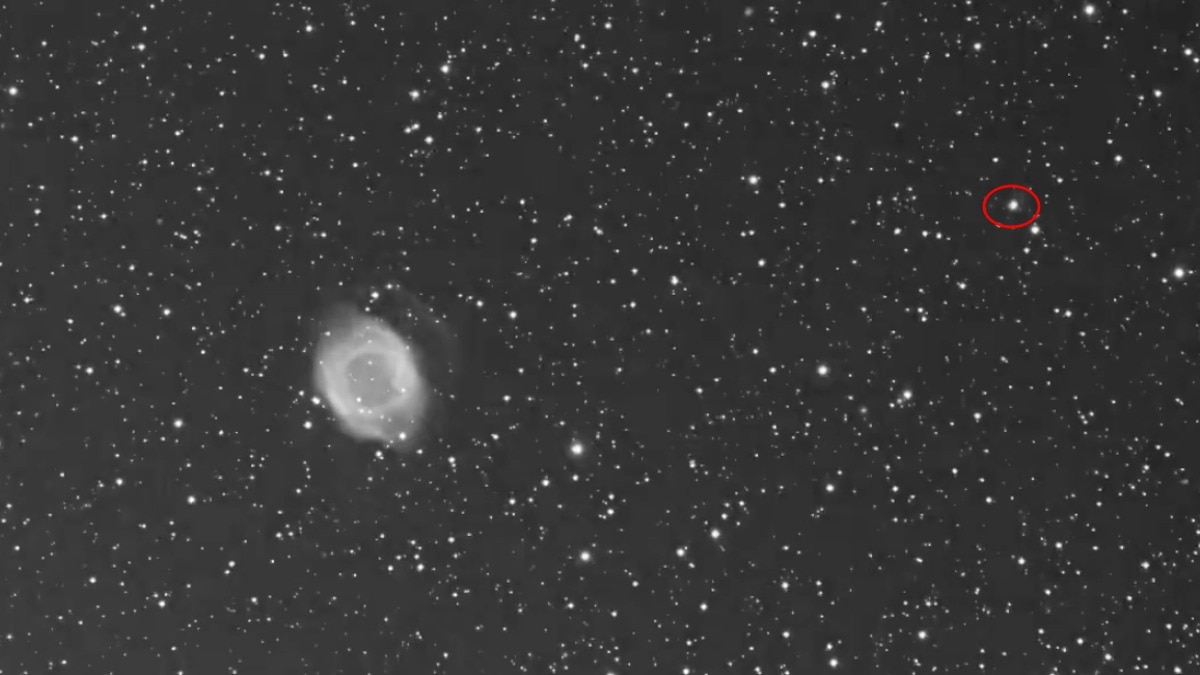
A faint moving dot crossing the night sky may not look like much. But one such dot recently turned out to be Nasa's newest Nancy Grace Roman Space Telescope, speeding towards its new home nearly 1.6 million kilometres from Earth.Arizona-based astrophotographer Andrew McCarthy captured the Nancy Grace Roman Space Telescope in a timelapse video just days after its launch.McCarthy later shared the footage on September 8, asking viewers if they could spot Roman moving across the sky.He later circled the tiny moving object and pointed out several other bodies visible in the frame. It’s this one I circled!There’s a bunch of things moving in frame- notably the asteroid 9 Metis, which is about 100miles wide and over 100 million miles away! (Bright object, lower right side) pic.twitter.com/RvX8CGXYPO— Andrew McCarthy (@AJamesMcCarthy) September 8, 2026 WHAT IS THE NANCY GRACE ROMAN SPACE TELESCOPE?Officially called the Nancy Grace Roman Space Telescope, the observatory is named after Nancy Grace Roman, Nasa's first chief astronomer and a key figure in the agency's space astronomy programme.Roman is designed to investigate some of the biggest questions in astronomy, including the nature of dark matter and dark energy, while also searching for planets beyond our solar system. Falcon Heavy launches @NASA’s Nancy Grace Roman Space Telescope from pad 39A in Florida, beginning its more than three-month journey to its destination where it will generate never-before-seen photos of the universe pic.twitter.com/L3gHrBiQ08— SpaceX (@SpaceX) August 30, 2026Its Wide Field Instrument can capture a patch of sky at least 100 times larger than Hubble's while maintaining a similar sharpness.That enormous view will allow Roman to survey huge portions of the universe far faster than Hubble. Nasa expects the mission to measure light from more than a billion galaxies and discover around 1,00,000 new exoplanets.Nasa Administrator Jared Isaacman described the mission as “exactly the kind of success story we want to see across Nasa”, noting that it was delivered ahead of schedule and on budget.BEGINNING OF A LONG JOURNEYRoman lifted off on August 30, 2026, at 4:56 pm IST aboard a SpaceX Falcon Heavy from Launch Complex 39A at Nasa's Kennedy Space Center in Florida.According to Nasa, the telescope is now on a roughly three-month journey to the second Sun-Earth Lagrange point, or L2, about 1.6 million km from Earth.After reaching L2, Roman will operate in an orbit around the point, giving it a stable vantage point for observing the universe. The location is also used by Nasa's James Webb Space Telescope.For now, engineers are checking the spacecraft and preparing its instruments.Nasa expects Roman's main Wide Field Instrument to be activated in the coming weeks, followed by months of calibration and testing. The full commissioning period is expected to last about three months.Deux tlescopes, un miroir de mme taille.Les tlescopes spatiaux Hubble ou Nancy Grace Roman disposeront tous deux d’un miroir primaire de 2,4 mtres de diamtre. Malgr cette taille identique, Roman offrira un champ de vision bien plus vaste que Hubble.: NASA GSFC pic.twitter.com/lz3r7E7WnC— Xplora (@XploraSpace) August 21, 2026Science operations are expected to begin after commissioning, with Nasa anticipating Roman's first images in early 2027.Its five-year primary mission will create vast surveys of the universe, helping astronomers study galaxies, dark matter, dark energy, black holes and planets beyond our solar system.If anything, McCarthy's backyard timelapse provides a remarkably down-to-Earth glimpse of a telescope that is currently on its journey into deep space.- EndsPublished On: Sep 9, 2026 17:29 IST
Watch: Astrophotographer captures Roman telescope flying in space
Full Article
Original Source
Read the full article at Indiatoday →KhanList aggregates and links to publicly available news content. We do not host full articles from third-party sources. Always verify important information with original sources.