
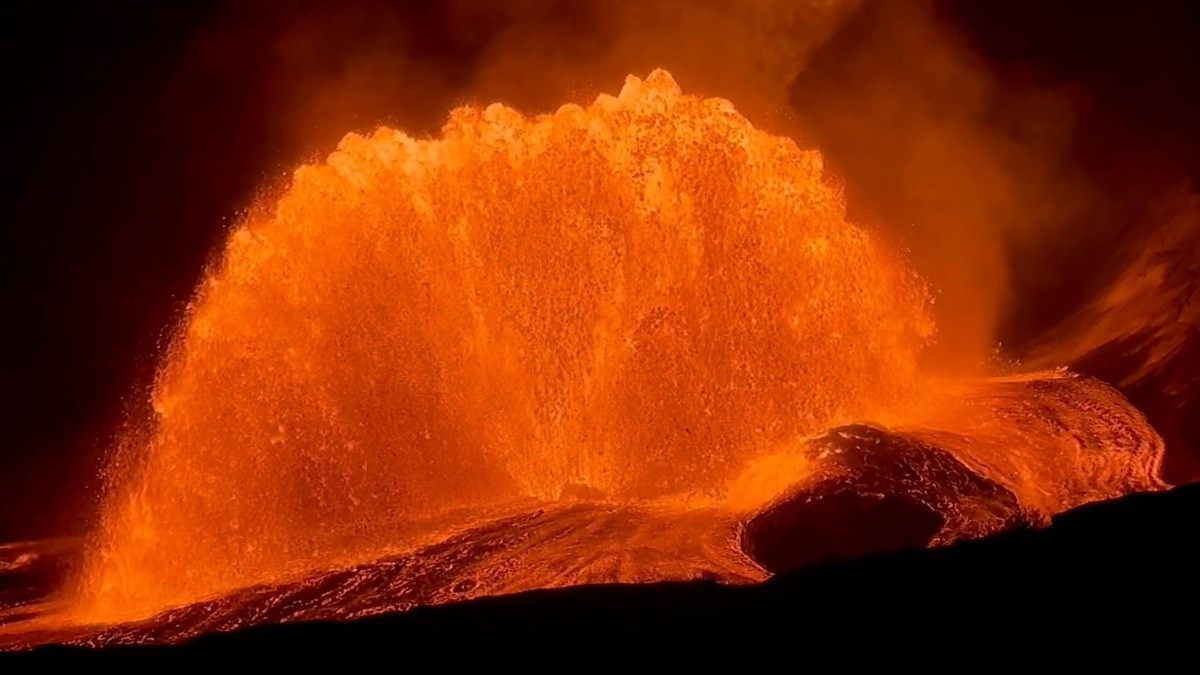
Kilauea's Episode 55 sent lava fountains soaring above its summit crater. The spectacle offered scientists insights while volcanic hazards persisted near active vents.The lava fountains reached a maximum height of approximately 720 feet. (Photo: USGS)New Delhi,Oct 19, 2026 12:28 ISTLava fountains reaching hundreds of feet into the night sky have illuminated Hawaii's Kilauea volcano, offering a dramatic display of the geological forces shaping Earth's surface.The latest episode of the volcano's ongoing eruption began on October 17, sending molten rock cascading across the summit crater.According to the US Geological Survey's Hawaiian Volcano Observatory, Episode Kanalima Kmlima (55) began at 3:19 am local time on Saturday, October 17, at the north vent inside Halemaumau crater in Hawaii Volcanoes National Park.The lava fountains reached a maximum height of approximately 720 feet (220 metres) around 5 am before the episode ended at 9:03 am. Klauea Eruption Update — Episode 55 of lava fountaining! After nearly two months since episode 54 of lava fountaining (Aug. 25, 2026), episode 55 of Klauea summit lava fountaining began at 3:19 a.m. HST this morning, October 17, and is ongoing. This is the 55th lava fountaining episode in the Klauea summit caldera eruption in Hawai‘i Volcanoes National Park that began on December 23, 2024. It occurs following weeks of intermittent spatter, low-dome fountains, and lava flows from the eruptive vent complex. The lava fountain from the north vent reached an estimated 700 feet high above the vent around 5 a.m. Hawaii Standard Time.The eruptive plume is reaching an estimated 25,000 feet above sea level. According to the National Weather Service, winds are blowing from the north-northeast direction, which suggests that volcanic gas emissions and volcanic material may be distributed to the south-southwest. Fountaining episodes typically last 12 hours or less, but ash can remain in the air for longer depending on wind and weather conditions. Please stay aware of hazards and rely on official updates from USGS, National Weather Service, and Hawai’i Volcanoes National Park. Video of episode 55 on October 17, 2026. #Kilauea #Eruption #Lava— USGS Volcanoes (@USGSVolcanoes) October 17, 2026 Preliminary estimates suggest about seven million cubic metres of lava erupted during the event. The eruption is currently paused, with scientists continuing to monitor the volcano.WHY IS KILAUEA SO ACTIVE?Kilauea is among the world's most active volcanoes, partly because of its location above a geological hotspot beneath the Pacific Ocean. Intermittent overflows and spatter continue to erupt at Klauea’s summit, with activity at both north and south vents and strong overnight glow. West vent also showed occasional glow. Tremor remains steady and summit tilt shows minor inflation. Episode 55 remains possible as conditions stay pressurized. No anomalous activity outside the summit region. : North vent eruptive activity on September 30, 2026. #Kilauea #Lava #Eruption— USGS Volcanoes (@USGSVolcanoes) October 1, 2026Unlike volcanoes that form primarily along the boundaries of tectonic plates, Hawaii's volcanoes are fuelled by unusually hot material rising from deep within Earth's mantle. As the Pacific Plate moves over this relatively stationary hotspot, magma rises through the crust, building volcanic islands over millions of years.Kilauea also produces predominantly basaltic lava, which is relatively fluid compared with the thick, sticky magma found at many other volcanoes. This allows lava to flow readily and gases to escape, contributing to frequent eruptions and spectacular fountains.An intrusion shook Klauea’s summit last night, September 30. Dozens of earthquakes, rapid ground deformation, and shifting activity beneath Halemaumau showed that magma was making a new path underground. Scientists are watching closely and on an overflight this morning, saw that lava is still visible within the north vent. Learn more: https://t.co/K9UPzgdxrA : Video shows lava in the north vent at the summit of Klauea during an overflight on October 1, 2026. #Kilauea #VolcanoWatch #Intrusion— USGS Volcanoes (@USGSVolcanoes) October 2, 2026The volcano's current summit eruption began on December 23, 2024, and has since produced repeated episodes of intense lava fountaining separated by pauses. Episode 55 followed nearly two months after the previous major fountaining episode on August 25, 2026.IS THE ERUPTION DANGEROUS?Although the latest activity has been confined to a restricted area of the national park, volcanic hazards remain significant. Lava, falling volcanic fragments, volcanic gases and unstable crater walls can pose serious risks near active vents.The USGS continues to monitor seismic activity, ground deformation and gas emissions to track changes in the volcano's behaviour.Kilauea's spectacular displays offer scientists a valuable opportunity to study how magma moves beneath Earth's surface — but its activity remains a reminder that the planet is constantly evolving.- Ends
Watch: 720-foot-high lava fountains light up Hawaii as Kilauea erupts
Full Article
Original Source
Read the full article at Indiatoday →KhanList aggregates and links to publicly available news content. We do not host full articles from third-party sources. Always verify important information with original sources.