
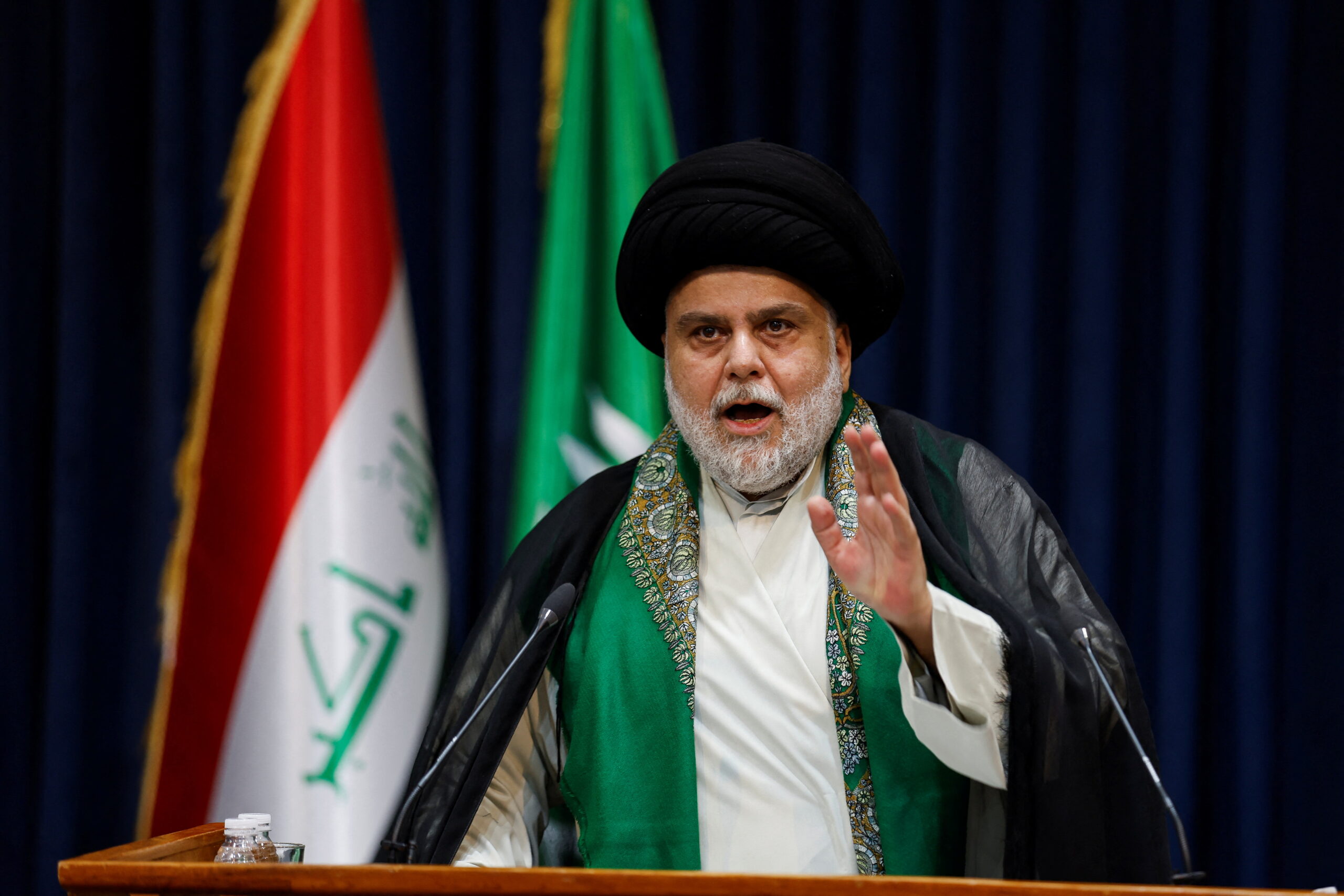
“Let us turn the page with justice and fairness, without condescension or arrogance,” Sadrist movement leader Muqtada al-Sadr wrote on October 7 in a post directed at the United States. Al-Sadr led the Mahdi Army, the militia established after 2003 to combat the US military presence in Iraq, and he boasts a long history of anti-Western rhetoric. The most significant signal from his post, however, was the distinction between his positions and those of his rivals in the Coordination Framework, the coalition of Shia political parties currently governing Iraq. He emphasized the centrality of Iraq in Shia decision-making and implicitly identified his primary enemies as “ISIS adherents,” linking them to the terrorist group. Parties closer to Iran within the Framework emphasize Iran’s centrality, considering themselves integral to the “Axis of Resistance,” and prioritize hostility toward the United States and its allies over confronting radical Sunni groups. Al-Sadr is attempting to present himself as a nationalist who is a more open partner to the United States and its allies. However, the true limits of his positions, and whether they signify a genuine shift in his political thinking, remain open questions. To understand what al-Sadr is signaling and his overall vision, I spoke with a number of Sadrists. But even they do not yet know the answers and even remain hesitant to meet US officials due to uncertainty over whether al-Sadr currently permits such contact. Placing a new bet Following his victory in the 2021 parliamentary elections, al-Sadr allied with Sunni and Kurdish factions to form a majority government that would exclude his Shia rivals from power. In response, Tehran facilitated the creation of the Coordination Framework to oppose al-Sadr’s project. By leveraging a Federal Supreme Court ruling that required a two-thirds parliamentary quorum to form a government, the Framework paralyzed the political process. Following months of deadlock that culminated in his supporters storming the Green Zone in August 2022, al-Sadr announced his complete withdrawal from politics and ordered his members of parliament to resign. Since his withdrawal, al-Sadr has adopted positions opposing the Framework to present himself as a viable alternative to the current ruling powers. In December 2024, he swiftly welcomed the end of the Assad regime in Syria, while various Coordination Framework factions were seeking to exploit and deepen fears within Iraqi society regarding the Syrian transition. These factions created additional obstacles to engaging with Syria by insisting on linking President Ahmed al-Sharaa to the jihadist groups that previously fought in Iraq. In April 2026, the Sadrist movement prominently displayed the flags of Arab Gulf states during a demonstration in Baghdad rejecting the war on Iran, declaring its opposition to the pro-Iranian militias that launched over five hundred drones at Saudi Arabia alone during the Iran war. Sadrists I have spoken with believe al-Sadr is preparing the movement to take power the moment the Coordination Framework’s rule collapses. One Sadrist politician, who was granted anonymity due to safety concerns, told me that Sadrists are the most organized and resourceful force within Iraq to fill any political vacuum and remain unaffected by the regional war. While al-Sadr has not issued specific directives on returning to politics, this belief aligns with his public messages. On January 3, he described the Trump administration’s arrest of Venezuelan leader Nicolas Maduro as a “heavenly message,” writing that the fall of the oppressors and the corrupt—borrowing from his recurrent lexicon of describing the Coordination Framework—will happen similarly. Al-Sadr is not immune to the ripple effects of al-Sharaa’s trajectory. In my conversations, both Sadrists and Coordination Framework members expressed admiration for al-Sharaa’s ability to rebrand past terrorist associations and emerge as a US partner. Will the bet pay off? Al-Sadr’s rise first requires the failure of the Coordination Framework. That might happen on its own. Since the closure of the strait of Hormuz, Iraq has lost approximately sixty billion dollars in oil revenue. This has led to a 16 percent contraction in gross domestic product, according to the International Monetary Fund. The Framework has not taken any effective steps to address the Iraqi economy or the growing public anger. Citizens face delayed salaries, mounting debt, and a rapidly declining standard of living, leaving society primed to accept a political alternative if presented. In addition to the economy, it’s unclear whether the Iraqi government will succeed in dismantling the country’s Iran-backed militias. A failure to disarm by June 30, 2027, as stated by the government’s plan, could prompt the US to withhold the delivery of US dollars collected from Iraq’s oil funds, leaving Iraq unable to pay public sector salaries and other financial obligations. Abu Mujahed al-Assaf, the security official for the militia Kata’ib Hezbollah, declared that the arms handover process remains at square one and called for designating a national day to burn the American flag. Out of six main militias, there are two still unwilling to disarm. It does not bode well for Prime Minister Ali al-Zaidi’s recent pledge during a visit to Riyadh, following the militia attack on Saudi Arabia’s East-West Pipeline, that Iraq would not be used to attack Saudi Arabia, While the economy and ongoing challenges with militias indicate a trajectory that might create an opening for al-Sadr, he faces two primary obstacles. The first is eroding cohesion within the Sadrist movement compared to previous years. The second is opposition from the clerics in the Najaf Hawza, the premier Shia religious establishment. The Sadrist movement’s withdrawal from politics for over four years has severely diminished its capacity to provide services to their base. Sadrist communities can no longer rely on Sadrist members of parliament or officials to meet their needs. Businessmen whose projects were previously protected by the movement have been forced to seek patronage from other political parties. Sadrist politicians themselves are under immense social pressure and frequently receive offers to join rival factions. The Sadrists I spoke with feel there is no clear compass regarding al-Sadr’s political choices. Meanwhile, al-Sadr refuses to comment on or answer such questions when asked by his inner circle, and a profound feeling of being left out prevails among Sadrist cadres. In addition, several prominent clerics within the Najaf establishment believe that an al-Sadr-led government would inevitably constrain them. Clerics remember the statement al-Sadr issued calling to clean up Najaf on the same day as Ayatollah Mohammad Saeed al-Hakim’s death, which was widely interpreted as an insult. At the time, al-Hakim was one of the four ayatollahs residing in the city alongside Grand Ayatollah Ali al-Sistani. The clerics in Najaf possess the structural power to obstruct al-Sadr’s path to becoming the sole Shia ruler. They generally prefer the active participation of multiple Shia factions in power to prevent a monopoly. What can Washington do? Al-Sadr’s post can help Washington understand Iraq’s Shia community. Politicians, members of civil society, clerics, and voices within the wider public, some of whom sharply disagree with al-Sadr, share the view that they do not carry hostility toward the United States. Many never subscribed to it in the first place, while others have arrived at this conviction only recently. These voices remain quieter than those of Iran-aligned forces. The militias’ influence raises the cost of speaking out, while fragmentation and the failure to organize this way of thinking leave them without tangible tools to shape policy. For Washington, moving past the persistent tendency to view Iraq’s Shia as a reflection of the Iranian regime is essential. This view hands Tehran exactly what it wants: a monopoly over Shia representation across the world. The United States should broaden the range of Shia voices it engages and encourage its regional allies in the Gulf, who are closer to Iraq’s Shia in culture and language, to do the same. Alfadhel Ahmad is an Iraq-based research fellow for the Atlantic Council’s Iraq Initiative, within the Middle East Programs. Image: Iraqi Shi'ite leader Muqtada al-Sadr delivers a speech in Najaf, Iraq on May 17, 2024. REUTERS/Alaa Al-Marjani
Washington should broaden its Shia outreach in Iraq. Muqtada al-Sadr is a case study.
Full Article
Original Source
Read the full article at Atlanticcouncil →KhanList aggregates and links to publicly available news content. We do not host full articles from third-party sources. Always verify important information with original sources.