
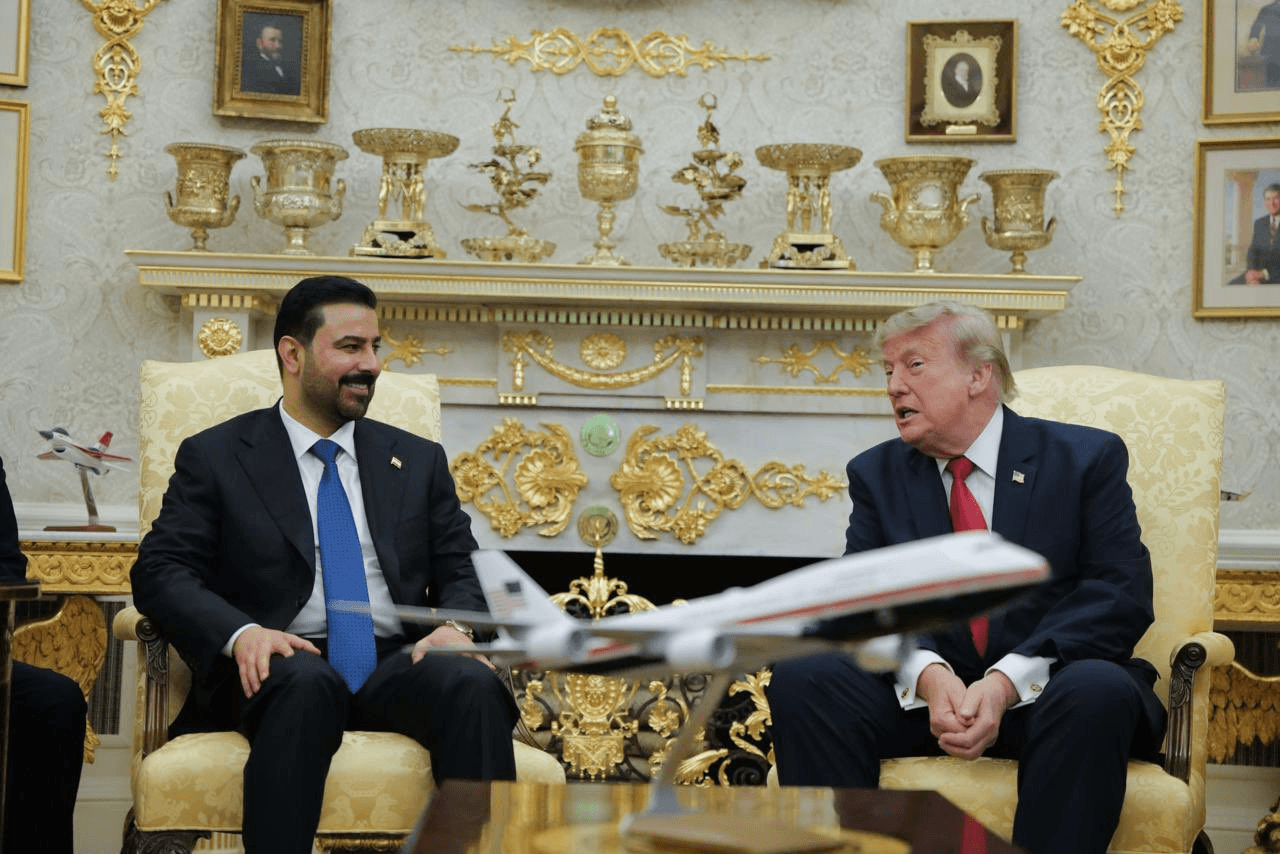
President Donald Trump welcomes Iraqi Prime Minister Ali Falih Al-Zaidi during a meeting in the Oval Office at the White House in Washington, D.C., where the two leaders discussed expanding economic cooperation, energy investment and the future of U.S.-Iraq relations. Baghdad (IraqiNews.com) – A policy analysis published by the Washington Institute for Near East Policy has recommended that the United States prepare targeted individual sanctions against former Iraqi Prime Minister Nouri Al-Maliki and Badr Organization leader Hadi Al-Ameri if both figures continue obstructing federal efforts to disarm armed factions. The study, authored by former U.S. Assistant Secretary of State David Schenker and reported by the 964 Network, argues that the two veteran political leaders—who collectively command 47 parliamentary seats within the ruling Coordination Framework—remain entrenched in maximalist positions rather than facilitating genuine state control over weapons, particularly following high-profile cross-border drone strikes against regional energy targets. The analysis highlights that while Al-Maliki previously pledged to defuse factional tensions and avert collisions with Baghdad’s sovereign agenda, Iranian-backed groups within the Popular Mobilization Forces (PMF) subsequently launched an explosive drone barrage on September 10 targeting Saudi Arabia’s East-West crude pipeline near Yanbu, Riyadh, and Medina. The assault, which temporarily disrupted up to 4–5 million barrels per day of transit to the Red Sea, directly undermined Coordination Framework claims of having neutralized escalation risks, exposing the fragility of domestic political assurances. Schenker notes that Al-Maliki narrowly escaped U.S. Treasury designations during the first Trump administration and warns that continued efforts to replace disarmament with ambiguous “containment” models—akin to Lebanese political formulas surrounding Hezbollah—should trigger direct U.S. financial designations against both Al-Maliki and Al-Ameri. The policy paper comes as Prime Minister Ali Faleh Al-Zaidi approaches his self-imposed September 30 deadline to monopolize arms under sovereign command—a date that coincides with the scheduled conclusion of the U.S.-led International Coalition’s mission in Iraq. While moderate factions like Asa’ib Ahl al-Haq and Kata’ib Imam Ali offered preliminary disarmament concessions, and Muqtada Al-Sadr agreed to absorb Saraya Al-Salam into the regular military, hardline elements led by Kata’ib Hezbollah, Harakat Hezbollah Al-Nujaba, and Kata’ib Sayyid Al-Shuhada have openly resisted. Bolstered by summer visits from IRGC Quds Force Commander Esmail Qaani, these groups have conditioned disarmament on non-starter demands, including dissolving the constitutionally recognized Kurdish Peshmerga, expelling Turkish forces, and enshrining PMF benefits by statute, while proposing unacceptable workarounds such as storing heavy weaponry in Iran or maintaining private depots under a nominal two-year activity freeze. To reinforce Baghdad’s authority and protect vital regional energy corridors, the Washington Institute urges the White House to pursue calibrated pressure rather than sweeping economic embargoes, outlining several immediate policy steps: Targeted Military Deterrence: Coordinate with Riyadh to track and neutralize senior operational commanders within Kata’ib Hezbollah, Al-Nujaba, and Kata’ib Sayyid Al-Shuhada responsible for strikes on critical infrastructure, while supplying Iraqi security forces with actionable intelligence to apprehend launching cells. Vetting the Counter-Terrorism Service (CTS): Assist Baghdad in conducting comprehensive background screenings of senior CTS leadership to ensure Iraq’s premier, least-penetrated tactical institution remains free of factional infiltration. Targeting Factional Funding Streams: Leverage financial pressure against Iraqi bureaucratic officials who facilitate direct federal budget disbursements—totaling roughly $3.6 billion annually across the PMF’s 238,000-man payroll—to U.S.-designated terrorist factions. Sustaining Kurdish Defense Backing: Maintain interim security and financial assistance to the Kurdistan Regional Government’s Peshmerga forces, mitigating vulnerabilities created by the pending expiration of the Pentagon’s annual $61 million memorandum of understanding and the redeployment of Patriot air defense systems from Erbil.
Washington Institute urges sanctions on Maliki, and Ameri over disarmament delays
Full Article
Original Source
Read the full article at Iraqinews →KhanList aggregates and links to publicly available news content. We do not host full articles from third-party sources. Always verify important information with original sources.