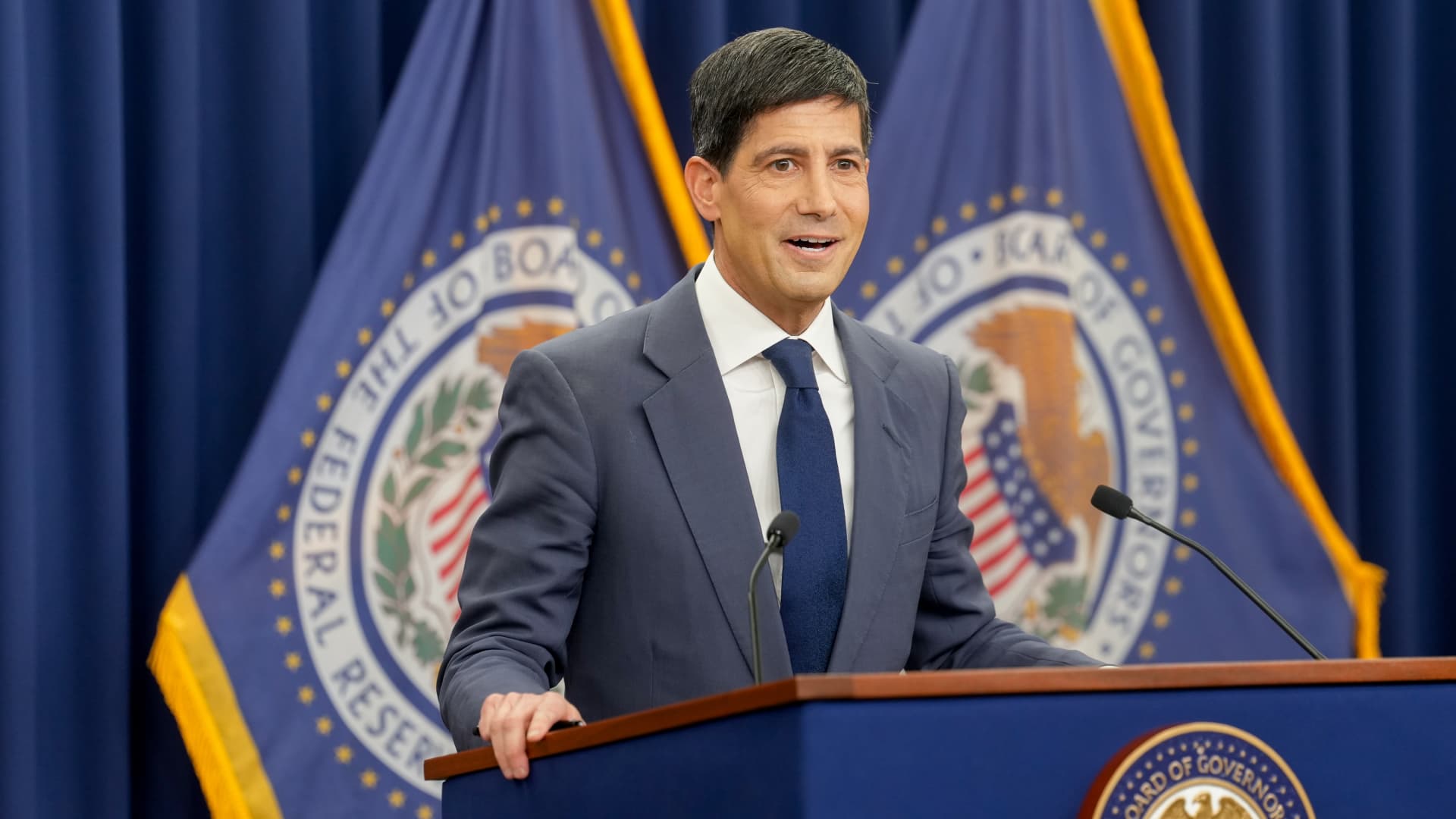
Kevin Warsh, chairman of the US Federal Reserve, during a news conference following a Federal Open Market Committee (FOMC) meeting in Washington, DC, US, on Wednesday, June 17, 2026. Al Drago | Bloomberg | Getty ImagesWe'll learn a lot Wednesday about whether new Federal Reserve Chairman Kevin Warsh's decision to be less clear about the outcome of the meeting is a better way to make monetary policy.Those lessons could come in the amount of market volatility around decision time and during and after the chairman's news conference. Something has to give, but how much and in what direction is unclear.What is known is that there is an unusual 35%-65% split in fed funds futures markets about the outcome, with the majority leaning on the Fed holding interest rates steady at 3.63% but a substantial bet on the chance of a hike. The market generally has a 95% probability on the correct outcome of the meeting in the days leading up to it. Those minority bets need to unwind if the majority has it right.That should not create much volatility, according to John Canavan, lead analyst at Oxford Economics. Less clear is where else the minority bets might reside. The 2-year yield has remained elevated, even after soft inflation and employment reports. It didn't decline with the fall in oil prices from mid-May through the end of June. If there are considerable bets on the outcome of this meeting in the much larger Treasury market, the decision and news conference could bring much more volatility.More interesting will be if equity markets have been held back by the possibility of a rate hike. Equities are highly sensitive to earnings and the ever-changing hot and cold views on the outlook for the hyperscalers. But some of the hedge against a rate hike could still be in equites, suggesting a pop in stocks if the consensus has it right.But it may not be quite so binary. A rate hold by the Fed that comes with multiple dissents or a new line in the statement suggesting a bias to hike could keep those hedges in place. The fed futures market ahead of the Wednesday meeting trades with an 80% probability of a rate hike in September and a 60% probability of a second hike in December. So what may be wrong presently could end up being right in just a few weeks.The amount of volatility around Wednesday's decision could be a nonevent. But if there are wild swings, it could raise questions about whether the lack of transparency is a better way to run policy. At a recent speech in New York City, Fed Governor Chris Waller said, "In all my years as an economist, I've never seen a single theory that says you make people's lives better or markets work better if you don't tell people what you're thinking."It had generally been viewed as a goal of policy to bring markets gently along with where the Fed thought they should be, helping the Fed achieve its goals.Warsh has a different idea: the Fed should be setting policy more on the signals markets send, untainted by Fed guidance. And yet, it remains unclear what markets Warsh is watching and what signals he's getting from them. If it's the fed futures market, a hold is the right call. The implied inflation rate in TIPS spread also shows little inflation concern in the bond market. But if it's the 2-year yield, now trading almost 70 basis points over fed funds, it would appear there's a market signal for a hike as soon as Wednesday.
Warsh's plan for a more opaque Fed will get put to the test by markets on edge
Full Article
Original Source
Read the full article at Cnbc →KhanList aggregates and links to publicly available news content. We do not host full articles from third-party sources. Always verify important information with original sources.