In Focus delivers deeper coverage of the political, cultural, and ideological issues shaping America. Published daily by senior writers and experts, these in-depth pieces go beyond the headlines to give readers the full picture. You can find our full list of In Focus pieces here.When one thinks of President Warren Harding today — and, let’s face it, that’s an exceptionally rare occurrence — they likely envision a failed, corrupt, lecherous do-nothing.In his time, however, the poker-playing former newsman was a wildly popular president, winning his 1920 election in a landslide on the promise of returning the nation to normalcy. That he did, without playing on the electorate’s fears, envy, and grievances. Oftentimes, he told them things they really didn’t want to hear. In October 1921, for instance, Harding stood in front of what the New York Times “conservatively estimated” to be a throng of 100,000 people in Birmingham, Alabama, to champion political and economic equality for all Americans. Democracy, Harding said, was a lie until equality of opportunity existed in the country.“I would say let the black man vote when he is fit to vote,” he went on, and “prohibit the white man voting when he is unfit to vote.” The New York Times headline of the speech read that Harding “Tells Audience He Will Speak Frankly, ‘Whether You Like It Or Not.’”They did not. Harding’s speech, given in the Deep South during the height of Jim Crow, shocked the crowd. The New York Times reported that the segregated black audience members who could hear the president from the back “gave vent to loud and lusty cheers to evidence their approval.” Only “once or twice” was there any applause from the majority-white audience, “and in both instances it was scattered.”If there’s another occasion in U.S. history in which a president showed up to challenge the worldview of tens of thousands of voters directly, I can’t recall it.Harding’s advisers, incidentally, sent the president to the newly christened Woodrow Wilson Park to shore up the white voter in the South. The name of the venue held its own symbolism. Wilson, the unapologetic bigot and authoritarian, still consistently ranked among our best presidents by historians and experts, had segregated the federal government in 1913, setting back civil rights for decades. Harding spent his first term trying to undo the damage, reappointing black people to civil service positions. But that wasn’t the only problem left by the ruinous Wilson presidency.After inheriting one of the worst recessions in U.S. history, Harding led the nation into the Roaring Twenties within a year, relying on methods that have been scoffed at by experts from President Franklin Roosevelt’s time until today. Harding did it by reprivatizing swaths of the economy, deregulating industry, slashing government spending, and paying down the debt, while also lowering taxes. As the late historian Paul Johnson pointed out in his book Modern Times, the 1920s recovery was “the last time a major industrial power treated a recession by classic laissez-faire methods.”Recent right-wing depictions of Harding falsely frame him as populist in the modern mold. While Harding, who spent most of his life in the then-major industrial center of Marion, Ohio, was a protectionist — no one is perfect — he detested class warfare and victimhood. Americans, he said in his Birmingham speech, should embrace the “full measure of usefulness to the country and of opportunity for themselves, and in which recognition and reward shall at last be distributed in proportion to individual deserts, regardless of race or color.”In my lonely quest to rehabilitate Harding’s reputation, I’ve read more about his presidency than I care to admit. Yet I’ve never run across anything he ever wrote or said in public or private that portrayed an American as a victim of Wall Street or the establishment or elites or the wealthy. Indeed, in Birmingham, Harding spent a considerable time of his time lashing out at the populist demagoguery of the age:“Coming as Americans do from many origins of race, tradition, language, color, institutions, heredity; engaged as we are in the huge effort to work an honorable national destiny from so many different elements; the one thing we must sedulously avoid is the development of group and class organizations in this country. There has been time when we heard too much about the labor vote, the business vote, the Irish vote, the Scandinavian vote, the Italian vote, and so on. But the demagogues who would array class against class and group against group have fortunately found little to reward their efforts. That is because, despite the demagogues, the idea of our oneness as Americans has risen superior to every appeal to mere class and group.”Today, this kind of talk would be dismissed as weak, creedal nonsense by national conservatives and “heritage” Americans and mocked by identitarian progressives.They wouldn’t be the first. The revisionist smearing of Harding began soon after his death, with the bestselling 1930 book The Strange Death of President Harding written by con man Gaston Means. The book, a collection of lurid tales of backroom orgies and mass corruption, claimed that first lady Florence Harding, in a jealous rage, had poisoned her husband. A year later, May Dixon Thacker, the ghostwriter of the book, admitted that Means had played a “colossal hoax,” but by that time, many of the stories had been internalized by the public.Harding, of course, was far from perfect. His long-term affair with Carrie Phillips, and since uncovered explicit love letters, have cast him as something of a lusty dunce. And post-New Deal historians, admirers of meddling technocratic presidents who exert power and “reimagine” the constitutional order such as Wilson or Roosevelt, haven’t been much kinder to Harding, who saw the job of the state as minimal and the liberty of citizens as paramount.Yet, there will likely never be a president who showed as much humility regarding his own abilities and power.“I am not fit for this office and should never have been here,” Harding had famously said.His private correspondences are replete with self-effacement and a Washingtonian view of the presidency.“Frankly, being president is rather an unattractive business unless one relishes the exercise of power,” he wrote a friend in 1921. “That is a thing which has never greatly appealed to me.”Unfortunately, the amiable Harding’s greatest weaknesses were his blind loyalty to shady friends and his inability to crack down on underlings. The Teapot Dome scandal, in which his close friend, Interior Secretary Albert Fall, took bribes in exchange for oil leases, was the most notable. Though he never personally benefited, the scandal haunted the president. His heart attack in August 1923 at age 57 was the result of taking the “Voyage of Understanding,” the most ambitious presidential cross-country tour in history, in which Harding even visited the Alaska Territory.WHICH WAY, REPUBLICAN?If he hadn’t died, it’s likely he would have won another term. Instead, he left America with the austere and morally upright Calvin Coolidge, who continued Harding’s hands-off policies to great success.A legacy worth remembering.
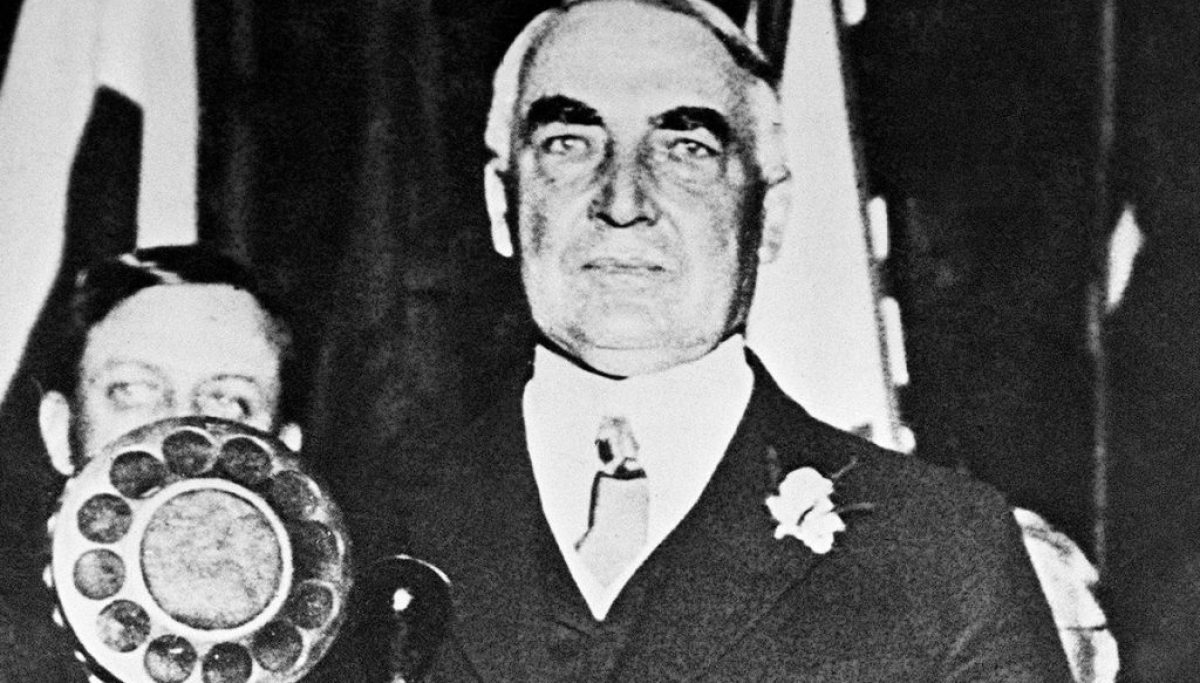
Warren Harding and the bravest presidential speech in US history
Full Article
Original Source
Read the full article at Washingtonexaminer →KhanList aggregates and links to publicly available news content. We do not host full articles from third-party sources. Always verify important information with original sources.