
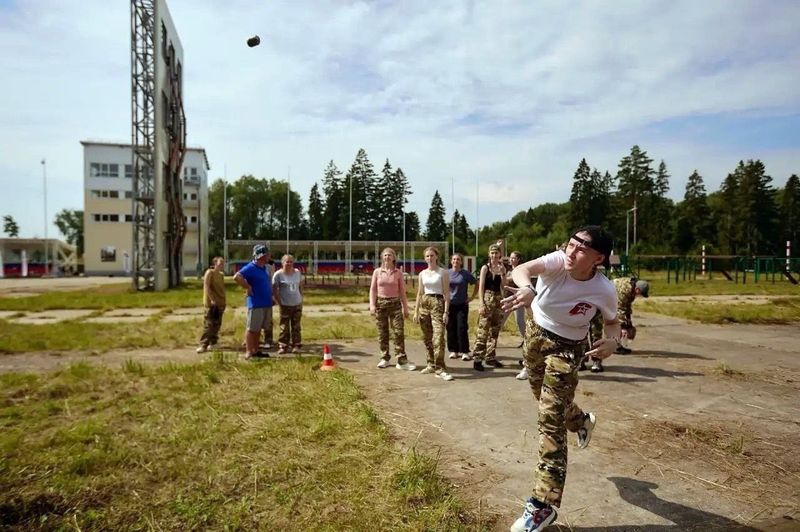
A year ago, a dream came true for 20-year-old Oleh: he escaped from the Russian-occupied Ukrainian town of Dniprorudne and reached Kyiv. He crossed the Ukrainian border on Ukraine’s Independence Day. The timing was unplanned, but it made him happy; it felt symbolic after he had fought for Ukraine’s independence under occupation. For that, Russian troops had imprisoned him, tortured him with electric shocks and beaten him with rubber batons.Oleh was only 16 when he endured captivity. Five of his friends, also 16, were held with him in a Russian torture facility.Dniprorudne is a small industrial town in Zaporizhzhia region, southern Ukraine. The region has large deposits of iron, manganese, uranium and granite, along with smaller deposits of gold and rare earth metals. Before the war, residents worked at Ukraine’s largest iron ore mining and processing plant and a major reinforced concrete factory. When Russia’s invasion began, the people of Dniprorudne seemed to be made of concrete and steel themselves.A monument in Dniprorudne. (Photo: Telegram) Russian troops tried for a month to seize the town. Residents stood on the roads around the clock, forming human barriers against Russian tanks. Civilians retreated only when the Russians began shooting at them.Once Dniprorudne was occupied, searches began, along with arrests of men suspected of being able to resist Russian forces. The town’s mayor, Yevhen Matvieiev, was among the first to be abducted. She was later beaten to death in a Russian remand prison – the same facility where prominent Ukrainian journalist Viktoriia Roshchyna was killed after she travelled to the occupied part of Zaporizhzhia region, and was abducted and taken to Russia.Despite the mass arrests, resistance in the town continued. Partisan groups emerged. Oleh, then 16, and his friends decided to tear down Russian flags and put up handmade leaflets urging Russian soldiers to go back to Russia.“We knew there was nothing good in the ‘Russian world’, so we fought back,” Oleh says.Oleh and his girlfriend. (Photo: Screenshot video /Anna Tsygyma) A few months later, in May 2022, Russian soldiers caught the teenagers putting up leaflets and took them to a police station. They questioned the boys one by one. Oleh was the last to be interrogated.They sat him on a chair in the middle of a room. Two men with assault rifles sat at a table and searched his phone, looking through photographs, messages and his internet search history. Two more armed men stood behind him, repeatedly shouting, “Tell us what you know”. Frightened, Oleh kept asking, “About what?” They struck him with a rifle butt, threatened to shoot him in the knees and said the FSB (Russian security service) would interrogate him next.“I thought they were just trying to scare us,” Oleh says. “I assumed the FSB was a very serious organisation that wouldn’t bother with kids like us over some leaflets.”He was wrong. Five more armed men wearing balaclavas entered the room. They twisted his arms behind his back and handcuffed him, then pulled a black bag over his head. They took him to a wall and ordered him to stand with his arms and legs spread wide. He remained like that for hours as they questioned him and beat him on the ribs and head with rubber batons.“They asked about our parents, our school, our interests and which Ukrainian soldiers were directing us. But nobody was directing us,” he says.Then they forced Oleh to the floor, pressed a knee into his lower back and attached electric wires to his fingers. With the bag still over his head, he lay face down, unable to see what was happening. He thought they were about to pull out his fingernails. Instead, an electric shock made his body arch and convulse. They applied the current for 10 to 15 seconds, paused for a few seconds and started again. It went on for about an hour.“If they had kept shocking me, I would have died,” he says. “They stopped because I was beginning to lose consciousness. It felt as though my organs were boiling inside me.”The Sokoly youth army detachment took part in a Cosmokvist competition organised by the Russian Knowledge Society. (Photo: Telegram / Yunarmia Crimea) The Sokoly youth army detachment takes part in the Cosmokvist competition. (Photo: Telegram / Yunarmia Crimea) Russian torturers use a field telephone known as a “tapik” to deliver electric shocks. Turning its crank generates 50 to 80 volts. Wires connect the device to the person’s body. The shocks do not necessarily kill, but cause intense pain. Torture can leave burns and cracked teeth; prolonged shocks can stop the heart.An international initiative, The Reckoning Project, has documented war crimes against Ukrainian civilians since March 2022. It has recorded the use of electric shocks as a widespread practice in Russian torture facilities. Ukrainians detained in several regions that were or remain under Russian occupation have endured this torture, including in Kherson and Izyum in Kharkiv region, and Melitopol in Zaporizhzhia region.Oleh and his friends were held in cells and interrogated over the next two months. They were beaten and threatened with weapons, though, fortunately, they were not subjected to further electric shocks. One night, Russian soldiers got drunk and beat the detainees with metal pipes. Oleh recalls that it was worse than his FSB interrogation. They slammed his head against a table, knocking out a front tooth, and beat his back and buttocks. His face and body were covered in wounds.The teenagers were released by a stroke of luck. The Russian soldiers and FSB officers who had questioned them left Dniprorudne. Their replacements did not want to deal with minors. They confiscated the boys’ Ukrainian passports and let them go.For a long time afterwards, soldiers kept coming to Oleh’s home and the homes of his friends. They searched their phones, threatened to arrest them again and urged them to enlist in the Russian army. Two of Oleh’s friends eventually gave in.Escaping the occupationOleh cannot explain why former Ukrainian partisans went to fight against Ukraine. He points out that all of them had been tortured. He had decided from the outset that he would escape the occupation at the first opportunity. To do so, he obtained a Russian passport, moved to another occupied town and then fled to Kyiv. The journey through Russia and Belarus took more than a week. Throughout the journey, he feared Russian security services would catch him.Oleh spent three years under occupation and has now lived in Kyiv for a year. In the Ukrainian capital, he began seeing a psychotherapist and taking antidepressants. He sometimes has panic attacks when he sees people in military uniform.“I know they’re our people, not Russians, but after the torture I can’t control my reaction,” he admits.He has cut off contact with the occupied territories, even with his parents, who did not support his move to Kyiv. Enforced disappearances and arrests continue in Dniprorudne.A mural depicts a child with a drip and a cat with an umbrella, shielding the child from a Russian missile, on a wall of the Okhmadyt children’s hospital in Kyiv, Ukraine, on 10 December 2025. Ukrainian artist Andriy Yarmolenko created the mural. The hospital was attacked by a Russian rocket during the massive shelling of Kyiv on 8 July 2024, when two people died, and 32 were injured, including the eight children who were patients. (Photo: EPA / Sergey Dolzhenko) Ukrainian human rights defenders learnt of Oleh’s case in 2022 because the Russians had posted videos of his interrogation on social media. Similar crimes against 16-year-old boys were later committed by the Russian law enforcement system established in the occupied territories.In June 2023, 16-year-olds Tihran Ohannisian and Mykyta Khanhanov were shot dead in occupied Berdyansk under circumstances that remain unclear. Vladimir Rogov, a representative of Russia’s occupation authorities in the Zaporizhzhia region, claimed the teenagers had attacked police officers and that the “terrorists had been eliminated”.Tihran Ohannisian and Mykyta Khanhanov. (Photo: Collage Zmina) Russian troops and occupation officials had pursued the boys since September 2022, accusing them of terrorism. They arrested them, tortured them with electric shocks and beat them. Their parents tried to take them out of the occupied territory, but soldiers stopped them on the way and sent them back to occupied Berdyansk.In another case, Russian soldiers detained five teenagers aged 16 and 17 in the occupied Ukrainian city of Melitopol in autumn 2023. They were first held at Pretrial Detention Centre No 2 in occupied Mariupol, then at a facility with the same designation in Taganrog, Russia, where beatings and torture are systematic.Two of the teenagers, Pavlo Hrymak and Danylo Dakhov, died while being transferred from Mariupol to Taganrog, Ukraine’s Deputy Foreign Minister Maryana Betsa said during a debate ahead of the 79th UN General Assembly. Russia did not respond to the statement. In March 2026, the Southern District Military Court in Rostov-on-Don, Russia, sentenced the three surviving teenagers to eight years in prison on terrorism charges.During a class at the Genichesk House of Yunarmiya (Young Patriot), the young army members were given a lesson in courage. (Photo: Telegram Yunarmia Crimea) War crimes against minorsUkraine’s Office of the Prosecutor General is trying to document war crimes against minors in the occupied territories during the full-scale invasion, but prosecutors say the task is nearly impossible. Russia conceals information, and neither UN missions nor the International Committee of the Red Cross have access to those territories.Under international law, torture and holding people in inhumane conditions are prohibited under all circumstances, particularly when minors are involved, even if they participate in resistance. This is stipulated in the Fourth Geneva Convention (articles 27, 31, 32). Prosecutors have gathered information about 12 cases in which minors were detained in occupied towns and accused of helping direct Ukrainian artillery fire, espionage or treason. The actual number of detained minors may be higher: war crimes against them began when Russia seized part of Donetsk region in spring 2014.The Mayak Center hosted the first Regional Forum of cadets from the Voin Center for students of cadet classes in the Kherson region. (Photo: Telegram Yunarmia Crimea) The Mayak Center hosted the first Regional Forum of cadets from the Voin Center for students of cadet classes in the Kherson region. (Photo: Telegram Yunarmia Crimea) A meeting of the Young Army members with the staff of the Investigative Department of the Investigative Committee of Russia. (Photo: Telegram Yunarmia Crimea) The first Ukrainian teenager tortured and killed during the war was 16-year-old Stepan Chubenko, Ukrainian prosecutors recall. He was detained near Donetsk in summer 2014 because of blue and yellow ribbons on his backpack. For a week, his captors beat him, suffocated him with a towel, knocked out his front teeth and tried to force him to join the so-called Donetsk People’s Republic, a separatist entity created by Russia. Then they took Stepan to a dug grave near a river, removed his trainers, bound his hands and feet with tape, forced him to his knees, pulled a T-shirt over his head and shot him three times in the head. They wrapped his body in a tarpaulin and buried him.Stepan Chubenko. (Photo: Donetsk Regional State Administration) His body was found two months later. The occupation authorities even named his killers – three pro-Russian fighters. They were never punished because they joined the Russian army.Turning children into soldiersDanylo (21) escaped from occupied Crimea in August 2025 because he did not want to be mobilised into the Russian army and sent to fight against Ukraine. His name has been changed in this article. He fears for the lives of his parents, who remain in occupied Crimea. The resort peninsula, bordered by two seas, has become a de facto military base from which Russia attacks the rest of Ukraine.Cadets at the Mayak Center-hosted Regional Forum. (Photo: Telegram Yunarmia Crimea) Cadets at the first Regional Forum of cadets from the Voin Center. (Photo: Telegram Yunarmia Crimea) Danylo spent 11 years under occupation. He was nine when Russian forces seized Crimea in 2014 and remembers little of that period. There were no protests against the occupation in his small village in the west of the peninsula, nor were there Ukrainian military bases there for Russian soldiers to seize.He did notice, however, that Ukrainian textbooks disappeared from his school and Ukrainian language classes stopped. They were replaced by a course on Russian history and a class called “Fundamentals of Life Safety”, where he learnt to assemble and disassemble an assault rifle. At traditional school celebrations, children were made to march like soldiers and sing Soviet and Russian military songs.At 13, Danylo went to a summer camp in Crimea, at that time controlled by Russia. Nearby was a camp run by the Russian paramilitary social movement Yunarmiya, or Young Army. He saw children aged eight to 17 learning to handle weapons, dig trenches and march. They also swore an oath of loyalty to Russia. He did not like what he saw and asked his parents not to send him to Yunarmiya.The Mayak Center hosted the first Regional Forum of cadets. (Photo: Telegram Yunarmia Crimea) Military camp for teenagers in Sevastopol. (Photo: Telegram Yunarmia Crimea) Military camp for teenagers in Sevastopol. (Photo: Telegram Yunarmia Crimea) At 16, Danylo registered with a Russian military enlistment office. He could not avoid it: a certificate from the office was required for university admission. From his first year at university, he and his classmates were made to attend events where Russian military personnel urged them to sign contracts to serve in the army or train as drone pilots. Students were handed application forms, and the recruitment pitch targeted girls as well as boys.“I know older students who took a leave of absence from university and went to fight,” Danylo says. “Some were killed; others were disabled and lost limbs.”Once, the military enlistment office called Danylo’s home. The callers spoke aggressively and demanded documents proving that he was indeed studying at university and was not evading service in the Russian army.“I realised they would mobilise me as soon as I graduated,” he says. “So I decided to flee Crimea.”The young man contacted Ukrainian volunteers who help people leave occupied territories, and reached Kyiv a few weeks later. He kept his escape secret even from his parents, calling his family only afterwards.“Under occupation, it’s dangerous to share your thoughts with anyone. You always have to keep your mouth shut,” Danylo says.Propaganda lessons. (Photo: Telegram / INFOdniprorudne) Propaganda lessons. (Photo: Telegram / INFOdniprorudne) Propaganda lessons. (Photo: Telegram / INFOdniprorudne) The militarisation of Ukrainian children in Crimea and other Ukrainian territories which Russia seized in 2014 and 2022 takes many forms, Ukrainian education experts and human rights organisations say.Russian Presidential Commissioner for Children’s Rights Maria Lvova-Belova meets President Vladimir Putin at the Novo-Ogaryovo state residence outside Moscow on 16 February 2023. (Photo: EPA-EFE / Mikhail Metzel / Sputnik / Kremlin Pool) Children are most often indoctrinated at school and through Yunarmiya, according to a report by the Center for Countering Disinformation at Ukraine’s National Security and Defense Council. Russia’s aim is to strip children of their Ukrainian culture, language and sense of identity so that they can later be recruited into the Russian army and used in its war against Ukraine.In Yunarmiya, children aged eight to 17 learn to use assault rifles and bladed weapons and to storm trenches. They kiss the Russian flag and sing the Russian national anthem. Russia’s Ministry of Defence founded the organisation in 2016 to militarise Ukrainian children in the occupied territories. Its first branch opened in Crimea. It later expanded to other occupied territories, throughout Russia, to Abkhazia, the occupied region of Georgia, and to Armenia and Tajikistan.In 2025, Viktor Pudak, the head of Yunarmiya in the occupied Donetsk region, told the Russian newspaper Rossiyskaya Gazeta that 22 former members of his organisation had died in the war since 2022.Oleksandra (right) celebrates her seventh th birthday in Riga, Latvia. (Photo: Maris Morkans) The Mezhevyi family starts a new life in Latvia. (Photo: Maris Morkans) In summer 2026, the Ukrainian investigative initiative Back to Ukraine, which searches for missing children in occupied territories, identified a 19-year-old soldier in the Russian army as a Ukrainian young man, Oleksandr Mustyatse. He had gone missing in 2022 after fighting began in the village of Krynky in Kherson region, where he lived with his grandmother and younger brothers. The children had no parents.Back to Ukraine contacted Oleksandr on social media. He said he had travelled with relatives to Russia after the war began. At 18, he joined the Russian army and now fights against Ukraine because, he said, “Russia has always been in my heart”. His middle brother, Valentyn, now 15, joined Yunarmiya. The fate of the youngest brother, 12-year-old Yaroslav, is unknown.About 40,000 children in the occupied territories of Ukraine have joined Yunarmiya, according to the Ukrainian civic education centre Almenda, which works to protect children’s rights under occupation.Children play in the dark with the aid of torches in a residential area during an electricity blackout in Kyiv, Ukraine, on 26 August 2024, following Russian shelling of all Ukraine territory. The main targets of shelling were electricity objects, Ukrainian President Volodymyr Zelensky wrote on Telegram. (Photo: EPA-EFE / Sergey Dolzhenko) Almenda analysed memorial plaques erected by the Russian authorities in Crimea to commemorate peninsula residents killed in the war against Ukraine. According to the organisation’s head, Mariia Sulialina, the centre counted 59 plaques. Thirty-three commemorate people who were minors when Russia occupied Crimea in 2014.Ukraine’s Office of the Prosecutor General regards the militarisation and indoctrination of minors as war crimes and is conducting more than 600 investigations. Hundreds of suspects are named in the pretrial case files. International humanitarian law prohibits the propaganda, militarisation and training of minors in occupied territories for service in the occupying country’s armed forces. In particular, the 1949 Fourth Geneva Convention prohibits compelling protected persons to serve in the occupying power’s armed forces (article 51(1)), and in the Convention on the Rights of the Child, which requires the preservation of children’s identity and nationality (article 8). In 2025, Ukrainian prosecutors notified Pudak, the head of Yunarmiya in Donetsk region, that he was suspected of the war crime of militarising Ukrainian children.‘Either you come, or they’ll have us adopted’According to Ukrainian authorities, Ukraine has brought back 2,358 children from territories temporarily occupied by Russia in the four years since the full-scale invasion. Compared with other figures, that is a small number. Ukraine’s Office of the Prosecutor General has identified the names and locations in Russia of 19,546 Ukrainian children taken from occupied territories.In 2023, the International Criminal Court issued arrest warrants for Russian President Vladimir Putin and Russia’s commissioner for children’s rights, Maria Lvova-Belova, in connection with the unlawful deportation and transfer of Ukrainian children.The Reckoning Project documented one such case involving the three Mezhevyi children from Mariupol. During the bombardment and siege of the city, Russian troops took 31 children away. The Mezhevyi children and the others were taken to a sanatorium near Moscow, where various Russian families began adopting them.Single father Yevhen Mezhevyi was raising 12-year-old Matvii, nine-year-old Sviatoslava and seven-year-old Oleksandra in Mariupol. During the siege, they tried to evacuate, but Russian troops imprisoned Yevhen for two months. Meanwhile, adoption paperwork was being prepared for his children, who had been taken to Russia. Social workers told them they would never return to Ukraine. Matvii managed to find a mobile phone, contact his father’s colleagues through social media and eventually reach his father, who had just been released from prison.Matvii (12) could find his father in Russian captivity. (Photo: Maris Morkans) From left: Matvii, Sviatoslava, Yevhen and Oleksandra. (Photo: Maris Morkans) “Dad, you have five days. Either you come, or they’ll have us adopted,” Matvii, the eldest, told him over the phone.Yevhen managed to reach Russia in time, persuade Russian officials to return his children and leave with them for Latvia. But 15-year-old Pylyp Holovnia had also been brought from Mariupol to the same sanatorium in the Moscow region. The Ukrainian teenager had a father, but Lvova-Belova adopted him in 2022.She later said that Pylyp read Ukrainian news, wanted to return to Ukraine and sang Ukrainian songs, but that she was working to make him love Russia. Three years later, Russian media reported that Pylyp had enrolled in the law faculty of a Russian university and dreamed of becoming a prosecutor. His “adoptive mother”, Maria Lvova-Belova, is wanted by the International Criminal Court for crimes involving deportation. In Russia, however, she has been rewarded. In the Russian parliamentary elections held in September 2026, she was among the top five candidates on the ruling United Russia party’s electoral list. Another of the top five was Vladislav Golovin, a Russian military officer and head of Yunarmiya. DMThe story had been produced within The Reckoning Project - an initiative of Ukrainian and international journalists, lawyers and analysts to document war crimes during the Russian invasion of Ukraine.
WAR IN EUROPE: Ukrainian children abducted, tortured and forced to fight for Russia
Full Article
Original Source
Read the full article at Dailymaverick →KhanList aggregates and links to publicly available news content. We do not host full articles from third-party sources. Always verify important information with original sources.