
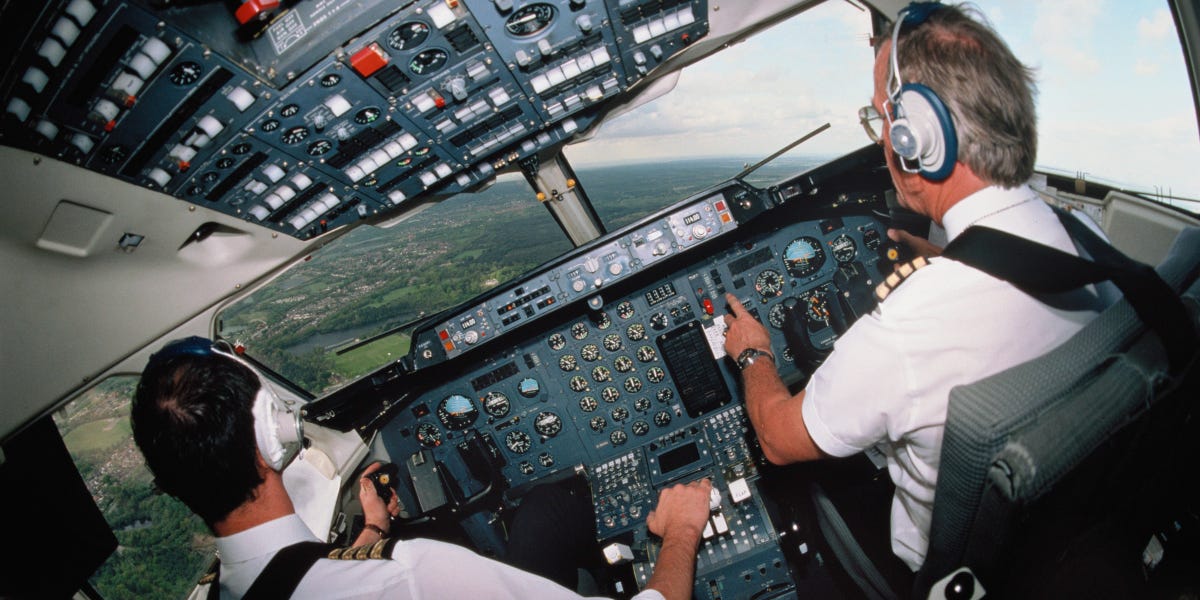
Pilots' reliance on autopilot may offer workers clues on how to navigate AI in the workplace. aviation-images.com/Universal Images Group via Getty Images Pilots have relied on autopilot for decades. Their experience could offer a lesson for workers increasingly relying on AI.Steven Shaw, an assistant professor at King's College London and coauthor of a widely cited study on "cognitive surrender," drew a parallel between pilots' reliance on automation and workers outsourcing their thinking and delegating their work to AI."We've had autopilot in planes for a very, very long time," Shaw said, speaking at a recent OxGen Summit panel. "So they learn to fly manually first, and then they learn to use autopilot strategically."Some federal aviation guidance encourages pilots to occasionally switch off autopilot to maintain their manual flying skills.There is a long track record of this. In a 2013 safety alert, the Federal Aviation Administration warned that "continuous use of autoflight systems could lead to degradation of the pilot's ability to quickly recover the aircraft from an undesired state."The agency reiterated the importance of manual flying in a 2017 alert, recommending that airlines encourage pilots to practice without autopilot periodically when conditions permit."Even experts are at risk of deskilling," Shaw said, referring to the dangers of repeatedly outsourcing cognitive tasks to AI.Shaw's warning comes as some tech leaders, AI researchers, and politicians have cautioned that overreliance on AI could weaken workers' underlying cognitive abilities.Speaking at More Perfect University's "Students vs. Billionaires" town hall in Maine on Thursday, Rep. Alexandria Ocasio-Cortez warned that "AI's goal is to take your thoughts away from you, your ability to think away from you so that you become dependent on a machine." OpenAI CEO Sam Altman said in July that one of AI's most overlooked risks was "cognitive atrophy," while Arthur Mensch, CEO of French AI startup Mistral, said last year that the technology's biggest risk could be "deskilling."Think before you promptEarly research is showing how readily people outsource their thinking to AI.Vivienne Ming, an AI researcher and theoretical neuroscientist, told Business Insider in March that one of her experiments, involving 72 participants, found that roughly 90% to 95% either relied on AI to generate answers or used it to validate their assumptions, rather than challenge and deepen their thinking."The overwhelming trend is substitution," she said.Similarly, Shaw's research suggests that the danger is that people increasingly accept AI's answers without thinking critically.In experiments involving 1,372 participants, people accepted AI recommendations nearly 80% of the time even when the answers were deliberately incorrect.Shaw calls this phenomenon "cognitive surrender."His advice for avoiding it is straightforward: develop your own judgment before asking AI for help."Just think first and then go to the prompt," he said during the OxGen Summit panel.Starting with AI, he warned, can narrow the range of ideas people consider independently.Other experts have offered similar advice. Geetha Rajan, a former AI adoption leader at PwC, previously told Business Insider that she writes her own first drafts before using AI to check facts and challenge her work.Ryan Deiss, CEO of DigitalMarketer, advocates a "10-80-10" rule: humans handle the first 10% of a task, AI takes on the middle 80%, and humans return for the final 10% to exercise judgment and refine the result. Read next Business Insider tells the innovative stories you want to know Business Insider tells the innovative stories you want to know Business Insider tells the innovative stories you want to know Business Insider tells the innovative stories you want to know Thibault is a tech reporter at Business Insider's London office.He covers the intersection of technology and work — focusing on AI’s impact on the workplace, job and cognitive skills, and how economic changes are affecting careers.Before moving to the trending team, Thibault covered international affairs, including the Russia-Ukraine war, tensions in the South China Sea, and Russia’s economy on the news desk.He has previously worked at the Daily Express and held internships at Agence France-Presse, Politico Europe, and Factal.Il parle français. Habla español.Email Thibault at tspirlet@businessinsider.com, connect with him on LinkedIn @ThibaultSpirlet, or follow him on X @ThibaultSpirlet and BlueSky @thibaultspirlet.bsky.social.ExpertiseAI and the future of work Job and cognitive skills in the AI economyWorkforce trendsFirst-person, "as-told-to" stories AI Artificial Intelligence
Want to avoid AI deskilling? Pilots may have the answer.
Full Article
Original Source
Read the full article at Businessinsider →KhanList aggregates and links to publicly available news content. We do not host full articles from third-party sources. Always verify important information with original sources.