
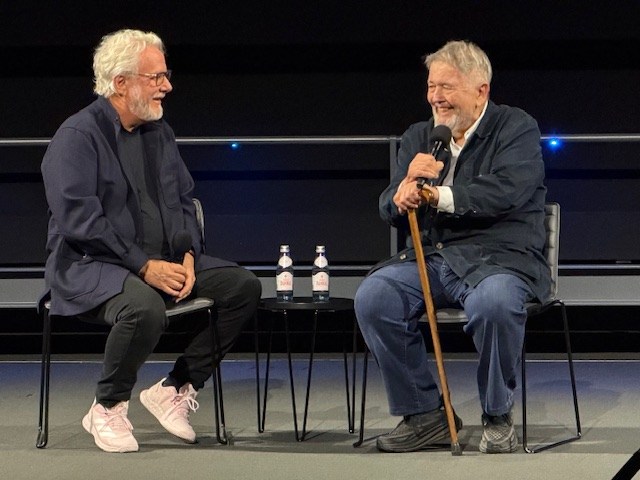
In 1972, Walter Hill was a young screenwriter with just one produced movie (“Hickey & Boggs”) behind him when he scored an enviable gig: adapting Jim Thompson’s tough-as-nails crime novel “The Getaway” for actor/producer Steve McQueen (then one of the biggest movie stars in the world) and director Sam Peckinpah (then, as now, one of the greatest directors who ever lived). On Wednesday night, Hill spoke before a packed screening at the Academy Museum of Motion Pictures and looked back on the movie that jump-started not only his screenwriting endeavors, but a directing career that would ultimately include classics like “The Warriors,” “48hrs.,” and “Streets of Fire.” “The Getaway” screened as part of the museum’s “Branch Selects” series, in which the Academy’s various branches program films they feel exemplify their crafts. “The Getaway” was, appropriately enough, selected by the writers branch, and screenwriter and Academy Governor Larry Karaszewski was on hand to introduce the movie and moderate the pre-screening discussion with Hill. Karaszewski, a longtime “Getaway” enthusiast who carried newspaper ads from the movie around in his wallet when he was 10 years old, pointed out that Hill changed the entire architecture of screenwriting when he burst onto the scene in the early 1970s. “ Walter, right off the bat, changed the art of screenwriting,” Karaszewski said. “We have an award show here at the Oscars called the Sci-Tech Awards, where they give awards to things that silently change the industry and advance them into the future. I really feel that Walter Hill did that in screenwriting, but it wasn’t a technical advancement. It was a literary advancement. He changed what a page should look like as a screenplay and what it could feel like to read it.” Karaszewski went on to illustrate his point by projecting pages from Robert Bolt’s “Doctor Zhivago” screenplay and Walter Hill’s “Hard Times” side by side on the screen. “You don’t even have to read [Bolt’s script], just look at it,” Karaszewski said, point out the dense blocks of words compared to Hill’s lean, spare page. “You’re looking at monoliths. It’s dense, and there are camera moves and references to things you would never see on screen. Walter Hill taught screenwriters that you can strip all that away. You can still direct on the page, but not by calling for specific camera movements — just by saying what you’re seeing. Walter’s scripts are made out of short sentences and white space. He looked at the placement of each line as part of the storytelling. He turned the carriage return into an art form.” Script pages from ‘Doctor Zhivago’ and ‘Hard Times’ As Karaszewski welcomed Hill to the stage, he pointed out that “The Getaway” — a smart, terse tale of a couple (Steve McQueen and Ali MacGraw) on the run after their involvement in a botched bank robbery — represented the emergence of Hill’s developing voice. “You’ll already see the beginnings of that remarkable style, the economy, the precision, the sense that every line is pushing you toward the next image.” Yet, as Hill revealed in his lively conversation with Karaszewski, the ruthless efficiency of the pacing and the concentrated emotional impact of “The Getaway” were not easily arrived at. “I think it’s much harder to adapt than it is to write an original, which is the reverse of the normal theory,” Hill said. “With an original, it’s just you at your desk with the typewriter or pen. When you’re adapting, that almost always means that somebody else owns it, so you’re not simply writing based on your own opinions about what should be in and what should be out, but there’s the producer’s opinion, and the studio’s, and the actor’s. There were all these political currents that one had to navigate.” One such political current came from megastar McQueen, who didn’t interfere much with Hill’s writing but did have one caveat that amused the screenwriter. “He wanted to play a reasonably sympathetic outlaw,” Hill said. “That was not in the Thompson sensibility. So we already had a disparity, but the producer wanted to keep Steve happy.” “The Getaway” began as an assignment not for Peckinpah, but for Peter Bogdanovich, who was white-hot coming off of successes like “The Last Picture Show” and “What’s Up, Doc?” Bogdanovich didn’t last long, however, given his clashes with McQueen and McQueen’s power as the film‘s star. “I couldn’t imagine two more diverse sensibilities than Steve and Peter,” Hill said, noting that he had his own disagreements with Bogdanovich over the movie’s tone but wasn’t in a position to argue. “You’ve got to remember, I was nobody. I had one screen credit. And these were big players.” ‘The Getaway’Everett Collection / Everett Collection The big players included not only Bogdanovich and McQueen, but MacGraw, hot off of the smash hit “Love Story.” MacGraw was pushed into the movie by her husband, Paramount studio chief Robert Evans, which Hill found amusing given the way everything played out. “I’m going to tread lightly here,” Hill said of the behind-the-scenes melodrama involving MacGraw leaving Evans when she fell in love with McQueen. “When the material was optioned and I was hired, Bob saw the movie as a fabulous idea for Steve and Ali. It didn’t work out so well for him.” After Bogdanovich and McQueen butted heads, Bogdanovich was let go and Peckinpah, who McQueen had enjoyed working with on “Junior Bonner,” came in to take his place. “We were very lucky to get such a talented guy, obviously,” Hill said. “I thought of him then and I think of him now as one of the great directors with a very unique sensibility. I was very privileged to work with him — which doesn’t mean he and I agreed about everything.” Hill’s biggest disagreement with Peckinpah had to do with a scene in which MacGraw’s character considered killing McQueen before turning the gun on his nemesis — and the man with whom MacGraw had gone to bed to secure McQueen’s early release from prison. This was a scene carried over from the book, which was darker and more paranoid than what made it to the screen given McQueen’s mandate that he be sympathetic. Hill felt that the moment no longer worked now that the relationship between McQueen and MacGraw was softer and more relatable in the novel. “I thought that for the movie we were trying to make, you might forgive your wife for sleeping with a bad man to do a very good thing for you,” Hill said. “That seemed to be to be conceivable. But if your wife fell into cahoots with the bad guy and actually was thinking about killing you and actually turned the gun on you before she decided to shoot the other guy…this did not track for me. But this is the screenwriter’s dilemma: you either talk the director into your point of view, or you make the change that he wants — or somebody else will. Those are your choices.” Hill lost the argument but liked the movie Peckinpah made in the end. “He staged it beautifully,” Hill said. “He shot it beautifully. It’s got one of Steve’s best performances. And the movie turned out to be his greatest hit. He used to call me every once in a while after I became a director and say, ‘Write me another one.'” Ironically, it was the success of “The Getaway” that put Hill in a position where didn’t have to write for other directors anymore. “Larry Gordon had a producing deal to make low-budget movies at Columbia,” Hill said. “He would give young writers a chance to direct, because he said, ‘Even if they’re no good as directors, at least we’ll get a good script. Most of the directors I’m working with aren’t any good anyway.'” Gordon gave Hill the opportunity to direct “Hard Times,” and the rest was history. Aside from kicking off Hill’s directing career, the collaboration became the first of many between the two men. “He’s a wonderful guy and a wonderful producer.” Now in his 80s, Hill continues to write and direct (his last film was the exquisite character-driven Western “Dead for a Dollar“), plying his trade in the world of graphic novels in between film projects. “I’ve had four of them published in France,” Hill said, joking that the only one published in America was “the least good of them,” but promising another one on the way. “You’ve got to keep your hand in somehow.” For information on Academy Museum programs, visit their website.
Walter Hill on Sam Peckinpah, Steve McQueen, and His Revolutionary Screenplay for ‘The Getaway’
Full Article
Original Source
Read the full article at Indiewire →KhanList aggregates and links to publicly available news content. We do not host full articles from third-party sources. Always verify important information with original sources.