
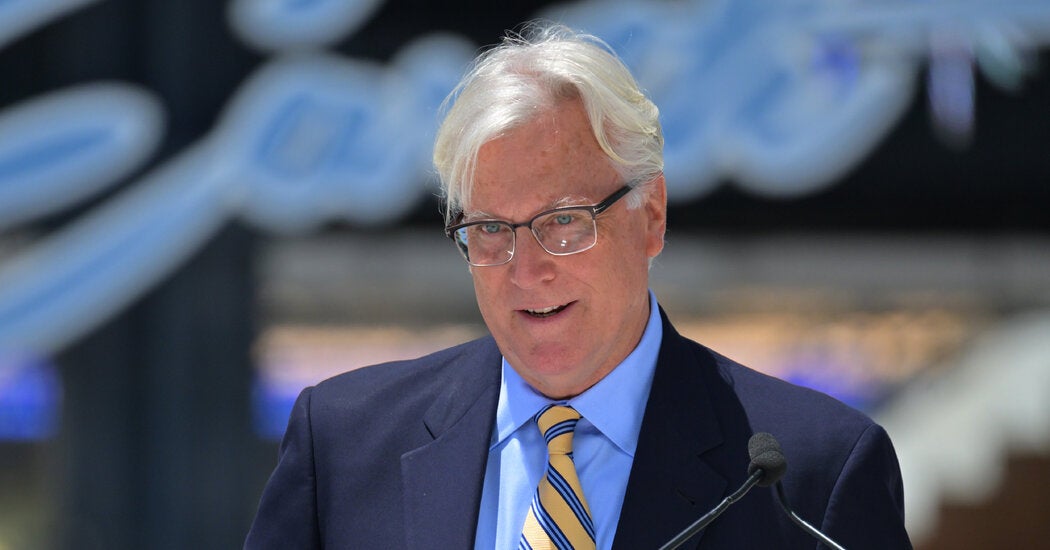
AdvertisementSKIP ADVERTISEMENTAnalysts are questioning how regulators missed billions of improperly reported investments at the heart of an investigation into Mark Walter’s companies.Mark Walter, owner and chairman of the Los Angeles Dodgers.Credit...Jayne Kamin-Oncea/USA Today SportsNov. 16, 2026, 5:00 a.m. ETIt was just over a year ago that insurance regulators in Delaware found no significant issues at two life insurers controlled by Mark Walter, a Wall Street billionaire and owner of the Los Angeles Dodgers.Months later, federal prosecutors started to come to a different conclusion. They collected evidence that those two insurers, Delaware Life and Clear Spring Life, had misclassified billions of dollars in investments with companies affiliated with other parts of Mr. Walter’s vast financial and sports empire, funneling customer money into potentially riskier investments.Now, prosecutors and securities regulators are trying to determine whether Mr. Walter’s companies broke laws along the way. Amid the scrutiny, he has been selling his stakes in the L.A. Lakers and the British soccer team Chelsea FC, and his two insurers have announced a plan to reduce the level of affiliated investments.The investigation has analysts, industry executives and lawmakers sorting out another issue: How did the misclassified investments go undetected by Delaware’s insurance examiners?The answer is crucial because the nation’s 700 life insurers are regulated at the state level. The potential failings in Delaware, where state regulators oversee dozens of life insurers, call into question whether states can keep pace with Wall Street’s growing role in the insurance business.Ever since the financial crisis of nearly two decades ago, life insurers have forged partnerships with Wall Street as way to expand their businesses. More than 100 of the nation’s life insurance firms are controlled by or linked to a deep-pocketed private equity firm or investment firm. Some of these insurers have begun plowing billions of dollars from customer premiums into the debt being used to finance the construction of A.I. data centers.Questions about the oversight of those relationships could gather steam in the coming year with Democrats’ taking control of Congress. They are expected to push for stricter financial regulation.“It’s definitely a miss and they appear to have been asleep at the wheel,” Nick Nemeth, a private investor, said of regulators in Delaware.Mr. Nemeth has been analyzing insurance filings from Mr. Walter’s companies for other investors and said regulators missed “one of the biggest, boldest numbers you would want to look at in the filings for potential conflicts of interest.”A spokeswoman for the Delaware insurance regulators declined to comment. The regulators have said in their reports on the insurers that their examination relied partly on work done in 2023 by KPMG, which audits financial filings for both insurers, to look for “current and prospective risks.”A KPMG spokesman said the firm’s audits were performed “in accordance with the professional standards.Representatives for Mr. Walter’s holding company, TWG Global, which includes the insurers, sports teams and his interest in the Guggenheim investment firm, declined to comment for this article. When an insurer invests in a deal with an affiliate, it raises the prospect that these transactions are not fully independent. Another concern is whether a life insurer with a high concentration of affiliated investments is being pushed into riskier assets, said Trace Dodge, a senior vice president at Capstone, a regulatory consulting firm.ImageMr. Walter after a playoff game in 2025 for his team, the Los Angeles Dodgers.Credit...Kirby Lee/Imagn Images, via ReutersFor years, Delaware Life, the larger of the two insurers, reported in its financial filings that its investments in affiliated businesses were running at roughly half the industry average of 7 percent. But in June, in the face of a federal investigation, the two insurers disclosed that the firms had collectively underreported the dollar value of investments with businesses associated with TWG Global entities by some $21 billion. Overnight, the dollar value of investments that Delaware Life had made with affiliated businesses rose to about 42 percent of the insurer’s investable assets from a relatively low 3 percent.The primary mission of an insurance regulator is to make sure a life insurer is making sound investments and has the ability to cover customer claims. Industry analysts said Delaware regulators should have raised more questions about the seemingly low-level of affiliated investments that Mr. Walter’s insurers had been reporting when doing their examinations.“For years, I avoided criticizing the state regulators,” said Tom Gober, who runs his own forensic accounting firm and has long studied the insurance business. “But it is clear that throughout the private-equity-controlled life and annuity industry, affiliated investments have surged significantly.”Mr. Nemeth, the private investor and consultant, conducted an analysis of Delaware Life and Clear Spring after the firms reclassified hundreds of investments as affiliated ones. His analysis showed that the two insurers had put money into bonds and loans to the Dodgers, the television company that broadcast Dodgers games and Guggenheim financial products.He also found loans to dozens of obscurely-named limited liability companies — some of which bore the names of streets in Chicago — near the offices of TWG Global and Guggenheim.Part of the problem is the business of regulating the nation’s life insurance firms is a fragmented one — making it difficult for any single regulator to get the full picture of the insurance industry landscape. Each state regulator acts independently, and there are no uniform laws. Some insurance commissioners are appointed and others are elected like in Delaware.Trinidad Navarro, Delaware’s insurance commissioner was first elected into office in 2016 and has since been re-elected twice. Before becoming insurance commissioner, Mr. Navarro was a police officer and a sheriff in New Castle County, Del.“Regulators have limited bandwidth,” said Tom Baker, an insurance law expert and professor at University of Pennsylvania Carey School of Law. “They aren’t going to check everything.”In recent years, the National Association of Insurance Commissioners, an organization that recommends standards to regulators, has advised its members to require insurers to provide more information about its investments in affiliated and related parties. But the association has no enforcement power, and its recommendations are not binding.The regulatory missteps related to Mr. Walter’s insurers have prompted calls for change even among the industry’s biggest players.At a recent banking conference, Marc Rowan, chief executive of Apollo Global Management, the private equity and investment management firm that helped pioneer Wall Street’s move into insurance, said he worried the investigation would lead to a “loss of trust.” He said the situation should be “a wake-up moment for the U.S. regulatory system.”An Apollo subsidiary, the life and annuity insurer Athene, has roughly $52 billion invested in affiliated transactions, which includes financing deals Apollo has done for other companies. That works out to about 18 percent of the insurer’s investable assets — more than twice the 7 percent industry average.Other Wall Street-backed insurers have a higher percentage of affiliated investments.Senator Elizabeth Warren, the top Democrat on the Senate Banking Committee, and a longtime critic of the private equity industry, has said more robust regulation may be needed. She sent a letter in September to the insurance commission association seeking more information about steps that regulators are taking to monitor Wall Street-controlled insurers.“Wall Street is exploiting gaps in our patchwork of state regulation to enrich itself on Americans’ insurance premiums,” Ms. Warren, who is likely to become the committee’s new chair next year, said in a statement. “We need stronger federal and state standards to close the gaps, rein in private credit and protect families’ savings and retirements from blowing up.”Kitty Bennett and Kirsten Noyes contributed research.Matthew Goldstein is a Times reporter who covers Wall Street and white-collar crime and housing issues.Related ContentAdvertisementSKIP ADVERTISEMENT
Wall Street Moved Into Insurance. Can State Regulators Keep Up?
Full Article
Original Source
Read the full article at Nytimes →KhanList aggregates and links to publicly available news content. We do not host full articles from third-party sources. Always verify important information with original sources.