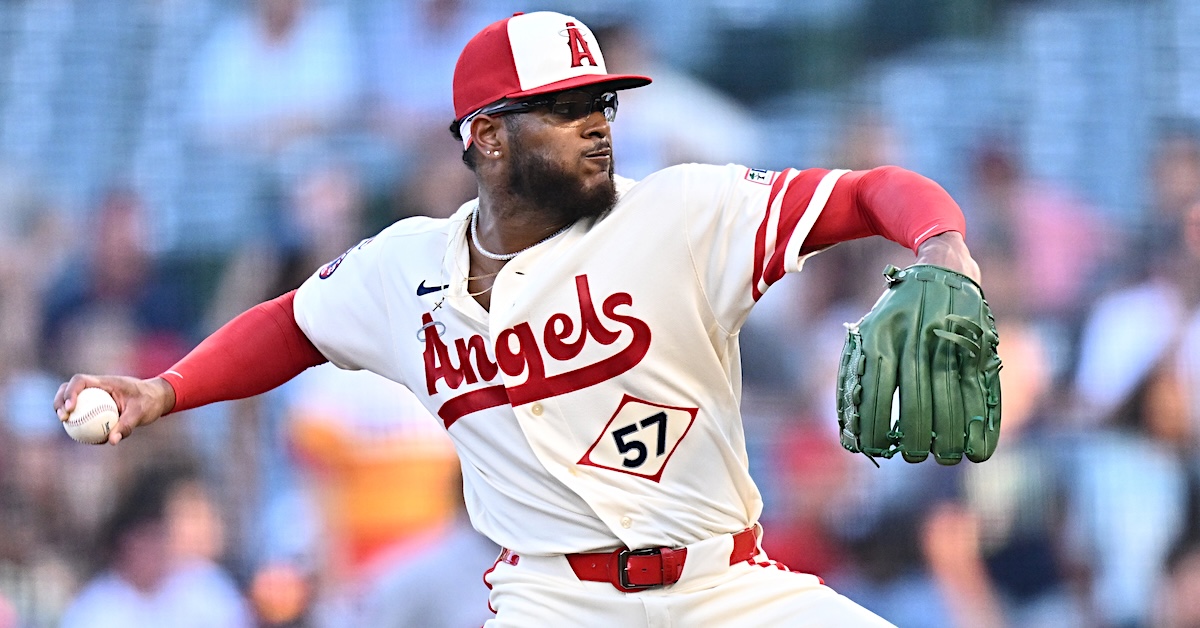
William Liang-Imagn Images The Angels might be as adrift as ever, shedding players at the deadline, but they need someone — anyone — to throw enough innings to close out the season. The biggest void in their pitching staff was left by José Soriano, who was traded to the Blue Jays a week ago on Monday. Soriano throws incredibly hard and gets a huge number of groundballs. This solidly built right-hander’s triple-digit fastball doesn’t get many whiffs — and his strikeout and walk rates are both cause for concern — but he does have a potent sinker-offspeed combination and a good breaking ball. How do you replace that guy? Good news: The Angels don’t have to, because they’ve had another Soriano all along. Walbert Ureña, a 22-year-old righty out of the Dominican Republic, was the Angels’ no. 23 prospect this past offseason, behind a number of pitchers — George Klassen, Ryan Johnson, Sam Aldegheri, Samy Natera Jr. — who have also come up to contribute in the majors this season. I’ll quote the first line of Brendan Gawlowski’s capsule on Ureña from January: “Ureña throws some of the easiest-looking 101-mph heaters you’ll ever see, but he can’t buy a missed bat with the pitch.” Where have we heard that criticism before? The marriage of big velocity and rock-bottom strikeout rates is practically the Angels’ calling card at this point: Soriano, Ben Joyce, Jack Kochanowicz… after some big strikeout numbers in the low minors, it’s even happening to Klassen, too. You Aren't a FanGraphs Member It looks like you aren't yet a FanGraphs Member (or aren't logged in). We aren't mad, just disappointed. We get it. You want to read this article. But before we let you get back to it, we'd like to point out a few of the good reasons why you should become a Member. 1. Ad Free viewing! We won't bug you with this ad, or any other. 2. Unlimited articles! Non-Members only get to read 10 free articles a month. Members never get cut off. 3. Dark mode and Classic mode! 4. Custom player page dashboards! Choose the player cards you want, in the order you want them. 5. One-click data exports! Export our projections and leaderboards for your personal projects. 6. Remove the photos on the home page! (Honestly, this doesn't sound so great to us, but some people wanted it, and we like to give our Members what they want.) 7. Even more Steamer projections! We have handedness, percentile, and context neutral projections available for Members only. 8. Get FanGraphs Walk-Off, a customized year end review! Find out exactly how you used FanGraphs this year, and how that compares to other Members. Don't be a victim of FOMO. 9. A weekly mailbag column, exclusively for Members. 10. Help support FanGraphs and our entire staff! Our Members provide us with critical resources to improve the site and deliver new features! We hope you'll consider a Membership today, for yourself or as a gift! And we realize this has been an awfully long sales pitch, so we've also removed all the other ads in this article. We didn't want to overdo it. The Angels’ inability to cultivate strikeouts is not only relevant to this story, it’s timely. On Tuesday, Angels interim GM John Mozeliak fired pitching coach Mike Maddux, assistant pitching coach Darryl Scott, and bullpen coach Dom Chiti, citing the trio’s inability and/or unwillingness to use technology. Be that as it may, I don’t think you can lay all the blame on the three recently departed coaches. This has been a problem for years, and Maddux, Scott, and Chiti were all in their first season on the Angels’ big league coaching staff. For Maddux and Scott, it was their first year in the organization; Chiti had been the Angels’ minor league pitching coordinator for two years prior, and had a previous stint in the organization. Regardless of the Angels’ ongoing pitching-development woes (and regardless of how echoes of those woes show up in Ureña’s game), this looks like a much-needed success story. In 21 big league appearances (19 starts and two relief outings totaling 101 2/3 innings), Ureña has 97 strikeouts, which is actually quite a good ratio by his team’s standards. He has a 2.83 ERA; as you’d expect for a rookie with a double-digit walk rate, it looks like there’s some batted-ball luck happening there, but not as much as you’d think. Ureña is outpitching his FIP by about a run, but that still leaves him with a FIP of 3.81. As of this writing, there are 134 starters with at least 80 innings this year; Ureña is 21st in xERA (3.38) and 57th in FIP, which is comfortably above average. The key to Ureña’s success has been his ability to keep the ball on the deck. He’s third among that same group of pitchers in groundball rate; Framber Valdez is fourth, Soriano sixth, and Logan Webb seventh, to give you a sense of the guys he’s outperforming. Ureña also has the fifth-lowest home run rate in the league, with a HR/FB% that’s lower than the league average, but not completely outside the realm of the sustainable. So what does Ureña’s game look like? Despite being only 6-foot, Ureña does come by that velocity really easily. He throws from a three-quarters arm slot and falls off the mound toward first base as he pitches. The overall effect is that he looks like someone dropped a cartoon anvil on Chris Devenski and squished him. I mention Devenski because, before spending most of the past decade as a replacement-level vagabond, he started his career with two unreal seasons as a multi-inning reliever for the Astros, and he did it with a pretty similar repertoire to Ureña’s: Hard four-seamer, tight breaking ball, and above all, a grotesque diving changeup. Ureña differs in a couple respects. First: He has a sinker, which has been his most frequently used fastball this season. Second, where Devenski generated sick arm-side run on his four-seamer, Ureña’s four-seamer dips as it runs. Baseball Savant’s pitch movement leaderboard shows 414 qualified four-seamers this season. Ureña’s is 28th from the bottom in vertical movement vs. comparable pitches. Most of the pitchers with sinkier four-seamers are either funky left-handers, extreme groundball guys, or both (hello, Ranger Suarez). On one hand, a four-seamer that dips an extra four inches unexpectedly is going to find the bottom of a lot of bats — hence the Valdezian groundball rate. On the other, a hitter who’d be swinging under a normal fastball and missing it would find his bat running straight into Ureña’s four-seamer. I’ll quote Brendan again: “As has been the case throughout his minor league career, opponents had no trouble smacking the fastball all over the ballpark. They were aided by the knowledge that he was probably going to throw it, as he used the gas or his cutter more than 75% of the time last year.” You understand why this prospect got a 40 FV and a reliever designation, triple-digit velo be damned. I’ll put it simply: That’s no longer the case. Ureña is no longer throwing a cutter. His four-seamer usage is down to 21%. And not only is he leaning on his sinker more, his most common pitch is actually that plus-plus changeup. He leans so heavily on his changeup, he’s even comfortable throwing it right-on-right matchups to get a whiff, as you saw in that clip earlier. Opponents are still beating up Ureña’s sinker (.308 average, .375 wOBA), but the sinker has kept his four-seamer viable (.164 average, .290 wOBA) and tunneled with the game’s most dangerous changeup. That’s not an exaggeration; Baseball Savant’s run value has Ureña’s changeup ranked first in the entire league, both in total value and on a per-pitch basis. Opponents are hitting .159 and slugging a mere .232 off his changeup. It’s an elite pitch. Say what you will about the Angels’ pitching development system (God knows I’ve said plenty), but “throw your best pitch more often” continues to pay dividends throughout the league. All that having been said, Ureña still needs to figure out how to keep his walks under control. The young righty is 111th out of 134 in Zone%, but take that for what it’s worth. The player who’s thrown the lowest percentage of pitches in the zone this year is Zack Wheeler, he of the 6.5% walk rate. Wheeler also has an arsenal full of whiff-getters of every size and shape, and is running a 96th-percentile chase rate. Ureña’s chase rate is just about average overall. When he throws his sweeper out of the zone, opponents chase just 24.3% of the time. There are 325 breaking balls that have been thrown outside the zone 100 or more times this season; Ureña’s sweeper is 298th in chase rate. (Wheeler’s curveball gets a 43.1% chase rate, which ranks 14th out of 325.) What does Ureña need to do to get more whiffs? Maybe learn Wheeler’s curveball. If I knew for sure I’d be the Angels’ new pitching coach. But it’s nice to see that they can grow José Sorianos at will these days, even if they haven’t figured out how to get them to rack up strikeouts.
Walbert Ureña Could Use a Little Fuel Himself, and We Could All Use a Little Change
Full Article
Original Source
Read the full article at Blogs →KhanList aggregates and links to publicly available news content. We do not host full articles from third-party sources. Always verify important information with original sources.