
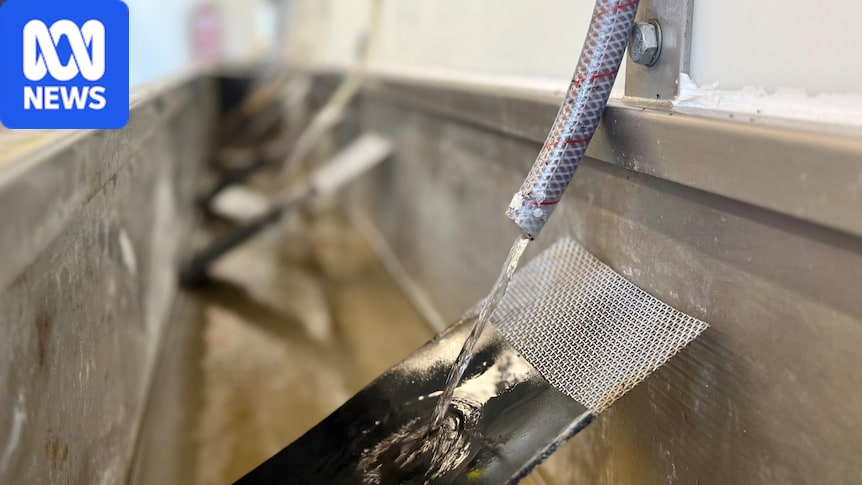
The water authority in a southern New South Wales city has assured its supplies are safe to drink, after a dilution program reduced the level of so-called "forever chemicals" found in some of its bores.Riverina Water said the dilution regime was implemented in December 2025 at two of its West Wagga Wagga raw water bores, after routine testing uncovered "unexpected" levels of PFAS (per- and polyfluoroalkyl substances).Riverina Water engineering director Troy Van Berkel said the source of the contamination was unclear."An initial desktop study has been carried out to say there is not a single source, it's more multiple sources and potential historic use in the area," he said.Elevated levels of PFAS have been detected in raw water samples taken from Riverina Water's West Wagga bore number five. (ABC News: Melinda Hayter)In one instance, the levels of one type of PFAS were almost double the Australian Drinking Water Guidelines in the untreated water, with PFOS in December 2025 measuring at 0.015 nanograms a litre (ng/L).The guidelines require PFOS levels to be under 0.008ng/L.Mr Van Berkel said dilution had lowered PFAS levels in its treated water to within Australian Drinking Water Guidelines and it remained safe for consumption.PFAS are laboratory-made chemicals historically used in firefighting foams, non-stick cookware and water-repellent clothing.The Australian Centre for Disease Control states some studies have associated PFAS exposure with high cholesterol, lower birth weight in babies, and an increased risk of testicular and kidney cancer.PFAS testing of Wagga Wagga's water supply is undertaken offsite by an accredited laboratory. (ABC News: Melinda Hayter)The West Wagga bore field is one of four sources for the city's drinking water.Riverina Water recently signed a memorandum of understanding with the Department of Defence over the management of its East Wagga bore field, due its proximity to a Royal Australian Air Force (RAAF) base where firefighting foams were previously used.Publicly available data shows PFAS levels at two West Wagga bores have regularly exceeded those at East Wagga.Mr Van Berkel said the West Wagga contamination was not linked to the RAAF base or the city's other known PFAS contamination site, the Kapooka Military Area.Troy Van Berkel says the PFAS in the West Wagga bore field is likely coming from multiple sources. (ABC News: Melinda Hayter)Dilution 'good choice'Friends of the Earth land use researcher Anthony Amis has been tracking PFAS contamination across Australia.Mr Amis said the West Wagga results were concerning."Even if they're not above the drinking water guidelines, there are still potential impacts that could be occurring with people that consume that water on a regular basis," he said.Anthony Amis is calling for testing of Wagga Wagga's tap water. (ABC News: Simon Tucci)PFAS remediation researcher associate professor Cheng Zhang, from the Australian Institute for Bioengineering and Nanotechnology at the University of Queensland, said while technologies to remove PFAS from the environment were being developed, they were not widely used."Dilution may be a good choice in the meantime to help maintain contamination below the regulation level," he said.Tap water tests ruled outMr Amis's research has focused on wastewater treatment plants.He believes the Wagga Wagga City Council (WWCC) owned Narrung Street Sewage Treatment Plant is a potential contamination source.A WWCC spokesperson said quarterly PFAS testing at the plant had been underway since January 2024."During this time there have been no measurable indications of PFAS at the Narrung Street Sewage Treatment Plant," they said.From October, licensed landfills and sewage treatment plants in NSW will be required to monitor and report PFAS in wastewater.The Narrung Street Sewage Treatment Plant is near the affected bore field. (ABC News: Simon Wallace)Mr Amis said Wagga's tap water should be tested."It's one thing to have it at the treatment plants and another entirely to see what's coming through the taps in people's houses," he said.Riverina Water said it was more cost effective to test at water sources.Collaborative managementRiverina Water has not published the results of its PFAS tests, undertaken offsite at an accredited laboratory, since March."There's sometimes a delay getting these results and making sure the data validated. The results for those bores have been within Australian Drinking Water Guidelines," Mr Van Berkel said.Riverina Water said while it will continue its routine PFAS testing, further investigations at the West Wagga bore field were the responsibility of the NSW Environment Protection Authority (EPA).A NSW government spokesperson said the Department of Climate Change, Energy, the Environment and Water was aware of "occasionally elevated" PFAS levels in some of West Wagga's bores."Threshold exposure levels are very conservative and consider a large margin of safety, which always err on the side of caution," they said."The NSW government will continue to work with local water utilities to ensure appropriate long-term measures are in places to effectively manage PFAS risks."Cheng Zhang says dilution is an effective way of managing PFAS in drinking water supplies. (Supplied: University of Queensland)Dr Zhang said with more than 14,000 types of PFAS chemicals, there remained significant challenges in managing their impact."I always think PFAS issues are both a legacy contamination problem and also an emerging environmental challenge," he said."The government should work with researchers, industry and also communities to form clear regulation and invest more in treatment plant infrastructure."
Wagga's drinking water diluted after elevated PFAS levels detected
Full Article
Original Source
Read the full article at Abc →KhanList aggregates and links to publicly available news content. We do not host full articles from third-party sources. Always verify important information with original sources.