
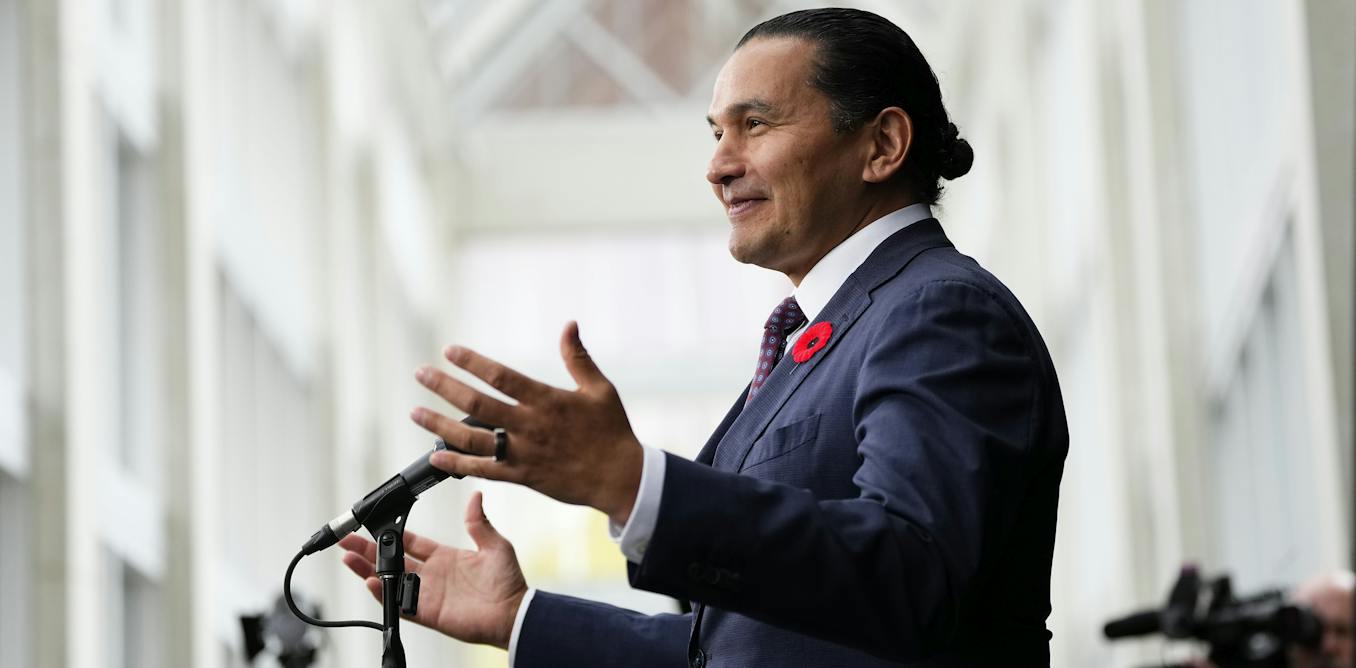
Manitoba Premier Wab Kinew recently called for the abolition of the Indian Act during a meeting in Ottawa with Prime Minister Mark Carney, provincial premiers and First Nations leaders. Holding up his Indian status card, Kinew questioned why Canada continues to maintain legislation that classifies Indigenous people according to a federally administered system of identity. Some have called his remarks a distraction from the conversation on resource extraction. A few Conservatives have called it an empty academic exercise. And still others have called it bold. But no matter what you think of his motivations, Kinew’s call raises important questions about the relationship between First Nations and the Canadian state, particularly concerning Indigenous nationhood and self-determination. Manitoba Premier Wab Kinew poses for a photograph with Chiefs before the First Nations and First Ministers’ meeting in Ottawa on Oct. 26, 2026. THE CANADIAN PRESS/Adrian Wyld What is the Indian Act? First enacted in 1876, the Indian Act consolidated earlier colonial legislation intended to regulate the lives of First Nations Peoples. The legislation established federal authority over reserve lands, political governance and the legal recognition of Indigenous identity. The Canadian government acknowledges the legislation was founded on the assumption that First Nations required federal guardianship until they could be integrated into Canadian society. The consequences of this approach have been profound. The Indian Act and associated federal policies undermine traditional systems of governance. Historically, it has restricted cultural and ceremonial practices. It contributed to the assimilationist policies that supported the residential school system. The legislation also established discriminatory provisions that historically deprived some First Nations women and their descendants of Indian status. Despite numerous amendments, the Indian Act continues to influence how numerous First Nations are governed. It still determines how their members are recognized under Canadian law. First Nations Peoples remain skeptical Kinew’s remarks invite consideration of a fundamental contradiction. While Canada professes a commitment to nation-to-nation relations, much of its relationships with First Nations continues to operate through legislation premised upon federal authority over them. Kinew’s call suggests First Nations should work with the Canadian government on the abolishment of the Indian Act and toward a replacement. There are good reasons for First Nations Peoples to remain skeptical of the federal government’s commitment to working with them. Canada’s history is marked by repeated failures by governments to honour First Nations rights, treaties and political authority. For example, the 1990 Oka Crisis was an episode in which Mohawk people defended ancestral lands against proposed development; the confrontation led to my First Nation existing under military occupation. More recently, the proposed Bill C-39, intended to accelerate major project approvals, raises concerns about whether expedited decision-making on development affecting traditional lands and rights sidesteps First Nations consultation. Such concerns raise questions about Canada’s willingness to recognize First Nations nationhood. Against this historical backdrop, promises of reconciliation and nation-to-nation relations warrant careful scrutiny. Prime Minister Mark Carney listens to National Chief of the Assembly of First Nations Cindy Woodhouse Nepinak as she delivers her opening remarks during the First Nations and First Ministers’ meeting in Ottawa on Oct. 26, 2026. THE CANADIAN PRESS/Adrian Wyld First Nations: Distinct political communities A genuine nation-to-nation relationship requires more than recognition of Indigenous rights within Canada. It requires recognition that First Nations are distinct political communities possessing their own histories, laws, governing traditions and understandings of nationhood. A nation-to-nation relationship should be grounded in mutual respect and the right of nations to determine their own political futures, a principle affirmed by the United Nations Declaration on the Rights of Indigenous Peoples. The Indian Act has never been particularly well-suited for this purpose. Established as an instrument of colonial administration, it presumes that significant aspects of First Nations political life should be governed through legislation created and maintained by the federal government. This arrangement is difficult to reconcile with the principle that First Nations possess an inherent right to govern themselves. Kinew’s call to abolish the act may present an important opportunity, one in which questions about what legislation might replace the Indian Act should be discussed. But more fundamentally, it should encourage First Nations Peoples to consider the realities of the Indian Act and how they understand their own nationhood and the political relationships they want to establish with Canada. Emancipation isn’t charity This is where the idea of native auto-emancipation becomes particularly relevant. In 1882, Jewish writer Leo Pinsker argued in his 1882 pamphlet Auto-Emancipation that Jewish emancipation could not depend exclusively upon the goodwill or recognition of other nations. Jewish people needed to take responsibility for their own collective political future. Although the historical circumstances of Jewish and Indigenous Peoples differ considerably, Pinsker’s argument offers a useful point of reflection. For generations, First Nations Peoples have been encouraged, and sometimes compelled, to understand their place within Canadian political and social institutions. This integrationist approach risks making Indigenous nationhood dependent upon the extent to which it is accommodated or recognized by Canada rather than upon the inherent right of Indigenous Peoples to self-determination. Native auto-emancipation suggests a different starting point. Rather than asking how First Nations might find greater recognition within Canada and its institutions, Indigenous Peoples should continue to ask what it means to belong to their own nations. This is not a new question. For instance, in the 2009 Peace, Power, and Righteousness: an Indigenous Manifesto,, Kahnawà:ke author Taiaiake Alfred explores the importance of Indigenous Peoples returning to their traditional political and governmental ways. To engage with such change would be to increase attention on such things as Indigenous languages, laws, histories, territories and responsibilities. The United Nations Declaration on the Rights of Indigenous Peoples, particularly Article 33, affirms the right of Indigenous Peoples to determine their own identity, membership and political institutions. Avoiding a reliance on Canada Abolishing the Indian Act might create opportunities for meaningful change, provided that existing rights and protections are preserved. But the more fundamental transformation may involve First Nations Peoples continuing to orient their identities, responsibilities and political leanings toward their own nationhood, and to avoid relying on Canada to define the terms of their political existence. In January 2016, Indigenous protesters created a blockade of a CN railroad track just west of Portage La Prairie, Man. THE CANADIAN PRESS/John Woods Some may believe Kinew’s call to abolish the Indian Act was bold. Some believe that his message was presumptuous and that he may have been attempting to speak for other First Nations people. But any card-carrying Status Indian is entitled to opine on the continued existence of the Indian Act. One way of addressing the Manitoba premier’s words is to allow them to fuel a conversation. If First Nations are interested in establishing a real nation-to-nation relationship with Canada, one where their nationhood, sovereignty and inherent right to self-determination are acknowledged and respected, then the extent to which the Indian Act enables such a relationship should be carefully considered.
Wab Kinew wants the Indian Act gone: It’s an opportunity to trade old colonial rules for new nation-to-nation relations
Full Article
Original Source
Read the full article at Theconversation →KhanList aggregates and links to publicly available news content. We do not host full articles from third-party sources. Always verify important information with original sources.