
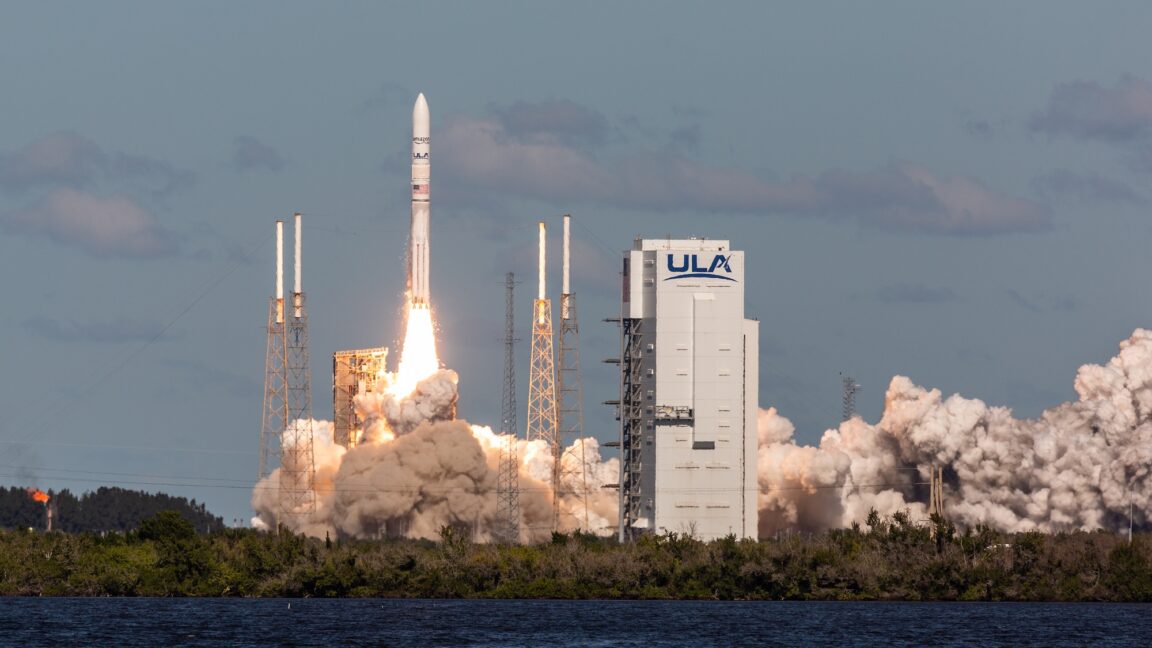
This was the first total mission failure in United Launch Alliance’s 20-year history. A United Launch Alliance Vulcan rocket lifts off from Cape Canaveral Space Force Station, Florida, at 12:40 pm local time Sunday. The rocket later suffered a failure. Credit: Manuel Mazzanti/NurPhoto via Getty Images United Launch Alliance’s Vulcan rocket and 40 Amazon Leo broadband satellites fell back to Earth minutes after liftoff Sunday, a crushing setback that will ripple across all sectors of the US space industry. The Vulcan rocket is on contract to launch roughly half of the US military’s national security space missions in the next few years, and Sunday’s mission was the first of 38 Vulcan launches booked by Amazon to build out its network of broadband Internet satellites aimed at competing with SpaceX’s Starlink. Sunday’s failure is expected to ground the rocket for an indefinite period of time. Vulcan is no stranger to close calls, having overcome failures with its strap-on solid rocket boosters on two of its four previous flights. In each case, the rocket corrected for those problems and continued into orbit to deploy its payloads. The incidents trigged months-long reviews and investigations before ULA could resume Vulcan flights. Sunday’s launch succumbed to a different kind of failure. The six solid rocket boosters appeared to perform well in the first two minutes after Vulcan’s liftoff from Cape Canaveral Space Force Station, Florida, at 12:40 pm EDT (17:40 UTC). In a statement, ULA said the rocket “suffered an anomaly 10 minutes into the flight and failed to deliver the Amazon mission to orbit.” The company said it did not immediately have “any specific data to understand what occurred.” “ULA exists to provide assured access to space for our nation and for the customers who depend on us,” the company said in a statement. “That purpose is why we take on some of the hardest missions in spaceflight, and why we hold ourselves to the standard of mission success. Today, we did not meet that standard.” Engineers will investigate the failure to “find the cause, determine the appropriate corrective action, and return to flight as quickly as possible,” ULA said. “ULA is committed to full transparency with our customers, and they will have visibility into the investigation process, which utilizes rigorous methodology and corrective action. We will provide further updates when new information becomes available.” ULA’s Vulcan rocket is powered by two BE-4 main engines made by Blue Origin. Credit: United Launch Alliance ULA’s Vulcan rocket is powered by two BE-4 main engines made by Blue Origin. Credit: United Launch Alliance Something amiss The first indications of trouble Sunday appeared to crop up before the 10-minute mark of the flight, the point in time when ULA initially said the anomaly occurred. Multiple sources told Ars the anomaly that impacted the launch occurred in the booster stage of the rocket, not the Centaur V upper stage or the solid rocket boosters. It could not immediately be determined whether the booster stage issue was caused by the two methane-burning BE-4 engines that power it, some other part of the booster that feeds propellant into the engines, or another problem. Heading northeast from Cape Canaveral, Vulcan jettisoned its spent solid rocket boosters on time, leaving the launcher flying on the power of its twin BE-4 main engines supplied by Blue Origin, Jeff Bezos’s space company. The BE-4s, each designed to produce more than a half-million pounds of thrust, were supposed to shut down just shy of the flight’s five-minute mark. However, they continued firing for at least 30 additional seconds. Such an overburn could be an indication the booster stage was not performing as expected and operated longer to try to compensate for the underperformance. A mission animation on ULA’s broadcast, driven by real-time telemetry data from the rocket, showed Vulcan start to spin moments after booster engine shutdown. The spin continued through separation of the rocket’s Centaur V upper stage a few seconds later. ULA’s launch commentator confirmed ignition of the Centaur’s two RL10 engines, and the animation showed them vectoring thrust in an apparent attempt to put the rocket back on course. ULA ended its live broadcast a few minutes later without discussion of the anomaly. The company then released a statement on social media declaring the launch a failure. This was the first total mission failure for United Launch Alliance since its formation in 2006 with the merger of the rocket divisions of Boeing and Lockheed Martin. Amazon Leo’s launcher fleet. The Atlas V is no longer available. Credit: Amazon Amazon Leo’s launcher fleet. The Atlas V is no longer available. Credit: Amazon Wider impacts Sunday’s incident is bad news for ULA’s two primary customers: Amazon and the US Space Force. It’s also a potential setback for NASA’s Artemis program to return astronauts to the Moon. First, Amazon. The loss of 40 Amazon Leo satellites onboard the Vulcan rocket is, by itself, a secondary concern next to the inevitable grounding of the company’s primary launch provider. Amazon has 37 more Vulcan launches reserved with ULA, each of which is slated to deliver 40 or more Amazon Leo satellites to orbit. The Amazon Leo constellation today consists of 396 satellites, a fraction of the network’s planned total of 3,292 first-generation spacecraft. Amazon officials told Ars in October that the company has enough satellites to start initial commercial Internet service by the end of the year, but more launches are required to realize the network’s full capacity. Amazon is setting up its service as the first head-to-head competitor in the consumer satellite broadband market with the Starlink network owned by Elon Musk and SpaceX. OneWeb and other companies also offer Internet connectivity from space, but their business models focus on beaming capacity to traditional telco providers. Previous delays with the Vulcan rocket have kept Amazon satellites on the ground far longer than the company planned. Amazon recently announced it manufactured its 1,000th satellite, meaning more than half of its network nodes are sitting in storage. Finally, Amazon was looking forward to ramping up its launch cadence, with Sunday’s launch the first for Amazon Leo on ULA’s Vulcan rocket. “There is risk with any launch, and that’s especially true for inaugural missions like LV-01,” Amazon said in a statement. “ULA has been a trusted partner for Amazon, and we believe they’ll learn from this mission and deliver on their long-term plans for Vulcan.” Amazon made launch bookings with Europe’s Arianespace and Bezos’s Blue Origin at the same time it signed the contract for 38 Vulcan launches in 2022. Amazon reserved additional launches with Arianespace in September, bringing that company’s total contract to 24 launches for Amazon. Three have launched so far, and the fourth is set to take off later this month on an Ariane 6 rocket from French Guiana. Blue Origin’s New Glenn rocket has also encountered setbacks on its early missions. Most recently, a New Glenn rocket exploded during a ground test in Florida in May, knocking Blue Origin’s launch pad offline until at least the end of this year. The New Glenn that exploded was supposed to launch a batch of Amazon Leo satellites, but the payloads were not stacked aboard the rocket at the time. What’s more, the New Glenn rocket uses a version of the BE-4 engine similar to the one that flies on ULA’s Vulcan rocket. Investigators traced the New Glenn explosion to a faulty valve on one of the booster’s BE-4 engines. If engineers determine a BE-4 was at fault on Sunday’s Vulcan failure, it could stand in the way of Blue Origin returning New Glenn to flight early next year. That would mean more delays for two of the rockets Amazon needs to get its satellites in orbit. Amazon’s past rocket woes forced officials to contract with SpaceX, its chief competitor in the satellite broadband and launch sectors, to use its workhorse Falcon 9 rocket to speed up Amazon Leo deployment. Amazon has 10 more missions booked on SpaceX’s Falcon 9, and will presumably be unable to buy more as SpaceX moves the rocket toward retirement. It’s a similar story for the Space Force, which relies upon SpaceX and ULA to launch the military’s most sensitive national security satellites. The Space Force in 2025 added Blue Origin’s New Glenn as a third option to launch the country’s critical military payloads. Previous Vulcan delays forced Space Force officials to swap move six national security launches from ULA to SpaceX. Military officials used the swaps to get time-sensitive payloads into space sooner on Falcon 9 or Falcon Heavy, rather than waiting for Vulcan. In exchange, the Space Force awarded a future SpaceX mission to ULA. A US Space Force GPS navigation satellite is seen during encapsulation inside a Falcon 9 payload fairing. The eight newest GPS satellites all launched on SpaceX rockets. Credit: SpaceX A US Space Force GPS navigation satellite is seen during encapsulation inside a Falcon 9 payload fairing. The eight newest GPS satellites all launched on SpaceX rockets. Credit: SpaceX Expect more Space Force rocket swaps after Vulcan’s errant launch Sunday. For the foreseeable future, the Pentagon will only increase its already heavy dependence on SpaceX to send US national security satellites to space as military leaders race to keep pace with China’s growing presence in orbit. But SpaceX has made it clear Falcon 9 and Falcon Heavy won’t be around much longer. Musk’s company is rapidly transitioning to Starship to launch its own Starlink satellites and new orbiting AI-powered compute platforms. SpaceX has not revealed plans yet to certify Starship for national security missions, a process that would take multiple years. Amazon will likely have to use the 10 Falcon 9 launches it has already reserved and Europe’s Ariane 6 rocket to add any more Amazon Leo satellites to the network in the coming months. Blue Origin’s New Glenn, once it returns to flight, has a series of backlogged launches for NASA’s Artemis Moon program next year, including key test flights of Blue’s lunar lander to prepare for future human missions. Those Moon lander tests could be pushed back further if the BE-4 engine was at fault for Sunday’s failure. NASA’s lunar program has another important link to the Vulcan rocket. The space agency recently announced it selected a version of ULA’s Centaur upper stage for future flights of NASA’s Space Launch System rocket, the vehicle used for launching astronaut crews to the Moon. The Centaur will replace a more expensive, unproven Boeing upper stage design. NASA officials will want to rule out a problem with the Centaur V upper stage on Sunday’s doomed launch as the agency aims to start flying ULA’s Centaur on SLS missions for crewed lunar flights as soon as 2028. “Appreciate you quickly keeping the public and your partners informed,” NASA Administrator wrote in reply to ULA’s statement on the Vulcan launch anomaly. “The team at NASA is available to assist in all matters related to the investigation and remediation effort. Artemis, Moon Base, and the nation need ULA. We are in your corner and here to help.” Stephen Clark is a space reporter at Ars Technica, covering private space companies and the world’s space agencies. Stephen writes about the nexus of technology, science, policy, and business on and off the planet. 6 Comments
Vulcan rocket fails during launch, dealing major blow to SpaceX competitors
Full Article
Original Source
Read the full article at Arstechnica →KhanList aggregates and links to publicly available news content. We do not host full articles from third-party sources. Always verify important information with original sources.