
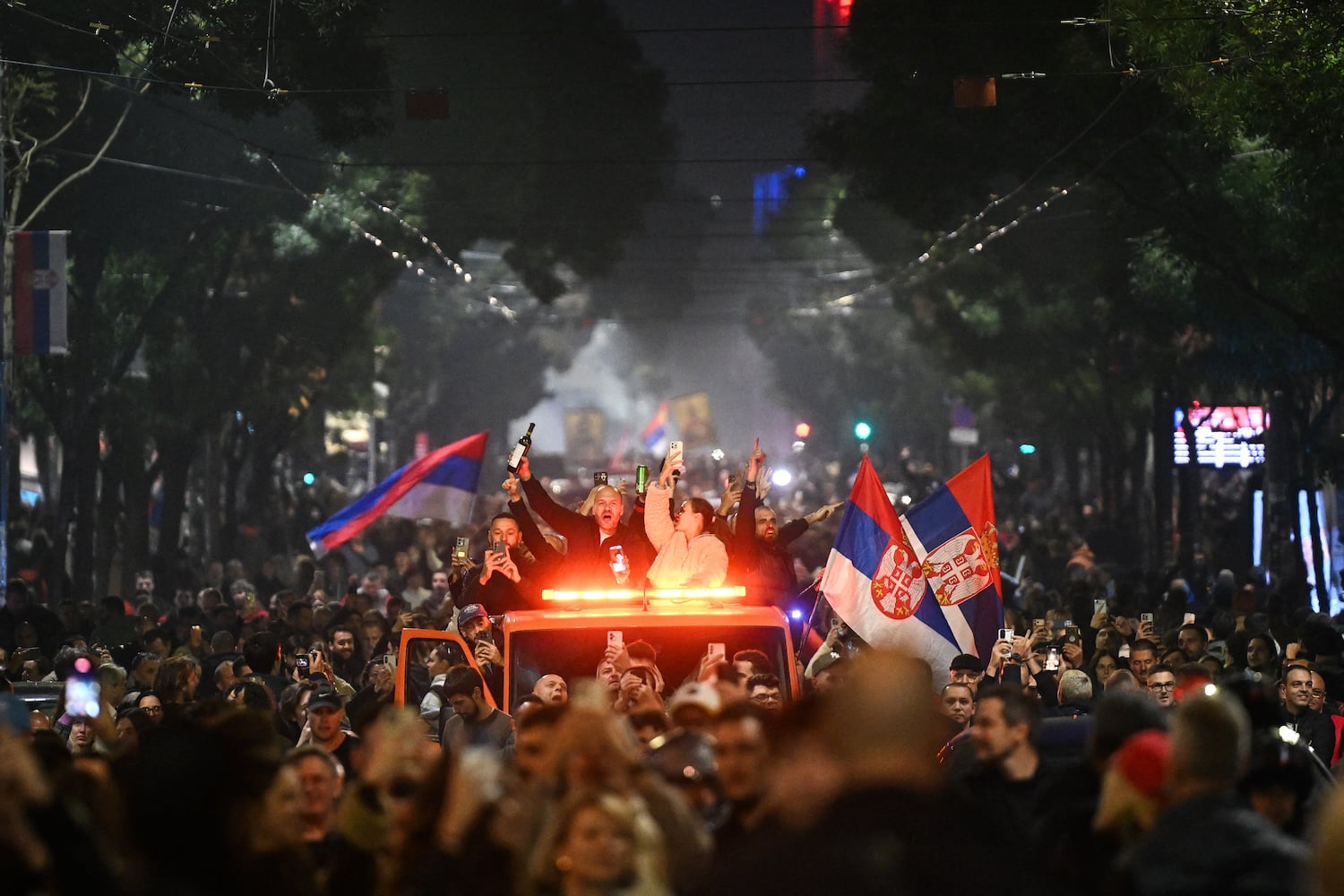
Welcome back to World Brief, where we’re looking at the electoral defeat of former Serbian President Aleksandar Vucic, Brazil’s surprise presidential election results, and the race for United Nations secretary-general. A New Era for Belgrade Tens of thousands of Serbs flooded the streets of Belgrade on Monday to celebrate the electoral defeat of strongman Aleksandar Vucic, who has dominated the country’s politics for more than a decade. His ouster is the culmination of nearly two years of student-led protests against one of Europe’s most staunchly populist regimes, and it ushers in a new era of governance led by a youth-organized grassroots movement. Since taking power in 2014, Vucic has cracked down on democratic freedoms. He has relied on systemic election fraud to keep his Serbian Progressive Party in power, used violence to quell unrest, and sidled closer to Russia and China despite European condemnation. Oscillating between the president’s and prime minister’s office to remain in control, Vucic managed to extend his reign for years. But a student-led protest movement years in the making appears to be what finally upended Vucic’s grip on power. In November 2024, demonstrations erupted over the collapse of a concrete railway station canopy that killed 16 people. Activists accused Belgrade of negligence, corruption, and poor state oversight. Security forces responded with excessive force, arbitrary arrests, and digital repression. Still, the protest movement never died out, and on Sunday, the Student List group won 52.54 percent of the vote, with voter turnout hitting nearly 69 percent—a more than 30-year high. “It is clear that we have lost these elections,” Vucic said in a televised speech. Vucic blamed foreign interference for his defeat without providing evidence. “This was the verification of a revolution that they carried out directly with support of different European countries and the deep American state, the one that is also against President [Donald] Trump,” Vucic said. Trump has sought closer ties with Vucic in recent months to try to keep him in office. However, international observers noted that Vucic’s party held an unfair advantage heading into Sunday’s vote. “Entrenched advantages enjoyed by the ruling party, including misuse of state resources, together with intimidation and pressure on voters, candidates, and civil society, as well as disruptions of campaign activities, further marred the electoral environment,” the Organization for Security and Cooperation in Europe’s international election observation mission wrote in a statement on Sunday. The Student List is expected to win 140 seats in the country’s parliament, giving the bloc a ruling mandate without having to rely on coalition-building. Now, the party faces the difficult task of choosing a prime minister to steer Serbia forward. The Student List has yet to name anyone to the post, though experts suspect that Ilija Srdanovic, a cardiologist who led the movement, is a top contender. Former central bank governor Dejan Soskic, who resigned from that post in 2012 to protest alleged government interference, is also seen as a front-runner. Following Sunday’s results, acting President Ana Brnabic must also now call for an extraordinary presidential election no later than Dec. 27; Vucic resigned from the presidency last month to run for the prime minister’s office. It is unclear whom the Student List will nominate for that role. Today’s Most Read Why Putin’s Defenders Are Increasingly American by Adrian Karatnycky The End of Asylum by Linda Kinstler Why the ‘Odds of Mischief Are High’ in These Midterms by Michael Hirsh The World This Week Tuesday, Oct. 27: German Chancellor Friedrich Merz begins a five-day trip to Asia, visiting Singapore, Japan, and South Korea. Meanwhile, German President Frank-Walter Steinmeier kicks off a four-day trip to China. Abu Dhabi Crown Prince Khaled bin Mohamed bin Zayed Al Nahyan concludes a two-day trip to Canada. Finland hosts a three-day session of the Nordic Council. Wednesday, Oct. 28: The Philippines hosts the two-day Association of Southeast Asian Nations defense ministers’ meeting. Russian President Vladimir Putin hosts the two-day Russia-Africa Summit. Thursday, Oct. 29: Canadian Prime Minister Mark Carney hosts the two-day European Union-Canada summit. A cease-fire in the Ukrainian city of Oleshky takes effect. Friday, Oct. 30: Chinese President Xi Jinping hosts Swiss President Guy Parmelin. Sunday, Nov. 1: Bulgaria holds a presidential election runoff. What We’re Following Lula’s big win. Brazilian President Luiz Inácio Lula da Silva secured a surprise victory against far-right Sen. Flávio Bolsonaro in Sunday’s presidential election runoff. With a more than 4 million vote gap, Lula’s win served as a rebuke of the conservative wave sweeping Latin America, and it defied Trump’s efforts to establish another populist ally in the region. Lula’s comeback stunned analysts, as the incumbent had finished nearly 2 percentage points behind Bolsonaro during the election’s first round earlier this month. “Faced with the vivid possibility of another Bolsonaro presidency, however, progressive Brazilians and some centrists mobilized with a level of grassroots organizing uncharacteristic of recent years,” Catherine Osborn wrote in Foreign Policy. Foreign congratulations have already begun to pour in. Notably, though, Bolsonaro (like his father) appears unwilling to accept his loss. “It is impossible to recognize the election results, given the circumstances under which things unfolded,” Bolsonaro said on Monday, citing the Supreme Federal Court’s last-minute decision to extend voting by two hours due to alleged voter transport irregularities. Yet legal experts suspect that the challenge won’t hold, since Bolsonaro had also called for an extension after torrential rain delayed public transportation in the country’s conservative-leaning south. Top job. The race to determine the next United Nations chief is heating up. With current U.N. Secretary-General António Guterres set to complete his second term at the end of this year, all eyes are on his potential successor. Seven candidates are currently jockeying for the position, and all five of the U.N. Security Council’s permanent members—China, France, Russia, the United Kingdom, and the United States—must ultimately be on board with the selection. New challengers may be entering the ring. The Trump administration is reportedly encouraging former Hungarian Prime Minister Viktor Orban to run, according to the Wall Street Journal Editorial Board. Trump also backed Orban, a close ally, in Hungary’s recent elections, though the far-right populist was ultimately voted out. Orban has not confirmed having U.N. ambitions. Last week, top Emirati diplomat Lana Nusseibeh also announced her candidacy, though she has faced sharp criticism for the United Arab Emirates’ role in Sudan’s devastating civil war. Reuters reported last week that former Costa Rican Vice President Rebeca Grynspan appeared to have a narrow lead in the race, according to informal Security Council polls. However, it remains unclear whether she will win the support of the council’s permanent members.—Christina Lu Talks in Tehran. Top security officials from Pakistan, Saudi Arabia, and Turkey met with Iranian leaders in Tehran on Monday to discuss opening channels to “prevent the return of military escalation” in the Middle East. The high-level talks are the first between Tehran and the so-called Mecca Pact since fighting erupted between Yemen’s Houthi rebels and Saudi Arabia in July, and they come amid fears that the United States and Israel are preparing to launch a fresh offensive against Iran after next week’s U.S. midterm elections. In early October, Pakistan, Saudi Arabia, and Turkey activated a mutual defense pact in response to repeated Houthi strikes on critical Saudi infrastructure. And on Monday, Egypt’s Parliament authorized the country’s military to help defend Riyadh. However, that hasn’t stopped the Iranian-backed rebel group from targeting the kingdom’s energy facilities, civilian airports, and Muslim holy sites. Members of the Mecca Pact seek to convince Tehran to force the Houthis to dial back their assault before the United States and Israel return to active fighting. However, Iran appears more focused on the threat from Israel. According to Iranian Foreign Ministry spokesperson Esmail Baghaei, Monday’s talks will include a discussion of “Israel’s expansionist policies, developments in the Palestinian territories and Lebanon, and the repercussions of U.S. and Israeli military action against Iran.” Odds and Ends A 93-year-old Japanese woman outfoxed an online scammer last week and helped local authorities arrest the suspect, police in Japan confirmed on Monday. The woman had received phone calls from a man claiming to be a police officer and asking for her ATM card. She pretended to fall for the scheme and allowed the man to visit her home to allegedly verify her account—only for authorities to be waiting there to detain him. Japan has the world’s second-oldest population, and its senior citizens are often the target of online scammers; last year, fraudsters stole around $2 billion from the country’s older residents.
Vucic’s Reign Is Over
Full Article
Original Source
Read the full article at Foreignpolicy →KhanList aggregates and links to publicly available news content. We do not host full articles from third-party sources. Always verify important information with original sources.