
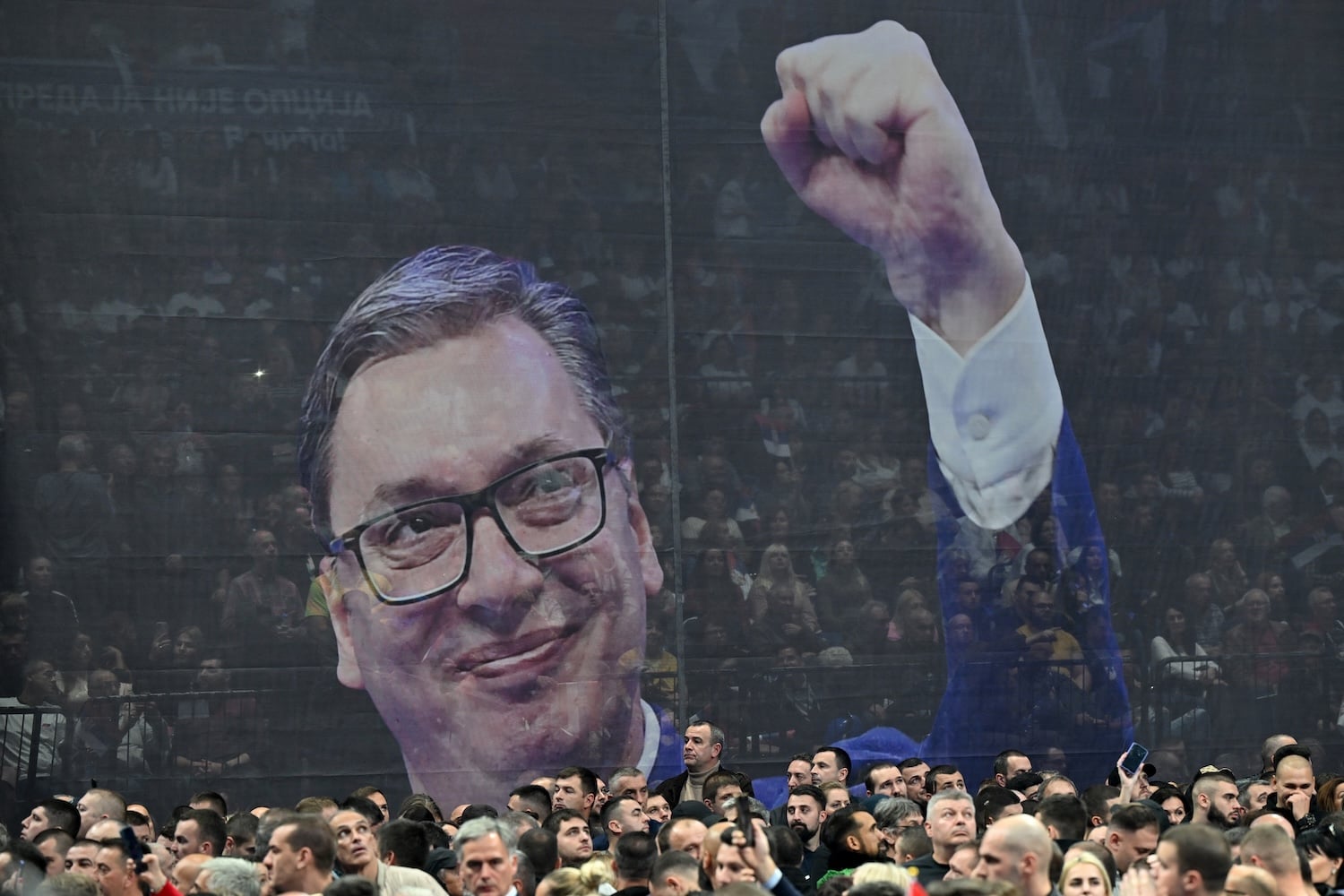
When President Aleksandar Vucic was defeated in Serbia’s Oct. 25 parliamentary elections, it represented the dramatic end of one of Europe’s most entrenched autocracies. But it also placed a spotlight on the economy that Vucic had built over the past decade in office. Serbia has become reliant on foreign investment from China, among others. His opponents are now hoping to build a more democratic Serbia—one with a closer economic relationship to Europe. How has Serbia’s economy developed since the 1990s? Was Vucic a successful economic leader of Serbia? What is the student movement’s economic program? Those are just a few of the questions that came up in my recent conversation with FP economics columnist Adam Tooze on the podcast we co-host, Ones and Tooze. What follows is an excerpt, edited for length and clarity. For the full conversation, look for Ones and Tooze wherever you get your podcasts. And check out Adam’s Substack newsletter. Cameron Abadi: What was Serbia’s strategy for recovering from its 1990s economic collapse in the wake of the breakup of Yugoslavia and the wars that followed? Has it been more reliant on economic integration with Europe or rather direct investment from China and other far-off countries? Adam Tooze: There’s really no question that Europe is decisive, and the tragedy really of Serbia’s situation since the disastrous end of the Cold War in Yugoslavia—with the bloody wars of the ’90s and then the conflict over Kosovo and Serbia’s isolation—is that it has lost connection to Europe. And so its trajectory has diverged from that of its former Yugoslavia neighbors, Slovenia, Croatia, but also from Hungary, with which, in political terms, you might compare the British regime with [Viktor] Orban in Hungary. I mean, it’s a really tragic story in the sense that Yugoslavia in the late 1980s was one of the relative success stories of Eastern Europe. It was relatively open. It had, you know, regular exchanges, notably with West Germany. It was open to tourism. It was, by the standards of the Eastern Bloc, an open, diverse, cosmopolitan, prosperous, lower-middle-income country. And then as a result of the civil war, and of course Serbia is a key agent in that extremely violent [Slobodan] Milosevic regime, its GDP collapses to about half what it was in the late 1980s by the late 1990s. And the recovery has been incredibly slow. I find these numbers really hard to believe, having visited Belgrade reasonably recently. But according to the official data, the Serbian GDP per capita didn’t return to its late ’80s levels until the end of the 2010s, in 2018, 2019. The Belgrade I visited, to me, that didn’t fit with those numbers. It seemed like a prosperous, middle-income country now. So it may be that the rest of Serbia is much poorer than the bits of Belgrade that I saw. In any case, it’s that kind of trajectory. And it’s a real outlier within Eastern Europe, even within the former Yugoslavia. Apparently, the Serbians are scandalized by the fact that Montenegro has higher basic pension and minimum wage levels than Serbia today. And China can help in various ways—it can build infrastructure. But for a small country of 6.7 million people who, in every sense, have to clearly be understood as European, to be as isolated as they’ve been, relatively speaking, in political terms and making no progress at all toward any closer serious affiliation with the European Union is a disaster. And in the enthusiasm of the protesters, you sense, of course, the hope that somehow they may finally be able to break out of this disastrous legacy that begins in the early ’90s and is personified by Milosevic and then by Vucic since the early 2010s. It’s a kind of Maidan moment, I think, in that respect. It’s a very dramatic, very dramatic story. CA: Vucic has earned a reputation in Serbia and elsewhere as a stabilizer of the country, even a modernizer. Was he effective economically? AT: I mean, as a person, he’s an impressive guy. I’ve been in very small group meetings with him, and he’s a powerhouse. He’s a flyweight boxer. He punches hard. He’s clever. He’s quick on his feet. He knows how to play the Western game. So he’s a bit of a bruiser. He comes out of the ultranationalist scene. So he was, like, doubling down on the hardest, most aggressive Serbian lines in the 1990s. He then does a stint as communications minister as a very young man in his late 20s for Milosevic during the Kosovo conflict, then goes into opposition along with most of the other extreme nationalists after the fall of Milosevic, and then comes back to power after 2008 and rapidly ascends to the position of prime minister. And then in 2015, leverages, I think one has to say, an International Monetary Fund program to build his reputation as the kind of anchor of stability—I mean, Serbia was in terrible trouble financially—and delivers fiscal stability in terms of a falling debt level, which is now down at really low levels, like 45 percent of GDP. It’s much harder for low-income or middle-income countries to kind of carry the kind debt levels that France does, whose debt-to-GDP ratio is about three times that of Serbia or heading that way. And in that extent, he earns his stripes as an effective manager of the Serbian economy. But the knock is, in a sense, that the tighter their control of fiscal policy and public spending became, the more that gave scope for a discretionary, clientelistic, politically managed regime of investments, of licensing, of crony capitalism, basically, within this tight ship that they were running. So austerity is not, as it were, the opposite of clientelism and crony capitalism, but rather it’s kind of preconditioned that the more tightly you run government spending, the more personal connections to the bosses’ network comes to matter. And this is hardball stuff. You know, I’ve had the privilege of meeting activists in Serbia who’ve had death threats. I mean, this was not an administration or a government to be messed with. And its control of the media, a little bit like in Orban’s Hungary as well, felt, while it was in power, massively solid. So it was a powerful regime of consolidation. And this is something, in fact, that is underrated, I think, as an element of these authoritarian-nationalist projects in Europe in the 2010s. [Russian President Vladimir] Putin, after all, is also notable for having run a very tight fiscal ship. So this kind of logic of politics is a model across Eastern Europe in the former Soviet space. CA: The student movement that has effectively won these elections necessarily comes to power from outside the channels of institutional politics. This was a leaderless, networked, anti-party structure that produced this election outcome. That raises the question of, what does this kind of movement do when it takes power? How does it relate to economic policy and power when it’s handed that opportunity? AT: Yeah, it’s a really remarkable movement. For those wanting a flavor, I recommend a Guardian article by Aleksandar Matkovic, who was an activist in the movement until he had to leave the country as a result of intimidation by the regime. And it’s a movement that, yeah, we describe it as a student movement. Effectively, it has become a kind of nonparty opposition in a much broader sense. I heard one Serbian commentator say that the remarkable thing about this election is that it has defeated both the regime and its opposition. Because the opposition parties that were living in a kind of live-and-let-live relationship with the government were effectively accepting their fate. And the student movement is singular and radical and novel in saying, “No, there is an alternative for our country.” They aren’t without a program when it comes to economics. It comes in different forms. So, in early October, there was a platform by 30 leading Serbian economists announcing, first of all, that a victory for the student-led opposition movement would not be a disaster for Serbia. There is a deeply ingrained fear that Serbia could slide back to an era of high inflation, to rapidly depreciating currency. And this was an important statement by some of the leading figures across the academic establishment, former heads of the fiscal council that implemented the austerity drive, people from the University of Belgrade, figures from the central bank, Serbians in exile or working in institutes in Vienna, for instance, all asserting first the bottom line that this is not a vote for economic disaster. And what then has emerged are a variety of different positions of economists and former technocrats who have allied themselves with the movement. Perhaps the one most commonly mentioned in this context is Dejan Soskic, who between 2010 and 2012, so before Vucic rose to power [in 2014], was the governor of the Serbian National Bank. Now, that’s a period in which the currency was depreciating. So he’s not an entirely uncontroversial figure. But he has emerged since then as a kind of standout centrist figure, arguing essentially for what you would expect—namely, you know, rigorous auditing of government spending, anti-corruption drives, high-quality public spending. It’s not a terribly imaginative kind of policy. But in the Serbian context, it’s important. And his role as a former central bank governor and his insistence that the future will not see further depreciation of the currency, though he considers the possibility of progressive adjustment rather than some sort of collapse so as to increase the competitiveness of the Serbian economy—he’s a kind of anchor figure for that whole issue, which is very neuralgic. How does Serbia revive growth in a conventional framework? How does it overcome corruption? What to do with the currency? There are also other figures associated with the movement who are offering much more fundamental kind of programs. And one such is Branimir Jovanovic, who is focusing not so much on immediate, short-run issues of governance and central bank policy but on the central issue of growth. How do you get growth going in Serbia other than through exploitative FDI [foreign direct investment] relationships, say with the Chinese, where you always have to ask what’s in it for them, if you like? How could you build a more attractive growth program? And then there is also what you might call the more genuinely populist left-wing element within the coalition that wants to target Serbian oligarchs, that wants to introduce redistributive taxation, that wants to raise the floor for those who have really suffered through the program of consolidation since the 2010s and to rebuild elements of a welfare state and raise the average standard of living. So, within this coalition, there are at least those three positions: a kind of clean-hands technocrat that’s concerned about financial markets and the currency, a growth-orientated structural industrial policy kind of person, and a welfarist tax-and-spend program. And it will be, I think, fascinating to see how this is worked out in coming months and years because it’s a central issue for the movement and there isn’t a single coherent platform. But there are a lot of ideas. This is not a movement that’s sort of naive on economic issues, but it’s not one that has consolidated a coherent position.
Vucic Is Leaving. His Economy Remains.
Full Article
Original Source
Read the full article at Foreignpolicy →KhanList aggregates and links to publicly available news content. We do not host full articles from third-party sources. Always verify important information with original sources.