
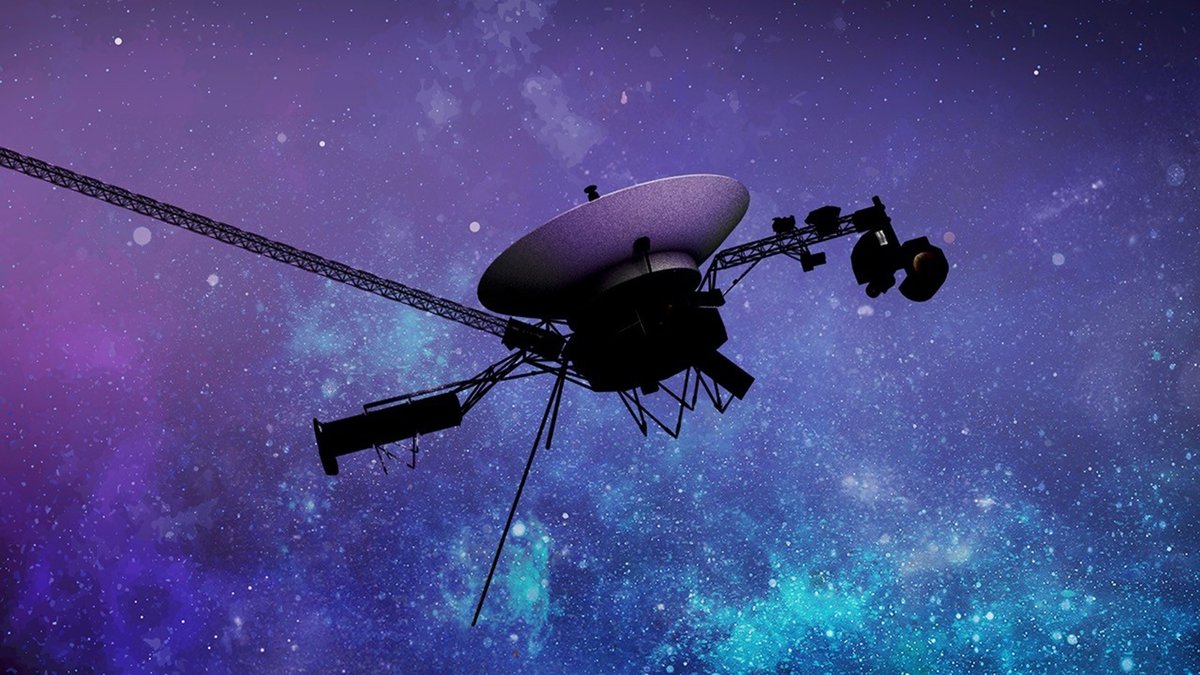
Early on November 18 Voyager 1 became the first human-made object to reach a distance of one light-day, or 16 billion miles (26 billion kilometers), from Earth. A radio command sent to the spacecraft on that day will take a full 24 hours to arrive, and its reply will take another 24 hours to come home.Launched by NASA in September 1977, Voyager 1 is the most distant human-made object ever. Traveling at about 38,000 miles per hour (17 kilometers per second), it’s also the fastest one currently leaving the solar system. It got that speed by siphoning gravitational energy from Jupiter and Saturn when it flew by those planets in 1979 and 1980, respectively, photographing them and probing their environments as it did so. After it surveyed the Saturnian system, the spacecraft cruised out of the plane of the solar system and traveled in the general direction of the constellation Ophiuchus. In August 2012 its charged-particle detectors showed it had crossed the heliopause, the invisible boundary where the sun’s outflowing wind gives way to the wind from neighboring stars. At that moment, Voyager 1 became our first interstellar spacecraft.Matthew Twombly and Juan Velasco (5W Infographic); Consultants: John Richardson (principal investigator, Voyager Plasma Science, the Massachusetts Institute of Technology Kavli Institute for Astrophysics and Space Research) and Merav Opher (professor, Department of Astronomy, Boston University)On supporting science journalismIf you're enjoying this article, consider supporting our award-winning journalism by subscribing. By purchasing a subscription you are helping to ensure the future of impactful stories about the discoveries and ideas shaping our world today.Its working life is nearly over. Built for the darkness of deep space, Voyager 1 draws power not from solar cells but from three radioisotope thermoelectric generators (RTGs) fueled by plutonium. These generators initially supplied about 470 watts at launch, and they now produce less than half that. Only two instruments, a plasma-wave detector and a magnetometer, are still working. By about 2036 the RTGs will no longer provide enough power for Voyager 1 to talk to Earth.But even if the mission stops, the spacecraft won’t. If unperturbed, Newton’s first law dictates that it will keep moving forever. Lacking the speed to escape the Milky Way, it will remain in orbit around the galaxy. Arguably that’s when it will enter the most important phase of its journey: serving as a dedicated interstellar envoy of Earth.You might ask why we’d send an envoy at all. The answer involves a mix of curiosity, pride and loneliness.We live on a planetary oasis in a vast cosmic sea. Our galaxy alone holds some 100 billion stars, each likely hosting at least one planet; estimated billions of those worlds may be small, rocky and temperate like Earth. Life emerged here shortly after our planet formed some 4.5 billion years ago, and all indications are that the conditions behind our primordial genesis are not unique. Yet our species, Homo sapiens, has walked the Earth for only about 300,000 years. And during that time, we’ve only had radio for about a century and spacecraft for only about 70 years. The timeline suggests our path to intelligence was tortuous, with no certainty of success. If our history is typical, intelligent species are exceedingly rare, and the distances between them in space and time are vast and isolating. So far the lack of verifiable extraterrestrial visitors and the “radio silence” from systematic searches for signals from alien civilizations are consistent with that view.Still, our desire to communicate with intelligences greater than our own appears hardwired into our DNA. We are like castaways on a seldom, if ever, visited island who, facing apparently insurmountable odds, put a message in a bottle and hurl it into the outgoing tide. The castaways may never escape their solitude, but if those bottled-up thoughts are someday found, they will not have been forgotten.Voyager 1 carries such a message. Attached to its side is the Golden Record, a 12-inch gold-plated copper disk pressed with “Earth’s Greatest Hits”: 115 images of people, places and things; sounds of a living world; music from around the globe; greetings in 55 languages; and messages from Earth’s leaders. Its cover shows how to play the record and includes a pulsar map pointing back to the spacecraft’s origin. There’s also a tiny, ultrapure sample of uranium 238 electroplated onto the cover; the sample’s isotope ratios reveal roughly when the record was launched. The spacecraft’s twin, Voyager 2, launched just over two weeks before Voyager 1, carries the same record. Pioneer 10 and 11, dispatched a few years before the Voyagers, each carry a simple engraved plaque. All four spacecraft are headed toward the stars in different directions.Today the amount of information shared in the Pioneer plaques and the Voyagers’ Golden Records seems quaint: A modern cell phone stores roughly 1,000 times more data than the digital equivalent of the Golden Record contents. Cutting-edge storage could allow an interstellar envoy to carry not a smattering of but essentially all published human knowledge. With today’s cutting-edge storage, an archive of about 360 terabytes could fit onto three thin disks.The Voyagers were expensive NASA missions designed to survey the outer planets, together costing taxpayers about $5 billion in today’s dollars. Their Golden Records were an afterthought—last-minute add-ons championed by astronomers Frank Drake and Carl Sagan. Fifty years later we can flip these priorities around by building a new class of low-mass, low-cost spacecraft whose main job is carrying our interstellar message, potentially with studies of outer solar system objects along the way.Rockets will remain our only way off the ground for some time, but once in space, other kinds of propulsion become practical. One method, first theorized separately by Russian astronautics pioneers Konstantin Tsiolkovsky and Friedrich Zander in the 1920s, is the solar sail, which rides on the pressure of sunlight without the need for fuel and accelerates as long as it soaks up enough momentum from photons. NASA, the Japan Aerospace Exploration Agency (JAXA) and the Planetary Society have all flown small solar sail craft as proofs of concept.Inspired by Pioneer and Voyager, our student team at the University of Arizona is developing Lunar Uranus Membrane Envoy (LUMEN), a solar-sail spacecraft that could carry an archive of human knowledge to the stars. LUMEN weighs about 10 pounds (4.6 kilograms), and its sail measures about 60 feet (18.4 meters) on a side. After a rideshare to lunar orbit, it would tilt its sail to slow its orbital motion and spiral down the sun’s steep gravitational well, converting potential energy into speed. At 0.2 astronomical unit (about 18.6 million miles) from the sun, LUMEN would turn its sail full-face to the light, catching 25 times more thrust than it would at Earth’s distance. After a few solar passes, this maneuver would give LUMEN a terminal velocity of about 26 km/s—roughly 50 percent faster than Voyager 1. If launched by the end of 2033, LUMEN would fly by Jupiter and Uranus, using its sail as an antenna to beam images and measurements back to Earth, and then pass the heliopause around 2058. In about 2147, when it would be some 57 billion miles from Earth, it would overtake Voyager 1 and become both the fastest and most distant human-made object.And for the cost of sending out a single Voyager-scale mission, swarms of LUMEN-like probes could be launched, each carrying a 5D quartz disk of human knowledge and returning unique science before becoming another fading and far-flung physical echo of Earth.LUMEN is not the only bottle being readied to send an interstellar message; others are also answering this cosmic call. A nonprofit called the Fermi Explorer Mission proposes a small probe bound for Alpha Centauri, our nearest stellar neighbor. Instead of a sail, it would use a solar-powered electric thruster, firing on repeated close passes of the sun before heading out at about 24 km/s on a journey of some 80,000 years. Its organizers hope to launch within the next few years for less than $15 million. The probe would carry a copy of the iconic Voyager Golden Record, messages from children around the globe and a handful of small experiments.Voyager 1’s milestone reminds us how far we’ve come—and how far we still must go. Future follow-up missions could carry our message farther and faster throughout the universe, with each one an immortal testament that, once upon a time, lonely, curious creatures on a single solitary world had the will and ability to reach to the stars.
Voyager 1 reaches ‘one light-day’ milestone
Full Article
Original Source
Read the full article at Scientificamerican →KhanList aggregates and links to publicly available news content. We do not host full articles from third-party sources. Always verify important information with original sources.