
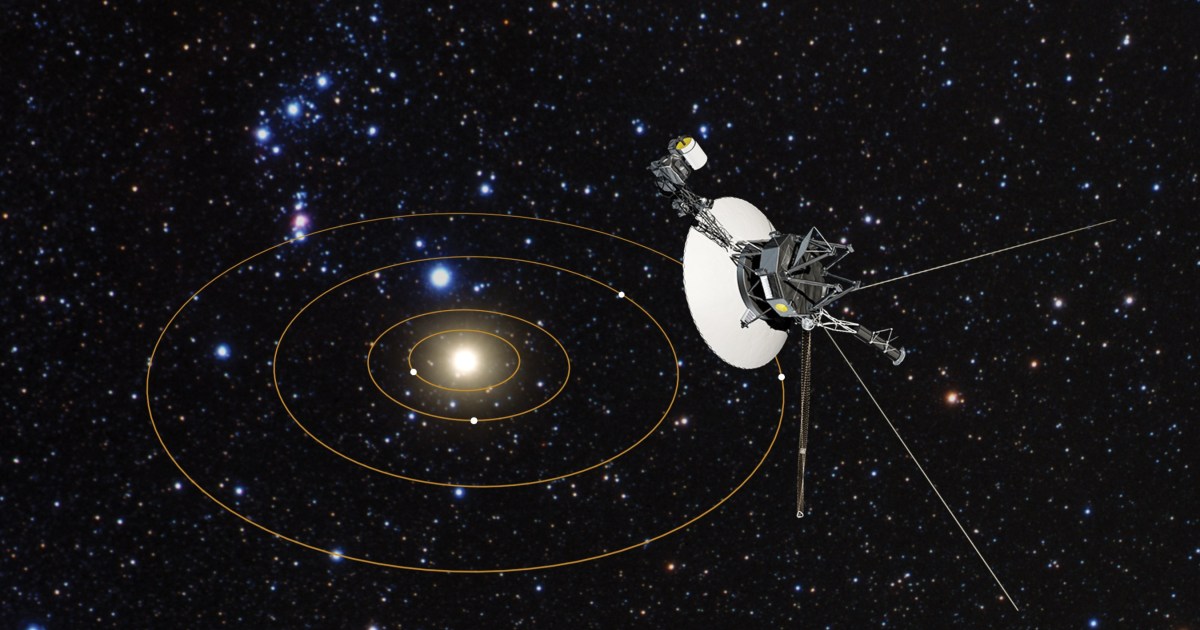
Nearly 50 years after launch, NASA’s most distant spacecraft is about to reach a new milestone. Celebrate by lighting up the sky after sunset on Nov. 17. | Published: November 17, 2026 Voyager 1 speeds away from the solar system, shown here in an artist’s depiction. On Nov. 18, nearly 50 years after launch, the spacecraft will become the first spacecraft to reach 1 light-day from Earth. Credit: NASA; ESA; G. Bacon/STScI At 5:16 a.m. EST on Wednesday, Nov. 18, Voyager 1 will become the first spacecraft to reach a distance of 1 light-day from Earth. A command radioed from home will need 24 hours to arrive, and a reply another 24 to come back. NASA is asking the public to celebrate by sending the spacecraft a signal on the evening of Tuesday, Nov. 17. What are the Voyager missions? NASA launched the twin Voyager spacecraft in 1977 to tour the giant planets: Jupiter, Saturn, Uranus, and Neptune. Voyager 1 flew past Jupiter and Saturn, while Voyager 2 went on to Uranus and Neptune and is still the only spacecraft to visit either one. Both then kept going. They’re now the only probes ever to study interstellar space directly, the region beyond the Sun’s magnetic field. Each spacecraft runs on a radioisotope thermoelectric generator, the same kind of power source that drives NASA’s Curiosity and Perseverance rovers on Mars. Plutonium-238, the fuel source, gives off heat as it naturally decays, and the generators turn that heat into electricity. But because the output fades by about 4 watts every year, engineers have spent years shutting off components and instruments to stretch the spacecraft’s lives. This year, a risky maneuver nicknamed the “Big Bang” turned off several devices in one coordinated move to buy the spacecraft and their remaining instruments several more years of operation. Today, Voyager 1 only runs two of its original 10 instruments, and Voyager 2 runs three. Where are Voyager 1 and 2? Voyager 1 is closing in on 1 light-day from Earth (about 16.1 billion miles [25.9 billion kilometers]) — farther than any spacecraft has ever gone. Its twin is about 2 billion miles (3.2 billion km) closer to Earth, near enough that a signal takes about 20 hours to reach Voyager 2. Voyager 1 lifted off Sept. 5, 1977, two weeks after Voyager 2 but on a shorter trajectory as it was traveling to Jupiter. After visiting Saturn in 1980, it drifted away from the solar system’s planets for good. A decade later, it captured the famous photograph of Earth known as the Pale Blue Dot. In August 2012, it became the first spacecraft to enter interstellar space, and Voyager 2 followed in 2018. Voyager 2 won’t reach the light-day mark until November 2035. You can see both missions’ exact locations on NASA’s mission status page. What is a light-day? A light-day is a distance measuring how far light travels in 24 hours. At about 186,000 miles per second (299,792 km per second), that adds up to roughly 16.1 billion miles (25.9 billion km). For scale, the Moon is just 1.3 light-seconds away, the Sun about 8.3 light-minutes, and Neptune a bit over 4 light-hours. Proxima Centauri, the nearest star beyond the Sun, lies more than 1,500 light-days away. At a speed of nearly 38,000 mph (61,000 km/h), Voyager 1 is anything but slow. Still, it needed more than 49 years to cover the distance light crosses in a single day. Send a signal Astronomy usually asks readers to dim their lights. But tomorrow night is an exception: To celebrate Voyager 1’s accomplishment, NASA invites everyone to flash Voyager’s call sign, V-G-R, skyward in Morse code on Tuesday evening. Use NASA’s automated flasher on your smartphone or tablet. Or grab a plain flashlight and do it manually: V: dot-dot-dot-dash; G: dash-dash-dot; R: dot-dash-dot. Dots are quick blinks of the light, and dashes are long flashes of about a second. Pause between letters. Brooks Mendenhall is a staff writer at Astronomy, based in Chattanooga, Tennessee, fueled by an unending curiosity about the universe. A former classroom teacher, he has a knack for breaking down complex concepts for a wide audience.
Voyager 1 reaches 1 light-day from Earth
Full Article
Original Source
Read the full article at Astronomy →KhanList aggregates and links to publicly available news content. We do not host full articles from third-party sources. Always verify important information with original sources.