
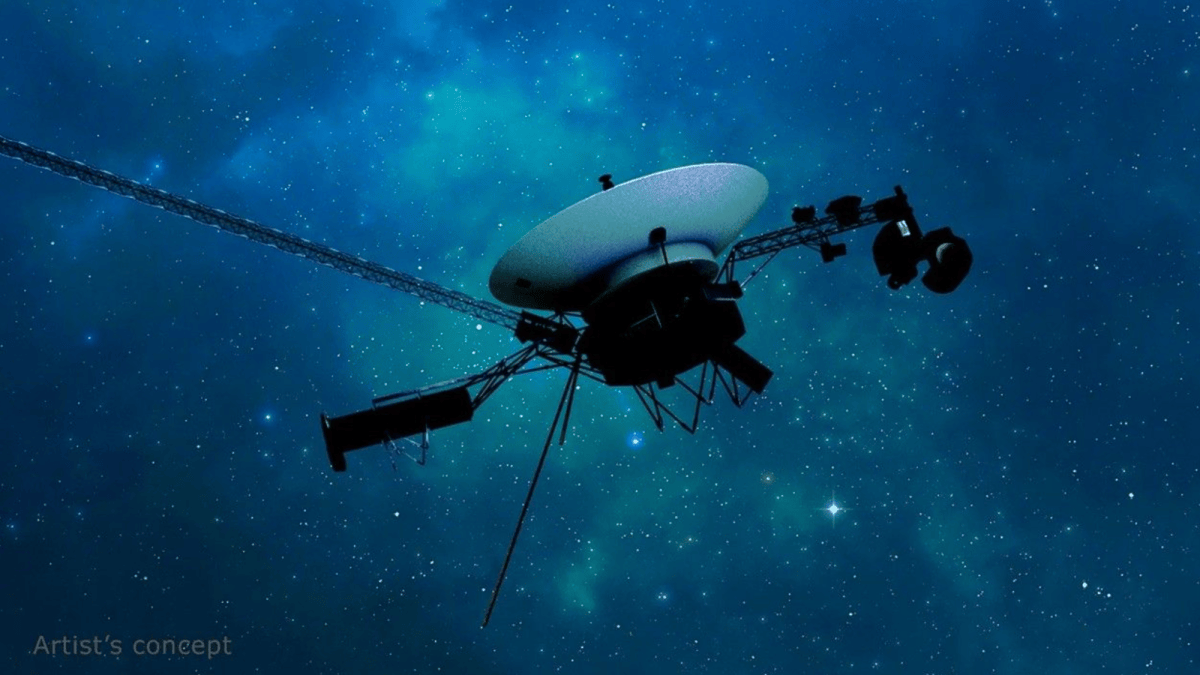
After traveling through space for almost 50 years, NASA’s Voyager 1 spacecraft should be one light-day away from Earth. The probe likely reached this record-breaking milestone at approximately 5:16:07 a.m. EST this morning. Since it will take about 24 hours to receive any signal from Voyager 1, NASA will confirm that it reached the distance at a news conference on Thursday, November 19. William Kurth, a research scientist at the University of Iowa who has worked on the Voyager mission since 1974 tells Popular Science that this mission is about more than just science. “The Voyager missions represent humanity’s curiosity and hunger to understand our species’ place in the universe,” he says. “They show that we are explorers and can work together to do wonderful things.” The Voyager spacecraft. Image: NASA/JPL-Caltech What does one light-day away from Earth mean? Astronomers often describe vast cosmic distances in light-years. It’s arguably the most famous unit of measurement when talking about the universe, in part because of its sheer incomprehensibility. A single particle of light travels at a speed of about 186,282 feet per second. Hypothetically speaking, if you fired a beam of light into the night sky at the outset of reading this story, it would travel around 44.7 million miles into space by the time you finished. But even a unit like a light-minute isn’t particularly useful to astronomers. For them, cosmic measurements only start making sense on a scale of light-years. Voyager 1 is nowhere close to a light-year away from Earth, but a light-day (approximately 16,094,799,105 miles) is still basically impossible to envision as a distance. And since radio communications travel at nearly the speed of light, any messages to and from the spacecraft will require about 24 (Earth) hours to receive. What will Voyager 1 do now? Even at one light-day from Earth, Voyager 1 isn’t done just yet. While several of its instruments are no longer functioning, it still routinely sends back invaluable information from its vantage point beyond the solar system. “Voyager 1 is telling us about our sun’s interaction with its galactic neighborhood. It has told us about the amount of galactic cosmic rays, unfiltered by the sun’s magnetic field,” says Kurth. “We are learning about the variation of plasma density in the interstellar medium just outside the heliosphere (sun’s extended atmosphere). We’re anxious to see where the direction of the magnetic field rotates from one similar to the heliospheric direction to that of the pristine interstellar medium.” “Though it might be a long shot, I hope to see Voyager 1 crossing into the predicted hot hydrogen wall,” Adam Szabo, a Project Investigator on Voyager’s Magnetometer Experiment, tells Popular Science. “The wall is composed of neutral hydrogen atoms, so it will not register easily, but it must have some magnetic and plasma wave signature.” What have we learned from Voyager 1? Voyager 1 launched on September 5, 1977, heading for Jupiter and Saturn. Voyager 1 has 10 scientific instruments onboard, including two Golden Records engraved with sights, sounds, and depictions of life on Earth onboard—should the probe encounter any extraterrestrial life. In March 1979, the Voyager 1 discovered a thin ring around Jupiter and two new Jovian moons: Thebe and Metis. When it reached Saturn in 1980, the spacecraft spotted five new moons and a new ring called the G-ring. Saturn’s rings are bright and its northern hemisphere defined by bright features as NASA’s Voyager 2 approaches Saturn, which it encountered in August 1981. Three images, taken through ultraviolet, violet and green filters in July 1981, were combined to make this photograph. Several changes are apparent in Saturn’s atmosphere since Voyager 1’s November 1980 encounter, and the planet’s rings have brightened considerably due to the higher sun angle. Voyager 2 was 43 million kilometers (27 million miles) from Saturn when it took this photograph. Image: NASA/JPL-Caltech. As part of a concept that NASA called the Grand Tour, the Voyager mission as a whole took advantage of a once-every-175-year alignment of the outer planets for a grand tour of the solar system. Its twin spacecraft Voyager 2 later explored Neptune and Uranus. On February 17, 1998, Voyager 1 became the furthest human-made object in space, after overtaking NASA’s Pioneer 10 probe. It crossed into interstellar space in August 2012, and became the first spacecraft to cross the heliosphere. This boundary is where the influences from outside of our solar system are stronger than those from our sun. ‘Dream big’ All good things must come to an end, of course. Voyager 1 is powered by three radioisotope thermoelectric generators (RTGs) fueled by decaying plutonium-23. The isotope possesses a 87.74-year half-life, so the batteries are currently operating at around two-thirds their original strength. NASA has slowly shut down onboard equipment in recent years to conserve energy, but there will come a time when there simply isn’t enough left in the RTGs for anything to operate. Barring any technical issues, mission engineers expect to bid Voyager 1 a final farewell sometime during the 2030s. The spacecraft may cease its work as a cosmic laboratory, but its very existence ensures it will remain a monument to humanity’s potential as it barrels forward for eons. “Voyager 1 and its companion Voyager 2 have taught us time and again that nature is not as simple and predictable as we thought,” Kurth explains. “Voyager has always provided surprising differences from our best guesses as to what it will see in any new region.” Additionally, Szabo adds that it has an important lesson for anyone on Earth who has ever had a dream. “Do not be afraid to dream big. In 1977, even the Grand Tour seemed like a long shot,” he says. “We did not even conceive of making it into interstellar space. Dream big.” This is a developing story that will be updated. 2026 Popular Science Home of the Future Awards 39 products that will improve your everyday life.
Voyager 1 is one light-day away from Earth, according to NASA estimate
Full Article
Original Source
Read the full article at Popsci →KhanList aggregates and links to publicly available news content. We do not host full articles from third-party sources. Always verify important information with original sources.