
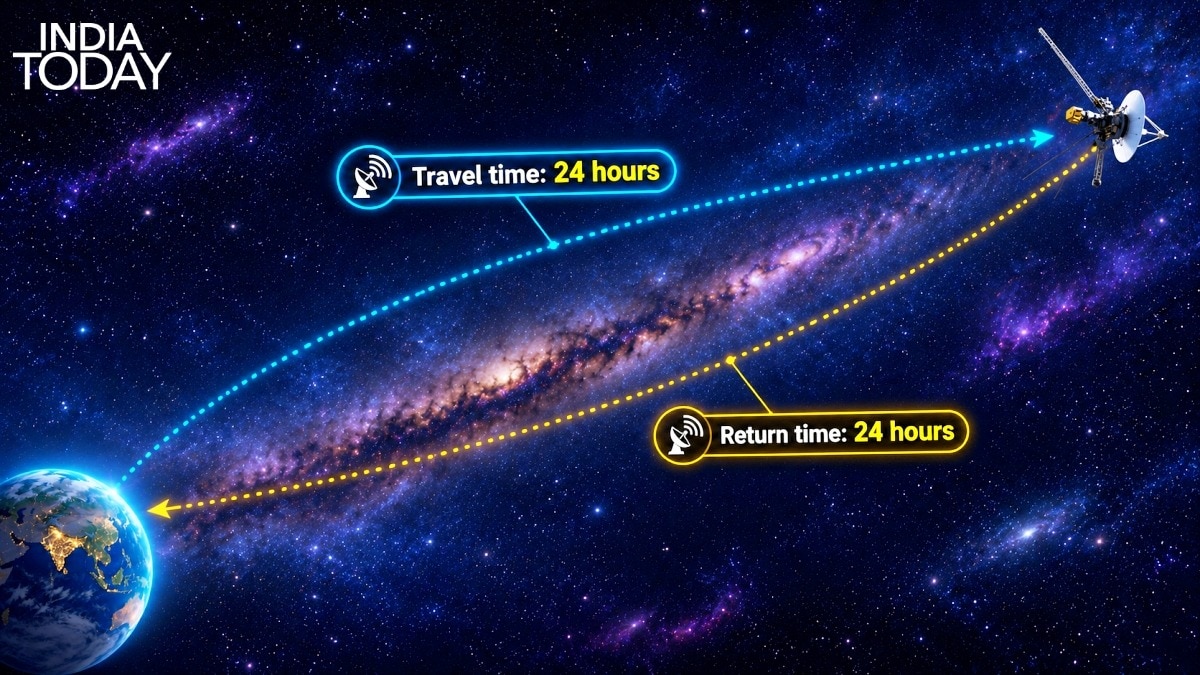
Voyager 1 is expected to cross the one-light-day mark on 18 November 2026. The milestone will stretch each command-and-response exchange with Earth to about 48 hours.The spacecraft is expected to cross the one-light-day distance mark on November 18, 2026. (Photo: India Today)New Delhi,Nov 3, 2026 12:07 ISTNearly five decades after leaving Earth, NASA's Voyager 1 spacecraft is approaching another extraordinary milestone in human space exploration.The spacecraft is expected to cross the one-light-day distance mark on November 18, 2026, meaning radio signals travelling at the speed of light will take approximately 24 hours to reach it from Earth, and another 24 hours for a response to return.Launched on September 5, 1977, Voyager 1 is currently travelling through interstellar space, more than 25.8 billion kilometres from Earth. According to NASA's tracking data, the spacecraft is already more than 172 astronomical units (AU) away from the Sun.But what exactly does reaching one light-day mean? A light-day is the distance light travels in 24 hours at approximately 3 lakh kilometres per second.That translates to nearly 25.9 billion kilometres. Unlike a light-year, which measures the distance light covers in an entire year, a light-day is a smaller unit used to understand enormous distances within our cosmic neighbourhood. When Voyager 1 crosses this threshold, it will become the first human-made object to travel one light-day away from Earth. Voyager 1 crossed the heliopause, the boundary where our Sun's impact ends, in August 2012. (Photo: Nasa) A 48-HOUR CONVERSATION WITH EARTHThe milestone will fundamentally change how communication with the spacecraft works. When mission controllers send a command, it will take nearly 24 hours to reach Voyager 1. Any response from the spacecraft will take another 24 hours to return.This means a simple exchange of instructions and confirmation could take approximately two days, making real-time communication impossible.NASA communicates with the Voyager spacecraft through its Deep Space Network, a global system of giant radio antennas located in California, Spain and Australia. These antennas track the probes, receive scientific data and transmit commands across billions of kilometres. Voyager 1 and its twin, Voyager 2, were launched in 1977. (Photo: Nasa) THE JOURNEY THAT CHANGED OUR UNDERSTANDING OF THE SOLAR SYSTEMVoyager 1 and its twin, Voyager 2, were launched in 1977 to explore the outer planets during a rare planetary alignment that occurs roughly once every 175 years.Their Grand Tour transformed our understanding of Jupiter and Saturn, while Voyager 2 went on to explore Uranus and Neptune.Voyager 1 crossed the heliopause, the boundary where our Sun's impact ends, in August 2012, becoming the first spacecraft to enter interstellar space. Its twin followed in November 2018.Both spacecraft also carry the Golden Record, a 12-inch gold-plated copper disc containing sounds, images, music and greetings in 55 languages, intended as a message from humanity to any intelligent life that might encounter them.As Voyager 1 approaches the one-light-day milestone, its journey offers a remarkable perspective on how far humanity's first interstellar messenger has travelled — and how much farther it continues to go.- Ends
Voyager-1 is about to break a record no machine or human ever has
Full Article
Original Source
Read the full article at Indiatoday →KhanList aggregates and links to publicly available news content. We do not host full articles from third-party sources. Always verify important information with original sources.