
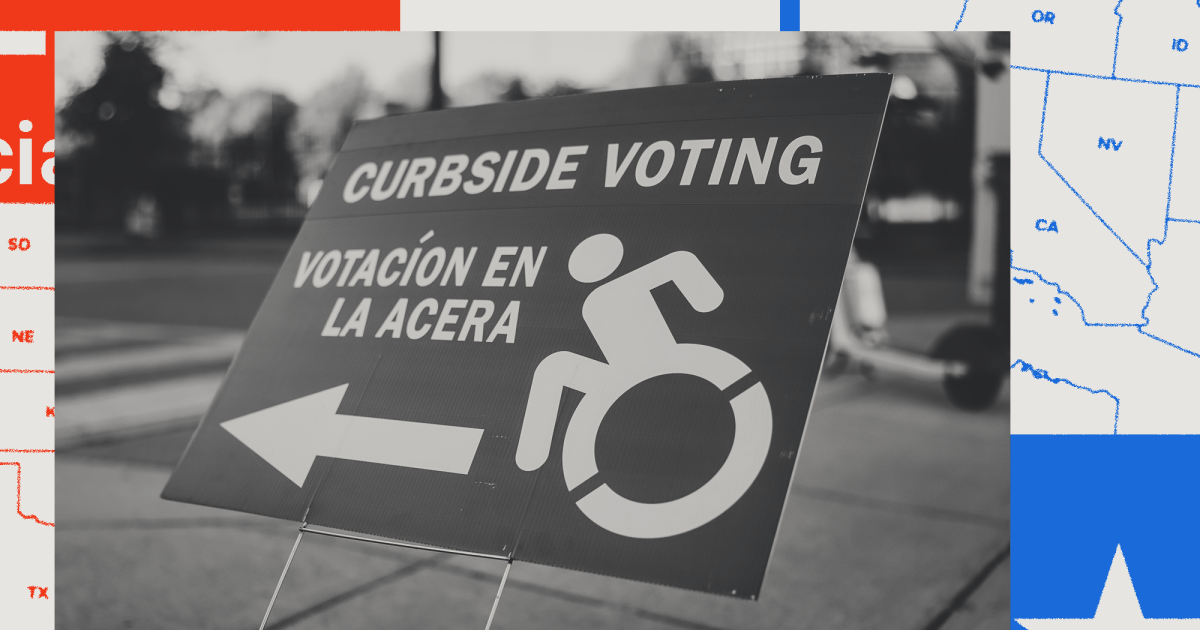
Mother Jones illustration; Bryan Dozier/NurPhoto/AP Get your news from a source that’s not owned and controlled by oligarchs. Sign up for the free Mother Jones Daily. Disabled people faced a myriad of hurdles to voting during the midterm elections, reflecting both apathy in accommodating marginalized people across the country and voter suppression in states that have sought to deliberately throw up physical and bureaucratic challenges to the process. “Disabled voters are unable to access the right to vote in every state, in many circumstances, in every county, at every polling place,” said Casey Doherty, a policy analyst for the Center for American Progress’ Disability Justice Initiative. Around 40 million disabled Americans are eligible to vote. That includes attacks on mail-in voting, which Doherty said effectively disenfranchise many disabled people, especially immunocompromised and otherwise Covid-cautious potential voters who may be hesitant to go to a potentially poorly ventilated polling location. But access issues extend to every stage of the voting process, Doherty noted, including in registering to vote and receiving voting materials on time. Many states attacking mail-in voting have legislated some exemptions for disabled people, who tend to break evenly along party lines. But some disabled voters, including many I spoke to, are surprisingly likely to emphasize voting in person—in part out of concerns that mail ballots, even if sent back on time, won’t be properly counted. That’s especially true for voters in a state like Georgia, which months after the 2020 presidential election made it a felony for certain people to return a ballot on another voter’s behalf; many disabled voters seek ballot assistance at polling places and by mail. And, especially in the South, people may have to travel further to vote, with ABC News finding that in the wake of the Supreme Court’s 2013 Shelby County v. Holder decision, which weakened voting protections, around 2,700 polling locations closed over a period of a decade. A 2024 report by the US Election Assistance Commission and Rutgers University found that 14 percent of voters with disabilities faced issues with voting in the 2022 midterm elections, in comparison to 4 percent of non-disabled people, and that more people faced accessibility issues voting in person than voting by mail. “The most common reported difficulties among in-person voters with disabilities in 2022 were difficulty waiting in line, reading or seeing the ballot, writing on the ballot, and getting inside the polling place,” the report reads. In the run-up to the 2026 elections, even more voting restrictions were deployed by states that have taken advantage of the Supreme Court’s gutting of the Voting Rights Act—some forcing disabled people to re-register, sometimes in person, and others slashing the window of time in which they can vote. Voting accessibility has improved overall across the past two decades, the report noted, with more ramps at voting locations and accessible voting machines. “The improved accessibility reflects funding…for accessible voting systems, improvements to polling places, poll worker training, and increased information about voting accessibility for individuals with disabilities,” the report says. But where problems still exist, the only remedy is often to file individual complaints under federal or state disability laws, a hurdle that has historically limited enforcement of accessibility statutes and makes it more challenging to expand voting accessibility specifically. As I reported in 2024, many polling places, particularly in the South, are in churches—but places of worship are exempt from the Americans with Disabilities Act when not acting as a polling location, which leaves few options when they’re inaccessible. And according to a Ballotpedia analysis, the average level of reading expertise needed to correctly parse the average ballot measure in 2026 was that of a graduate student, posing clear challenges to some disabled people, including would-be voters with intellectual disabilities. Failure to accommodate access needs while voting can vary immensely. One Deaf voter in Georgia told me that she had been repeatedly instructed not to use an electronic device she requires for captioning. In New Mexico, a woman with severe ME/CFS reported that her county clerk’s office said it never received her absentee ballot request, forcing her to obtain a sworn statement from her doctor attesting to her disabilities in order to receive a last-minute one—another obstacle significant numbers of disabled voters wouldn’t be able to clear. A chronically ill Illinois voter asked for a chair while waiting in line, but inadequate staffing at the polling place meant she had to lug it through the line herself as it moved. Maria Town, president and CEO of the American Association of People with Disabilities, reported not being able to vote privately on Election Day in Maryland’s Prince George’s County, where the only voting table without long lines at her polling place lacked a privacy screen that matched the height of her mobility scooter, “preventing our ballots from being anonymous,” Town said. “Polling places should be provided with more privacy shields as a temporary accessibility remedy for voters who may need to vote in a different configuration than a typical booth,” Town said. Justin Salas, who is blind, wanted to access a sample ballot for his area before he went to vote on Election Day, but the ballot on his county’s election website didn’t work with a screen reader. Salas, who lives in Nevada, said he’d been reprimanded intensely for using a magnifying tool on his phone to vote in the 2024 elections, and wanted to iron out problems in advance. But the county never got back to him with a resolution. “I just wanted to be an informed voter,” Salas said, “and I was not an informed voter.” In Riverside, Missouri, Patrisha Gillette set out to use curbside voting. Gillette lives with lupus and small fiber neuropathy, both of which contribute to mobility issues. But signs at her polling places directed prospective voters to go inside to inquire about curbside voting. “I’m like, ‘You’re kidding, right? You want me to come inside to then ask you if I can vote outside, and then get back into my car and pull around’” to vote, Gillette said. That obstacle, Gillette said, could easily deter other disabled and aging people who want to vote in the state. (The Missouri Secretary of State did not reply to a request for comment.) “I worry about everybody who it’s just too much [for],” Gillette said, who was able to find a phone number for her polling location—though it wasn’t readily available—eventually online. “Then they leave and don’t end up voting.” “There’s a failure of empathy and lack of understanding on the state and local government level as well as the federal level,” Salas said. “It doesn’t matter if it’s left or right or center; people seem to think that the accessibility issue can be blown off.”
Voting While Disabled Needs to Get Easier
Full Article
Original Source
Read the full article at Motherjones →KhanList aggregates and links to publicly available news content. We do not host full articles from third-party sources. Always verify important information with original sources.