
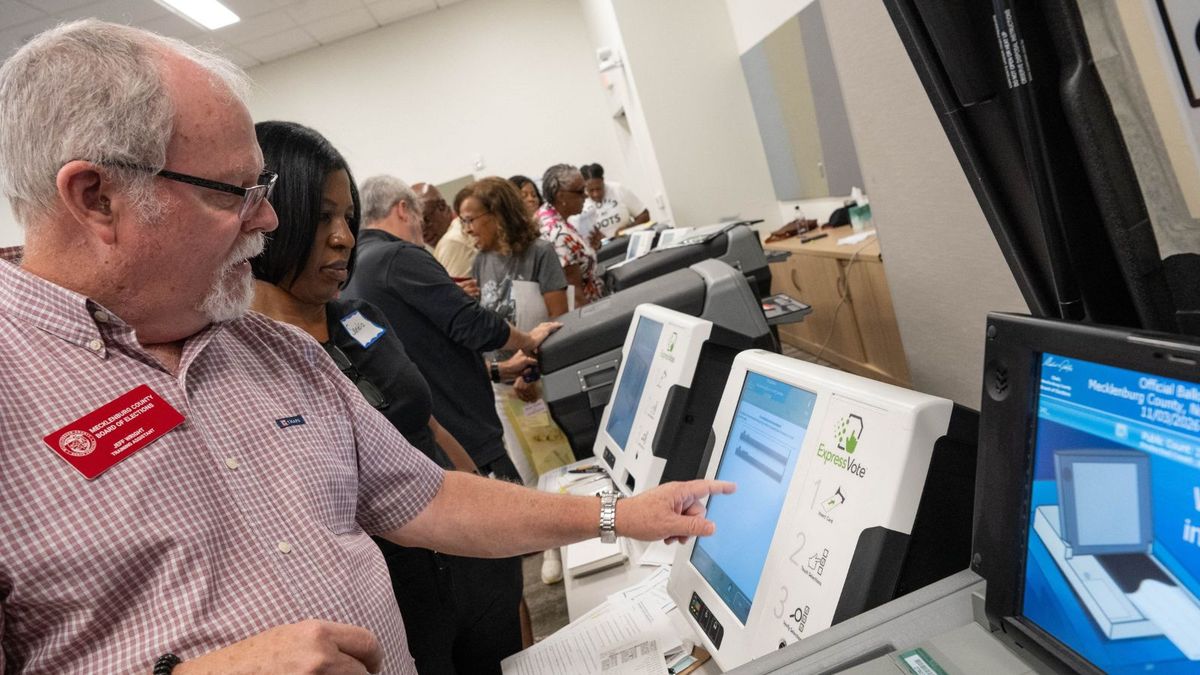
Claim: U.S. election machines in Florida, South Carolina, Tennessee, Texas and potentially other states are deliberately changing voters’ candidate choices in the 2026 midterms. Rating: Snopes has long debunked claims that electronic voting machines in the United States are rigged to switch votes from one candidate to another. During the 2026 midterm elections, these claims spread again as people flocked to the polls for early voting. There is no evidence voting machines were switching votes one way or the other. As some officials told us, these reports were likely the result of human error or touch screen alignment problems. Voting machines undergo extensive testing and election administration in the United States is decentralized, meaning that local and state governments oversee the accuracy of their voting machines. Voting machines are typically closed networks that are not connected to the internet. Each state referenced in claims that Snopes reviewed requires public testing of voter equipment ahead of its use in elections. While each state's standards differ, they each must follow federal standards requiring that voters have "an opportunity to verify the votes selected and correct any errors before casting the ballot." Many of these states also use a paper-record system, meaning a voter will select candidates on an electronic machine and then print their ballots, allowing for further review before submission. With fewer than two weeks until Election Day, rumors spread in late October alleging electronic voting machines across the country were switching votes for Democratic candidates to Republicans in various midterm races. For example, on Oct. 21, users on Facebook (archived), Threads (archived), X (archived) and other social media platforms shared (archived) a copied-and-pasted post reading as follows: There is a very disturbing trend being seen in early voting. Texas, Florida, Tennessee, Ohio are reporting difficulties getting the machines to accept democratic votes. The machines change them back to Republican unless the voter persists, pressing several times to get the correct vote to go through. Check your machine, check to see that it accepted the correct vote. Make sure your voice counts. Stella Parton, a sibling of the late country music star Dolly Parton, alleged in a Facebook post (archived) that one of her vote selections "kept defaulting to Marsha Blackburn," referencing the long-time Republican U.S. senator in Tennessee who is running for reelection. Parton said, "I would never vote for her for anything," adding, "Don't let them rig this election." While our research found no shortage of posts spreading the rumor, we located only a very small number of examples of people who claimed, anecdotally, that they personally experienced a vote-switching issue. Snopes has debunked vote-switching claims since at least 2014; our research found examples of this rumor from as early as 2008. As with previous vote-switching claims, no evidence credibly suggested voting machines were switching votes one way or the other, whether as a software bug or some sort of election fraud scheme. Instead, all available data pointed to either human error or potentially touch screen alignment problems. As such, we have rated this claim as false. Voting machines in the United States undergo extensive testing before use, often in public. Importantly, we have yet to receive information from any state or territory suggesting that a sizable number of voters completely submitted a ballot with incorrect selections. From the data we reviewed, this matter appeared to largely involve people purportedly experiencing temporary issues prior to casting their correct selections. Snopes emailed state election officials in six states at the center of these vote-switching claims to ask about the allegations. None of them shared information suggesting they uncovered proof of any such widespread activity. Some pointed to human error and touch screen calibration, saying voters can review selections and ask for help from a poll worker prior to confirming submission of a ballot. We will update this article if we receive more information, including replies from Parton and county officials. Contextualizing voting conspiracies Claims about "rigged" voting machines often fail to consider the detailed standards and processes that officials, from the local to federal level, use to prepare for U.S. elections, as well as how decentralized the elections process is. In the United States, states and local governments run their own elections and purchase their own voter equipment using their own budgets, making it highly unlikely — if not impossible — to coordinate a widespread conspiracy to "rig" or "steal" an election, especially without leaks to the public. Research from the Bipartisan Policy Center has found that the average voting equipment in the United States is about 7.3 years old as of 2026, indicating that most equipment has been used in previous elections. These machines largely have no connectivity to the wider internet or wireless technology because federal certification requires voting systems to be "air-gapped," or entirely independent. As we've previously said, even in the instances where ballot scanners are connected to anything, it is typically a closed network. Furthermore, while each state may have different requirements, all voting systems must meet a set of minimum standards in the Help America Vote Act of 2002. According to the National Conference of State Legislatures, baseline requirements include "providing voters with an opportunity to verify the votes selected and correct any errors before casting the ballot, the ability to produce a record with a manual audit capacity, and accessibility for voters with disabilities and alternative language needs." In addition, voting systems must have error rates of no more than one error per 10 million ballot positions. Many states also use or mandate use of the federal government's voluntary voting systems standards program, which was updated in 2021. Snopes searched news coverage and online rumors across the country for reports of vote-switching issues. Here's what we found in the states where these rumors appear to be the most popular, as of this writing: Florida On Oct. 21, news station WFOX in Jacksonville, Florida, wrote that "some voters have reported problems with the touch screen on ExpressVote machines." In an email to Snopes, Duval County Elections Supervisor Jerry Holland pointed to human error. Holland said that voters should use the stylus provided. "If they are touching the screen to select, it appears their fingernails can reach the selection above," Holland said. During a video interview with WFOX, Holland specified that voters can check their selections on a printout before submitting the ballot: The ExpressVote fills out your ballot for you. It does not tabulate. And what it also does is, when it fills it out and prints it, you have the opportunity to look. If you see any mistakes on that, you can get another ballot [or] use another machine. Holland also told us that he knew of no reports of voters completely submitting a ballot with incorrect selections, saying, "No one has reported they cast a ballot with wrong selections." Florida's election machine testing system involves public auditing for accuracy, and detailed certification memos for each election machine the state uses are available on the state's Division of Elections website. Kansas On Oct. 22, the Kansas City Star reported that Johnson County, Kansas, Election Commissioner Connie Schmidt acknowledged that officials recalibrated several touch-screen voting machines after receiving reports from election judges about voters raising concerns regarding their selections. In an email, Schmidt told us that officials have heard directly from three voters reporting concerns with a ballot marking device, and that "all three reports were received after the voter had already cast their ballot and left the polling place." She continued: "We have also received five calls from Early Voting locations where a Supervising Judge reported that a voter raised a concern while making their selections. In each instance, a technician responded, recalibrated the screen and verified the accuracy of the touchscreen." Schmidt also sent us a graphic displaying how best to use the voting machines: (Johnson County Election Office) Kansas requires that voting equipment "shall never be connected to the internet." The state also tests the equipment ahead of the election in front of the public (Page 5). Ohio Although a popular copied-and-pasted post warned social media users about vote-switching issues in Ohio, we found no news reports from Ohio suggesting that voters have come across this problem, at least as of this writing. In a post on Facebook, Ohio's secretary of state called the rumors about vote-switching "intentional election disinformation." The post noted that Ohio law requires voting equipment testing and a bipartisan post-election audit. Furthermore, like the other states listed here, votes in Ohio are printed from election machines onto paper ballots, which voters can then review. South Carolina Sydni Bain, a spokesperson for the South Carolina Election Commission, told us that her office has commonly received reports of voters having trouble making selections during past elections, especially in years with high turnout rates. She said voters can review their selections, including with a printout, prior to fully submitting their ballots. When a selection is made, it is very apparent. The box beside the selection is checked and the block containing the selection is highlighted. Voters should pay attention to ensure these selections reflect their wishes. Voters should also carefully review their selections on the ballot review screen before printing their ballot to confirm their choices are accurately reflected. If a selection is not correct, the voter can navigate back through the ballot at any time to change selections. After printing the ballot, the voter should carefully review their paper ballot before putting it in the ballot scanner. South Carolina's state election commission also has released a video showing how to use the paper-based system. State law requires voting systems to disable connection to the internet when used for elections and the preservation of all electronic records for no less than 24 months following the election. Voting machine testing is open to the public. Tennessee In Tennessee, residents in Williamson and Madison counties have reported issues with ballot selections. WSMV, an NBC affiliate, interviewed two voters who experienced issues at different Williamson County election machines with choosing their candidates. One of the voters, Jackie Herrud, said she was attempting to vote for a Democratic candidate, Jerri Green, over Blackburn — the same specific problem Parton experienced. However, WSMV reported that the Tennessee secretary of state's office said that out of approximately 400,000 early votes cast, the office had received only one complaint related to this issue. Williamson County Election Administrator Chad Gray said the county has found "no discrepancies in the voting equipment." "If we are made aware of any issue reported, even related to any unintended touch on the screen, the ballot marking devices are examined by the officials representing each party to ensure they are working properly," Gray said. Gray said he recommends that voters use a stylus if they have trouble with the touch screen and, when making selections, "to touch the middle of the center of the rectangle containing the candidate's name or desired choice." Poll officials, Gray said, are always available to answer questions or help if voters have trouble with the equipment. In Madison County, NBC affiliate WNBJ reported that several community organizations had received complaints about election machines "changing some votes." Madison County Administrator of Elections Lori Lott told the outlet that the machines undergo extensive testing, including by "both Republicans and Democrats" who are experienced machine techs appointed to the elections board. Tennessee's secretary of state's office did not immediately return a request for more information. We are also awaiting responses from the counties involved. Tennessee, like some of the other states listed, uses electronic voting machines that print a paper ballot for voters to review before casting a formal ballot. The state's government provides instructions for voting using each kind of machine. Tennessee law requires the election commission to notify local political parties' committees and independent candidates when the machines are examined. They can then designate a representative to be present during testing to ensure the machines are "properly prepared for use in the election." The state also requires county commissioners to publicly test the machines. Texas Alicia Pierce, a spokesperson for the Texas secretary of state's office, said in an email that she was "not aware of anyone reporting this experience to our office." Similar to other states, Pierce said Texas election machines print paper ballots after a voter makes electronic selections. The state encourages voters to review the physical ballot before casting it. In 2022, the Texas Tribune debunked claims that electronic voting machines had switched people's votes from Democratic to Republican candidates: But this isn't a case of grand conspiracy, malfeasance or rigged machines. Instead, election officials, security experts and voting rights advocates say some of the touch-sensitive screens on voting machines can be tricky to use, much like miscues while trying to use a smartphone. Midland County Election Administrator Carolyn Graves likened the experience to texting with a small keypad. "If you don't hit it just exactly right, you're gonna hit one of the letters around it," Graves said. "It's essentially the same thing. If you don't hit it with the tip of your finger or turn your finger to the side, then you could hit the other [choice]." The Tribune also interviewed Dan Wallach, a computer science professor and election security researcher at Rice University, who reportedly said these issues have existed since electronic voting machines were introduced more than two decades ago. "As far as we can tell, these are simply design issues with the machines," he told the Tribune. Texas does not connect its voting systems to the internet at any point in time, and the machines undergo testing in front of the public.
Voting machines aren't deliberately switching votes. Here's what's likely happening
Full Article
Original Source
Read the full article at Snopes →KhanList aggregates and links to publicly available news content. We do not host full articles from third-party sources. Always verify important information with original sources.