
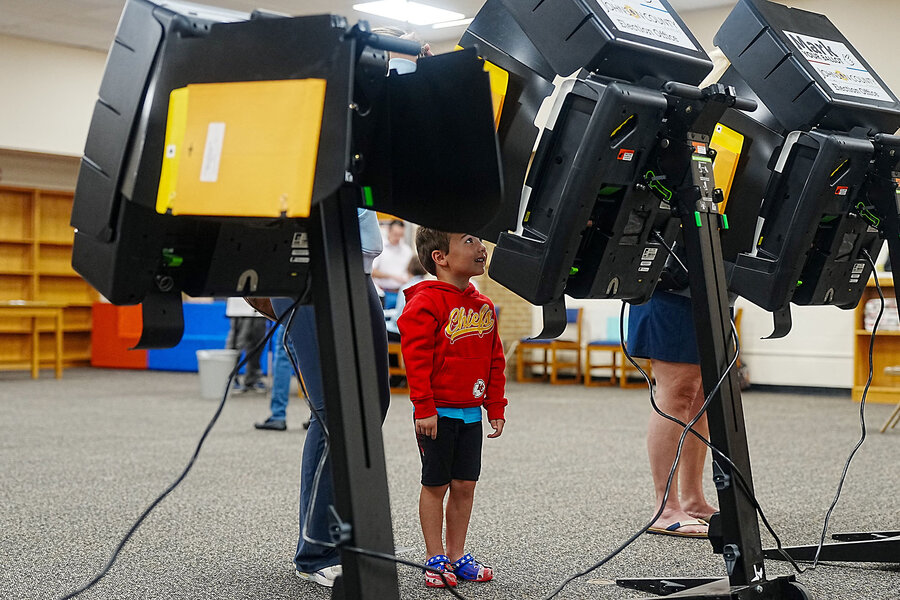
As American voters turned out in high numbers on Election Day to hand Democrats control of Congress, they also cast their votes for ballot initiatives from Colorado to Missouri to North Carolina.Despite Democratic candidates emerging victorious in races in deep-red bastions like Texas and South Carolina, some conservative policies on state initiatives saw strong results.Some policies favored by President Donald Trump – such as requiring photo or government identification to vote – proved popular in traditionally red states such as Kansas, where Democrats nevertheless will send a senator to Washington for the first time in nearly a century. A host of other states also explicitly barred noncitizens from voting, showing strong support for another of Mr. Trump’s policy priorities. “We didn’t see a huge lurch to the left on ballot propositions,” says John Matsusaka, executive director of the Initiative and Referendum Institute at the University of Southern California. “Voters haven’t changed very much in terms of what they’d like the country to do. They just have really soured on Republicans being able to do that.”Voters were slated to decide 145 measures in 39 states concerning transgender rights, abortion, partisan redistricting, and voting rights. Results are still rolling in nationwide; the outcomes in a handful of measures considering how much to tax the wealthy, and some on transgender rights, have not yet been called. Here’s a look at where things stand now.Voting rights and redistrictingExplicitly banning noncitizens from voting in state elections proved resoundingly popular. Voters in South Dakota, Kansas, Arkansas, West Virginia, and Alaska all passed such measures with margins exceeding 60%.It is already illegal for noncitizens to vote in state and federal elections. State audits have long shown that noncitizen voting does happen but is exceedingly rare, and there is no evidence to suggest it has ever changed an election’s outcome. Lindsey Wasson/APVoters leave the polling station at the Hope Retreat Center after casting their ballots on Election Day, Nov. 3, 2026, in Hope, Alaska. Alaskan voters passed a ballot measure explicitly banning noncitizens from voting in state elections. Laws requiring photo or government identification for voting had more mixed success. The measures passed in Nevada, Ohio, and North Carolina, but failed in Colorado and California. Arizona was still counting votes on a similar measure as of the morning of Nov. 5, according to The Associated Press, but so far, more than 53% of voters have rejected the policy, with 86% of the vote counted. Missourians rejected a measure that would have allowed a redrawn congressional map intended to break Democrats’ hold on Kansas City to go into effect. The measure failed by a 24-point margin.Campaign financeMeasures restricting campaign donations received bipartisan endorsement from voters, succeeding both in ruby-red Montana and in purple Michigan. Tommy Martino/APDavid O'Hern casts his ballot at Station #5 Petty Creek on Election Day in Petty Creek, Montana, Nov. 3, 2026. Voters in Montana passed a ballot measure banning “artificial persons” from donating to campaigns. Montana’s Initiative 194 bans “artificial persons” from donating to campaigns. The measure attempts to work around the Supreme Court’s landmark ruling in Citizens United v. Federal Election Commission, which opened American politics to vast spending from corporations, and potentially sets up a legal battle. Michigan’s narrower policy bans contributions from certain utility companies and those who receive more than $250,000 worth of state contracts annually.AbortionIn Idaho, residents voted down a measure that would have legalized abortion until fetal viability, rejecting a policy that has proven popular in other typically Republican-dominated states such as Montana, Ohio, and Kansas. Idaho currently bans abortion in nearly all circumstances and makes it a crime for healthcare professionals to perform them.Missourians, on the other hand, spurned an initiative to repeal a constitutional amendment that legalizes abortion until fetal viability, voting for the second time in two years to allow access to the procedure. Measures to enshrine abortion access in state constitutions also succeeded by wide margins in Virginia and Nevada, where the procedure is already legal. About 60% of Americans say abortion should be legal in all or most circumstances.Transgender rightsMeasures requiring student athletes to play on teams that match their sex at birth netted comfortable majorities in Arizona (58%) and Nebraska (68%).A similar measure in Washington that also requires those seeking to play on female sports to submit documentation from a healthcare provider verifying their sex passed with more than 56% of the vote. As of the morning of Nov. 5, Colorado’s measure about prohibiting transgender girls from playing on female athletic teams was too close to call, with votes in favor currently at 52%. Conservatives have seen the initiatives in those blue states as tests of whether voters in Democratic strongholds support policies limiting participation of transgender students on girls’ and women’s sports teams at public schools and universities. Deepen your worldviewwith Monitor Highlights.Politics with respectGet political stories with respectful analysis.There‘s a world of new ideas in everyBooks newsletter.There‘s more to life, enrich yours withCulture & Learning weekly.Follow humanity‘s discoveries withScience & Nature stories in your inbox.Gain a spiritual perspectivefrom the stories in your inbox.Want to understand the deeper impact of critical events? Learn the Monitor‘s insight.Already a subscriber? Log in to hide ads. Missourians solidly rejected a measure that, along with banning abortion, would have prohibited surgery and hormone treatment for gender transitions for minors. A second initiative in Colorado that would ban surgery but allow hormone treatment was too close to call, with 86% of the vote counted and “yes” leading by over 4 points.Wealth and income taxesOn the morning of Nov. 5, states were still counting votes on a handful of measures that would change how much they tax their wealthiest residents amid rising concerns about inequality and the cost of living.With 61% of the vote counted, 55% of voters had so far rejected California’s Proposition 40. The measure would impose a one-time, 5% tax on billionaires and has precipitated an expensive opposition campaign. By contrast, voters in Washington appear on track to reject efforts to overturn a state tax on millionaires. Almost 58% of Washington’s voters have so far rejected a measure to repeal the state’s recently passed 9.9% tax on household incomes exceeding $1 million. About 68% of the vote has been counted in that race. ALREADY A SUBSCRIBER? LoginReal news can be honest, hopeful, credible, constructive.The Christian Science Monitor was founded in 1908 to lift the standard of journalism and uplift humanity. We aim to “speak the truth in love.” Our goal is not to tell you what to think, but to give you the essential knowledge and understanding to come to your own intelligent conclusions. Join us in this mission by subscribing.
Voters swept Democrats in, but on ballot measures some conservative issues prevailed
Full Article
Original Source
Read the full article at Csmonitor →KhanList aggregates and links to publicly available news content. We do not host full articles from third-party sources. Always verify important information with original sources.