
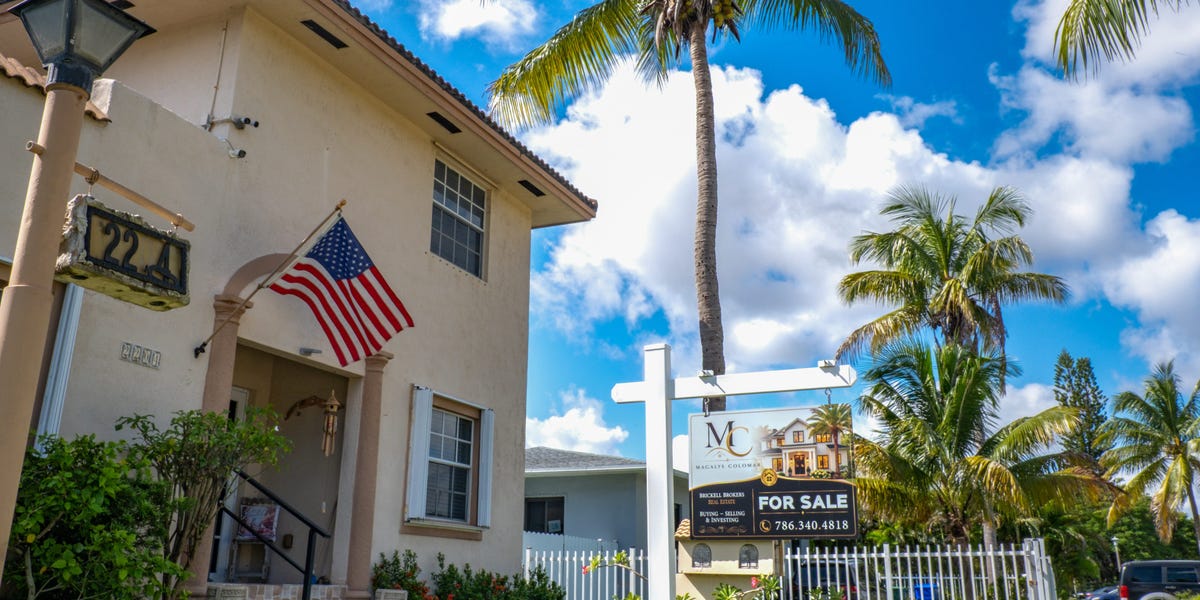
Voters really, really don't like property taxes Florida voters gave themselves a property tax break. Nicole Combeau/Bloomberg via Getty Images On Election Day, real estate agent Christopher Wands got a $2.3 million offer on a luxury condo in Miami.It came from a Chicago family interested in relocating to Florida. They wanted an answer that night and had a condition: They needed to close in 30 days.There was one surprising factor in the family's rush to close — this week's midterm elections and a big change to how Florida taxes homes. "They want to achieve the exemption," Wands said.Florida passed a property tax exemption Tuesday night that applies to people who were state residents in 2026; move to Florida after that and you'll have to wait five years for a tax break.Florida's Amendment 3, which passed by a wide margin, doubled the homeowner tax exemption to $100,000. It'll grow to $150,000 in 2027 and $250,000 in 2028. However, for those who buy next year, that larger exemption only applies once they've been in their houses for at least five years, with newer owners getting a smaller break."Think of Amendment 3 as a big coupon," Wands said. "It doesn't matter how rich you are. People like to save money."The Florida amendment is the latest move in a generational game of tax hot potato. Across the country, America's homeowners, who are generally older, have voted to give themselves property tax breaks. State and local governments will need to either make up the lost revenue by raising sales, income, and other taxes, or cut services such as education or fire coverage. Younger workers and renters would likely feel the burden of those non-property taxes more than entrenched older homeowners.Voters across several states said "no" to raising taxes on their real estate. In North Carolina, voters gave the state assembly power to limit property tax increases, and Louisiana voters opted to give older residents property tax breaks. Tennessee will amend its state constitution to prevent the legislature from imposing a property tax, and Texas municipalities rejected billions in new property taxes.In Florida, homestead property taxes are the largest source of revenue for local governments, according to the Tax Foundation; Amendment 3 is projected to cost them $4.9 billion in its first year, per the Tax Foundation's analysis, and could become an $8.7 billion hit when the exemption is increased in its second year. In 2025, school districts, counties, and municipalities collected more than $59 billion in property taxes, according to the Florida Department of Revenue. "Over time, this reduces the amount that Florida can collect from homeowners, particularly from long-time homeowners who also get the benefit of Florida's Save Our Homes assessment limit, which reduces the taxable value of their property," Jared Walczak, a senior fellow at the Tax Foundation, said of Florida's new tax regime. "This shifts much more of the burden to newer homes, newer homeowners, to renters, to commercial property."He also expects that Florida's move will create copycats."The fact that it passed in Florida, where a lot of people are paying attention, is likely to mean that lawmakers and organizations may try to get similar measures either before legislatures or on ballots in other states," Walczak said. "But I think voters overall across the country struck a tone of caution."But changing tax burdens may not move the needle on Florida's home prices, said Peggy Olin, CEO of Florida brokerage OneWorld Properties."I wish real estate worked that way," Olin said. "But let us keep it in perspective: nobody with any sense buys a home for a tax break." Read next Business Insider tells the innovative stories you want to know Business Insider tells the innovative stories you want to know Business Insider tells the innovative stories you want to know Business Insider tells the innovative stories you want to know Alex is a reporter at Business Insider writing about how people, from billionaires to penny-pinchers, save, invest, and manage their money. He previously covered private credit and equity, real estate, and real estate technology for Business Insider.Recently, he's covered Steve Schwarzman's hidden family office, private capital's push into your retirement account, a massive Airbnb tax-break unlocked by President Trump, and the ex-McKinsey consultant connecting Zohran Mamdani to the business world. According to one Fortune 500 CEO, he's a "fringe reporter."Before joining Business Insider in 2019, he worked for Bridgewater Associates and Peloton. He is the interim vice-chair of the Insider Union.He welcomes any and all reachouts, prioritizes his source's safety, and has a long record of working with confidential sources to tell deeply reported, complicated stories. He loves to yap.Get in touch! Contact this reporter via encrypted messaging app Signal at @alexnicoll.01 using a non-work phone, email at anicoll@businessinsider.com or alexonicoll@protonmail.com, or Twitter DM at @nicollsanddimes. Madeline Berg is a correspondent at Business Insider, where she covers the wealthy, famous, and powerful. Her stories include analyses of some of the most well known billionaires, from Mark Zuckerberg to MrBeast, investigations into celebrity brands, and deep dives into figures like Jeffrey Epstein and Leon Black.Previously, she was at Forbes. Her work included cover stories on Tyler Perry and Shonda Rhimes, investigations into Kylie Jenner's beauty brand, and deep dives into Britney Spears' fortune. Madeline has also written for The New York Times, The New York Observer, and Racked. She regularly appears on panels, on television, and in documentaries discussing the entertainment industry and general business news.Contact her via email at mberg@insider.com or by phone, Signal, or WhatsApp at 914-420-4721. https://www.businessinsider.com/secure-news-tips. Economy Real Estate
Voters really, really don't like property taxes
Full Article
Original Source
Read the full article at Businessinsider →KhanList aggregates and links to publicly available news content. We do not host full articles from third-party sources. Always verify important information with original sources.