
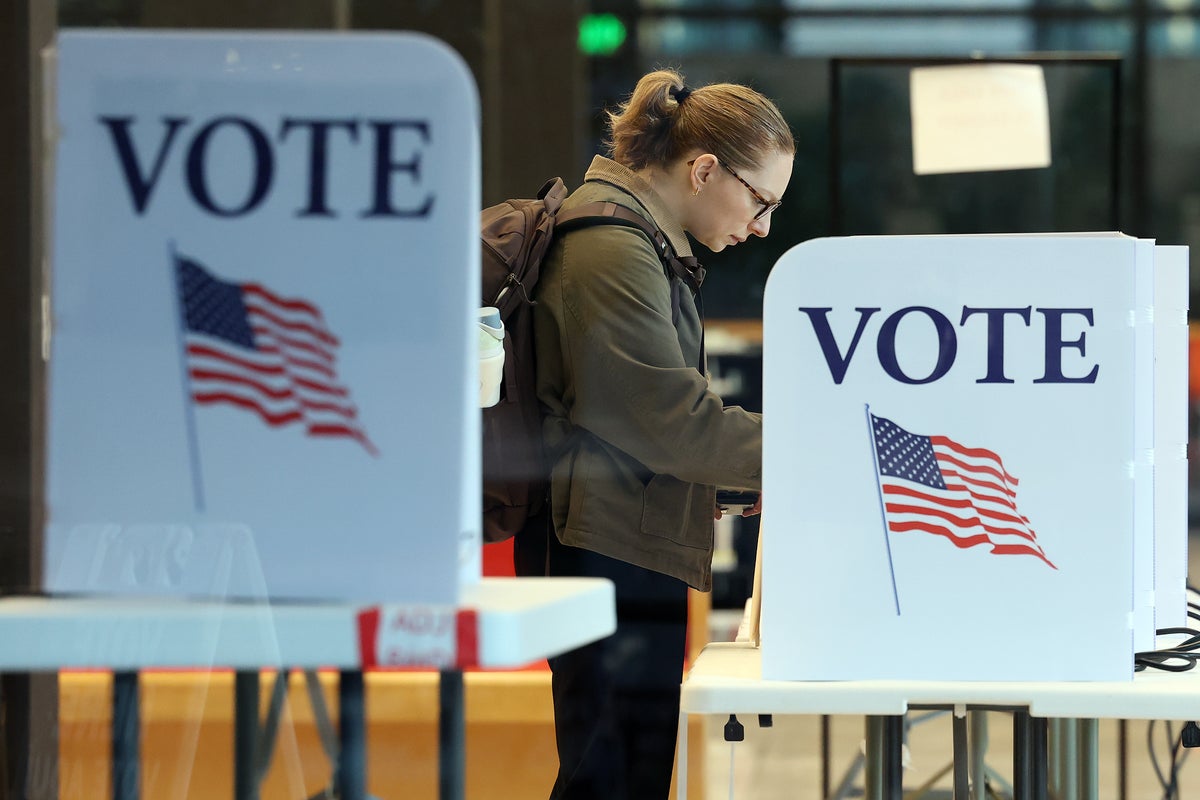
Voters in more than three dozen states weighed 145 ballot questions on Tuesday, delivering a double dose of disapproval to President Donald Trump’s redistricting efforts.Abortion-rights advocates notched victories in Missouri and Virginia.The ballot measures provided a political undercard for a high-profile midterm election that was determining which party controls Congress, state legislatures and gubernatorial offices in many states.Abortion-rights advocates notched victories in Missouri and Virginia on Tuesday, and voters delivered a double dose of disapproval to President Donald Trump’s redistricting efforts (Getty Images)Some of the questions put Trump’s priorities to a public test.They gauged support for his attempts to redraw congressional districts, limit transgender athletes in sports and strengthen voter identification requirements.Voters in Missouri stand by abortion rights, defeating a GOP-backed amendment to reinstate restrictionsMissouri voters have rejected a constitutional amendment that would have tightened abortion rules across most of the state.The result on Tuesday reaffirms the choice the state's voters made two years ago, when they became the first in the nation to undo an existing abortion ban by approving an abortion-rights amendment.The Republican-led Legislature had referred a new, less restrictive version of an abortion ban to this year's ballot.People at an election night watch party react after an abortion rights amendment to the Missouri constitution passed (AP)Under the measure, abortions would have been allowed only for medical emergencies and fetal anomalies, or in cases of rape or incest up to 12 weeks of pregnancy.It would also have amended the constitution to prohibit certain medical procedures for transgender minors.Abortion-rights advocates, led by national progressive groups, heavily outspent abortion foes in a successful campaign to defeat the ballot measure.In Virginia, a separate measure creates a “ fundamental right to reproductive freedom ” in the state constitution, ensuring that abortions can occur during the first two trimesters of pregnancy.The amendment also creates a right to contraception and fertility care, among other things.Since the U.S. Supreme Court overturned a nationwide right to abortion in 2022, voters in more than one-fifth of the states have passed ballot measures protecting abortion rights.Ballot measures in Idaho and Nevada would block bans on abortion before fetal viability, usually considered after 21 weeks.Nevada voters already approved the measure once, but they must approve it a second time for it to become official.Missouri rejects Republican-drawn congressional map as Maryland clears path to redistrict in 2028 Voters in Missouri rejected new congressional districts drawn up to help Republicans win an extra House seat, halting a mid-decade redistricting push encouraged by Donald Trump.Republican lawmakers in the state adopted the new House districts last year to gain an additional seat in the Kansas City area.Opponents responded by gathering petition signatures to put the map to a public vote.Voters in Missouri rejected new congressional districts drawn up to help Republicans win an extra House seat, halting a mid-decade redistricting push encouraged by Donald Trump (Getty)The districts were used in the August primary.But courts later ruled they could not be used again unless voters first approved them in a November referendum.On Tuesday, voters ended the new map by rejecting the redistricting legislation.Missouri is one of nine states using new congressional districts in the midterm elections, after a rare spate of mid-decade redistricting encouraged by Trump.In Democratic-led Maryland, voters approved a constitutional amendment that could pave the way for new congressional districts in 2028.Democratic proponents, backed by former President Barack Obama, had urged a “yes” vote as a way to “stop Trump.”Some Democrats also want to redistrict in Colorado.Florida voters pass sweeping property tax cuts over objections from local officialsFlorida homeowners are set to see a large share of their property tax bill disappear after an amendment passed on Tuesday.Local governments could be left hunting for revenue to replace the money.The change was referred to the ballot during a special legislative session called by Republican Gov. Ron DeSantis.Ron DeSantis backed the property tax cut in the Sunshine State (Getty)It stood out among the many property tax proposals put forward this year, a period in which numerous politicians floated ways to give residents relief from high costs.Under current Florida law, the first $50,000 of the value of a person's permanent residence is exempt from many property taxes.That exemption will triple next year for non-school taxes.It will then rise to $250,000 in 2028.Some local officials warn the measure could lead to cuts to police and fire departments, public libraries and parks.Nebraska locks in transgender healthcare restrictions with approval of constitutional amendmentNebraska has voted to write its existing restrictions on transgender medical care into the state constitution.Voters approved the amendment.Ballot measures on transgender issues were also before voters in Arizona, Colorado and Washington.Protesters chant as they are heard in the legislative chamber during a final reading on a bill that combined a 12-week abortion ban with a measure to restrict gender-affirming care for people under 19, May 16, 2023, at the state Capitol in Lincoln, Nebraska (Lincoln Journal Star)Those measures target transgender athletes or medical procedures.The push at the state level comes as Donald Trump's administration has been seeking restrictions affecting transgender people, with a particular focus on youth.Most states led by Republicans already prohibit transgender women and girls from playing on female school sports teams.In Colorado and Washington, both Democratic-led, citizen-led ballot initiatives propose similar restrictions.California and Colorado reject voter ID proposals while Ohio voters approve stricter rulesVoter ID measures fared badly with voters in California and Colorado, while an Ohio measure passed and a North Carolina proposal was leading.The California amendment, which was defeated, would have required voters to show a government-issued ID in person or provide the last four digits of that identification number when voting by mail.Most Californians cast their ballots by mail.A sign instructs voters about the state's voter ID law a a polling place inside the Community of Christ church on November 03, 2026 in Council Bluffs (Getty)Opponents of the amendment campaigned successfully against it by linking the measure to Trump.Colorado voters also rejected a voter ID measure, which would have required people voting by mail to include the last four digits of a government-issued identification number.Trump's push for nationwide voter ID mandates remains stalled in Congress.Citizen activists bypassed Democratic-led state legislatures in California, Colorado and Nevada to place new voter ID requirements on the ballot.In Ohio and North Carolina, Republican-led legislatures referred measures to the ballot that would enhance existing voter ID requirements by placing them in the state constitution.Voters across multiple states reject legislative efforts to curb direct democracy and citizen initiatives Missouri voters were favoring an amendment that would make it harder for lawmakers to change voter-approved citizen initiatives.Under the measure, revisions would need an 80% vote in the state House and Senate.In the Dakotas, voters defeated ballot measures that would have made it harder to amend the state constitutions in both North Dakota and South Dakota.Those measures would have required 60% approval from voters to change the constitutions, instead of a simple majority.Utah voters also rejected a measure at the ballot box. It would have required a 60% threshold to pass citizen initiatives that raise taxes.Arkansas, Kansas, South Dakota, and West Virginia pass symbolic ballot measures restricting voting to US citizensVoters in Arkansas, Kansas, South Dakota, and West Virginia approved constitutional amendments restricting voting to US citizens.The measures reinforce current election practices in those states.Arizona had a similar amendment on its ballot.President Trump, who has repeatedly and baselessly insisted that US elections are riddled with widespread fraud, has pushed lawmakers to pass the SAVE America Act, which would require new voters to show proof of citizenship (Getty Images)In Alaska, voters approved a ballot question allowing citizens to vote.Noncitizens are already forbidden from voting in federal elections, and voting by noncitizens is rare, critics of the measures say.Those critics argue the measures are largely symbolic and unnecessary.Some local elections do allow noncitizens to vote in California, Maryland, Vermont, and the District of Columbia.Proposed Colorado amendment would require police to alert federal agents over violent crimesConservative activists have placed a proposed constitutional amendment on the ballot in Colorado that would chip away at state laws restricting cooperation with federal immigration agents.The state is Democratic-led, and the measure, if passed, could boost Donald Trump's immigration enforcement efforts.Colorado is Democratic-led, and the measure, if passed, could boost Donald Trump's immigration enforcement efforts. (Getty)Under the proposal, law enforcement officers would be required to notify the U.S. Department of Homeland Security when someone with an illegal or unknown immigration status is charged with a violent crime.The notification requirement would also apply when such a person faces a new charge following a prior felony conviction.Arizona voters decide the fate of traffic cameras after lawmakers bypass governor's vetoA proposal to restrict traffic cameras used to catch speeding drivers and red-light runners is on the ballot in Arizona.The measure would stop new contracts for traffic camera systems from 2027.Local governments would also have to put the future of existing systems to a vote.The Republican-led Legislature referred the proposal to voters after Democratic Gov. Katie Hobbs vetoed a ban on the cameras.Hobbs said the cameras enhance roadway safety.Opponents contend they infringe on people's privacy and point to instances of misuse by certain law enforcement officers.About half the states, including Arizona, have communities that use cameras to enforce speeding or traffic signal laws, according to the Insurance Institute for Highway Safety.
Voters deliver fresh abortion wins and deal sharp blow to Trump agenda across 145 state ballot measures
Full Article
Original Source
Read the full article at Independent →KhanList aggregates and links to publicly available news content. We do not host full articles from third-party sources. Always verify important information with original sources.