
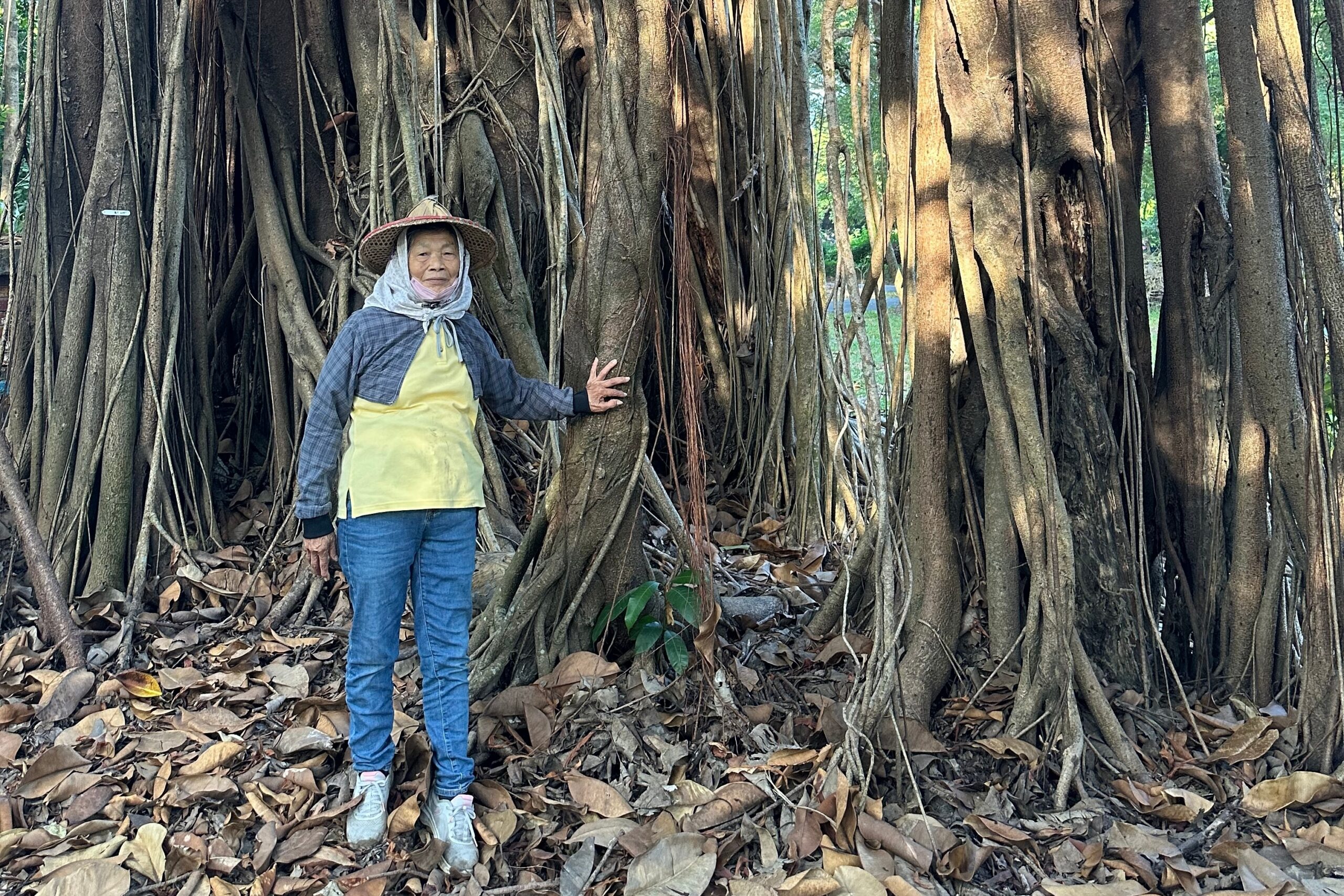
In Kaohsiung’s Ciaotou district, a community is fighting an urban development project that threatens a 154-hectare (380-acre) woodland surrounding the former Ciaotou Sugar Refinery.After failing to find politicians to support their fight, they turned to an 83-year-old former factory worker to defend the Ciaotou Woodland, which provides habitat for local wildlife and helps protect the area from flooding.Chiang Huang-nu, nicknamed Forest Grandma, is running as an independent candidate in Taiwan’s local elections, with a campaign slogan: “Vote for trees, not for political parties.”The push for the development is tied to the growth of the semiconductor industry in southern Taiwan, with the project set to convert a large swath of land around the historic factory into commercial and residential zones for high-tech businesses and their workers. KAOHSIUNG, Taiwan — At dawn, just as the birds begin to sing, Chiang Huang-nu usually puts on her traditional straw hat and walks through the wooded grounds of a former sugar factory in Ciaotou district in southwest Taiwan. Along the way, the 83-year-old might greet around 30 other regular strollers, most of them retirees. Chiang has taken these morning walks among the greenery since she was a child. For the past several months, the walk has involved chatting with fellow community members about the community’s fight against the government’s plan to redevelop the area and demolish their beloved wood. For decades, Chiang and fellow residents have spent their mornings in the Ciaotou Woodland, a 154-hectare (380-acre) urban forest surrounding the historic Ciaotou Sugar Refinery. Located in the eponymous district, north of Kaohsiung city center in southwestern Taiwan, the woodland is home to 100,000 trees, according to local environmentalists, and a habitat for local wildlife. “Some of the trees were planted during the Japanese colonial period,” which lasted from 1895 to 1945, Chiang told Mongabay. “They are more than 100 years old. They protect us from the heat in summer.” For the past year, however, residents can only walk in the nearby park. The woodland has been fenced off and made inaccessible to the public, following a government order. Its trees are under threat from the urban redevelopment project. On a November morning, three elderly men in their 70s were sitting on plastic chairs in the middle of the park, sheltered from the sun by the trees. “I would rather see this place preserved, but what can we do against the government’s decisions?” said one 77-year-old man. His two companions nodded in agreement. Three regular morning walkers sitting in the Ciaotou Sugar Industry Culture Park in Ciaotou district, Kaohsiung, Taiwan, on Nov. 12, 2026. Image by Aylin Ho for Mongabay. Kaohsiung city councilor candidate Chiang Huang-nu, also known as Forest Grandma, stands in front of the fence surrounding the Ciaotou Woodland in Ciaotou district, Kaohsiung, Taiwan, on Nov. 12, 2026. Image by Aylin Ho for Mongabay. Faced with such powerlessness, residents have found a glimmer of hope and a figure of resistance in Chiang. The octogenarian, nicknamed “Forest Grandma” for her passion for protecting the woodland, is running in Taiwan’s local elections on Nov. 28. She is contesting a city council seat in Kaohsiung, the island’s third most populous city. Her only manifesto policy is to protect the wood. Her slogan is “Vote for trees, not parties.” “Of course I’m going to vote for her,” a 70-year-old resident, who only gave her surname, Tsai, told Mongabay. “If you destroy this forest, what will we have left? We won’t have anywhere to go for a walk.” Like Chiang, other morning residents on the morning walk come from working-class families. Either they themselves, their parents, or both were employed by the factory, which began operating in 1902. After the sugar refinery ceased operations in 1999, the surrounding area was transformed into a vast woodland. For around 15 years, the old woodland became a place for many residents from Ciaotou and nearby districts to walk in the mornings or to hike or cycle on weekends. The Ciaotou Woodland in Ciaotou district, Kaohsiung, Taiwan. Image courtesy of Forest City Association, Taiwan. Forest Grandma has no formal education and is illiterate. She does not speak Mandarin, the official language in Taiwan, and communicates only in Taiwanese Hokkien, the language spoken by descendants of early immigrants from China’s Fujian province who moved to Taiwan centuries ago. Born into a poor farming family in 1943, during the Japanese colonial rule, she was given a Japanese name, Tamako. Her current name, Huang-nu, was registered after the Nationalist government retreated to Taiwan in 1949, following a civil war in mainland China. For Chiang Huang-nu, who worked at the Ciaotou Sugar Refinery for years, her political involvement did not stem from an electoral ambition but from a long-standing attachment to a place she has known since her youth. “Destroying this forest means destroying my entire life,” she said. The idea for her candidacy came from her son, Chiang Yao-hsien, also known as Jungle Chiang. The 68-year-old is a heritage and environmental activist. In 2001, two years after the Ciaotou Sugar Refinery was shut down, he turned the complex into an artists’ village, where his mother volunteers to work as a sweeper. “My mother is popular in the area,” Chiang Yao-hsien told Mongabay. “Her background as a former factory worker speaks to an entire generation. I knew she could bring people together around our cause. So I encouraged her to run.” Large-scale urban forest In 2007, APEC nations made a regional commitment to increase forest cover by 20 million hectares (50 million acres) by 2020. Taiwan pledged to contribute to this goal by increasing its reforested areas by 11,550 hectares (28,540 acres). As part of the commitment, a woodland was planted near Tienpao River in Ciaotou between 2010 and 2012. Environmentalists praise the woodland as a rare example of a large-scale urban forest in Kaohsiung. “These trees are not even 20 years old, and today, while we continue to take part in APEC meetings, the authorities are considering destroying this forest for a real estate and land development project,” said Chuang Chieh-jen, chairperson of the Forest City Association, Taiwan (FCAT). According to environmentalists, the development would threaten the habitats of fireflies and at least eight protected bird species in Taiwan, including the crested serpent eagle (Spilornis cheela), ring-necked pheasant (Phasianus colchicus), Asian emerald dove (Chalcophaps indica), collared scops owl (Otus lettia) and black-naped oriole (Oriolus chinensis). The crested serpent eagle (Spilornis cheela) is a protected species in Taiwan. Image by gwyn0429 via iNaturalist (CC BY-NC 4.0). Both Chuang and Chuang Huang-nu have also raised concerns that removing the trees would weaken the district’s flood resilience. Some recall that before the woodland existed, Tienpao River would overflow and flood their homes. The Taiwanese government had plans to construct a new town in Ciaotou as early as 1994. In the first phase, it built a residential district in Ciaotou. In the second phase, it constructed a science and technology park, which opened in early 2026. The push for the third phase is related to the growth of the semiconductor industry in southern Taiwan, which received a boost with the “Southern Silicon Valley” project approved by the central government last year. The 227 hectares (561 acres) of land around the former sugar factory, including the woodland, will be converted into commercial and residential zones for high-tech businesses and their workers. It will also build roads connecting Phases 1 and 2, including a 60-meter-wide (197-feet-wide) thoroughfare that will cut through the forested area. In response to Mongabay’s query, the National Land Management Agency (NLMA), under the Ministry of the Interior, said that a significant part of the wood is considered artificial forest rather than natural forest. The agency does not say how many trees will be felled but promises that some trees will be preserved or transplanted. “Around 3,500 new trees are therefore planned to be planted, prioritizing species suited to their environment and benefiting from long-term sustainable maintenance,” the NLMA said. Both residents and green groups, however, say the solution cannot replace the existing trees and the ecosystems that have developed around them. “Some people say that this area used to consist of agricultural land and that it is therefore not really a forest,” Shang Yun-hsun, Forest Grandma’s 16-year-old grandson, told Mongabay. “But this argument does not make much sense. Can’t these planted trees form a forest? Today, it is a habitat for many species.” Kaohsiung city councilor candidate Chiang Huang-nu, front row fourth from right, and her supporters, including Forest City Association chairperson Chuang Chieh-jen, second from right, and her son Chiang Yao-hsien, third from right. Image courtesy of Forest Grandma Chiang Huang-nu. Population decline Chuang also rebutted the government’s claim that the third phase was necessary to accommodate more people in Ciaotou, pointing out that residential units built for around 76,000 people in previous phases remain largely unoccupied. According to projections by the National Development Council, Taiwan’s population could fall from 23.2 million in 2026 to 12.15 million in 2075. Kaohsiung’s population has been declining for 10 consecutive years. “Under these circumstances, is it really necessary to destroy around a hundred hectares of forest to turn them into building plots for housing?” said Chuang, who has initiated the “Save the Hundred Hectare Forest” movement. On March 21, the grassroots campaign organized a World Forest Day rally in the Ciaotou Woodland, attended by more than 1,000 people, Chuang said. Around 5,000 Kaohsiung residents and 60 civic groups signed a petition to save the forest. More than 1,000 people attend the World Forest Day rally in Ciatou district, Kaohsiung, Taiwan, on March 21, 2026. Image courtesy of Forest City Association, Taiwan. However, they didn’t get support from local politicians, with ward chiefs backing the development plan. Chuang and Chiang Yao-hsien tried unsuccessfully to convince election candidates to include forest protection in their manifestos. Then, they turned to Chang Huang-nu. When Forest Grandma registered her candidacy in September, she became the face of the movement. “Our demands have taken on a new dimension thanks to Forest Grandma,” Chuang said. The two main parties, the governing Democratic Progressive Party (DPP) and the opposition Kuomintang (KMT), are running a tight race in Kaohsiung. “I won’t hide from you that this 83-year-old woman is frightening her opponents,” her son, Chiang Yao-hsien, said. The DPP and the KMT, he said, “are spending millions of New Taiwan dollars on their campaigns and fear that my mother might take votes away from them, which could tip the election results.” Kaohsiung city councilor candidate Chiang Huang-nu takes part in a protest in front of the Presidential Office building in Taipei on Oct. 10, 2026. Image courtesy of Forest City Association, Taiwan. On Oct. 10, on Taiwan’s National Day, Chiang Huang-nu joined around 20 activists and residents to travel to Taipei and stage a protest in front of the Presidential Office. For some, it was their first time taking part in a demonstration. At the front and center of the protest was Chiang Huang-nu, wearing her trademark traditional straw hat and raising her fist towards the sky. Next to her was a picture of her holding a seedling while flying on a broomstick in front of the Presidential Office. However, Forest Grandma would need nothing short of magic to win. Her son said he estimates that she could receive between 2,000 and 5,000 votes, a remarkable achievement for an independent candidate, though it may not be enough to gain a seat. Even if she loses, her candidacy has made their cause national news. With election day approaching, she spends her days campaigning, canvassing and talking with residents. An election poster and banner of Kaohsiung city councilor candidate Chiang Huang-nu are on display in Ciaotou district in November 2026. Image courtesy of Forest Grandma Chiang Huang-nu. That morning, after hours of walking, Forest Grandma stopped to photograph a bird with her cellphone. Her grandson Shang Yun-hsun, who accompanied her, said: “If you listen carefully, you can hear many animal calls and the cries of insects. There are also eagles flying above us.” After a moment of silence, he added, “If we are not even capable of protecting a small forest like this one, then what will we still be able to protect?” Banner image: Kaohsiung city councilor candidate Chiang Huang-nu, also known as Forest Grandma, stands in front of a century-old tree in the Ciaotou Sugar Industry Culture Park in Ciaotou District, Kaohsiung, Taiwan, on Nov. 12, 2026. Image by Aylin Ho for Mongabay. Credits Topics
‘Vote for trees’: Taiwan community pins hope on ‘Forest Grandma’ to save beloved woods
Full Article
Original Source
Read the full article at News →KhanList aggregates and links to publicly available news content. We do not host full articles from third-party sources. Always verify important information with original sources.