
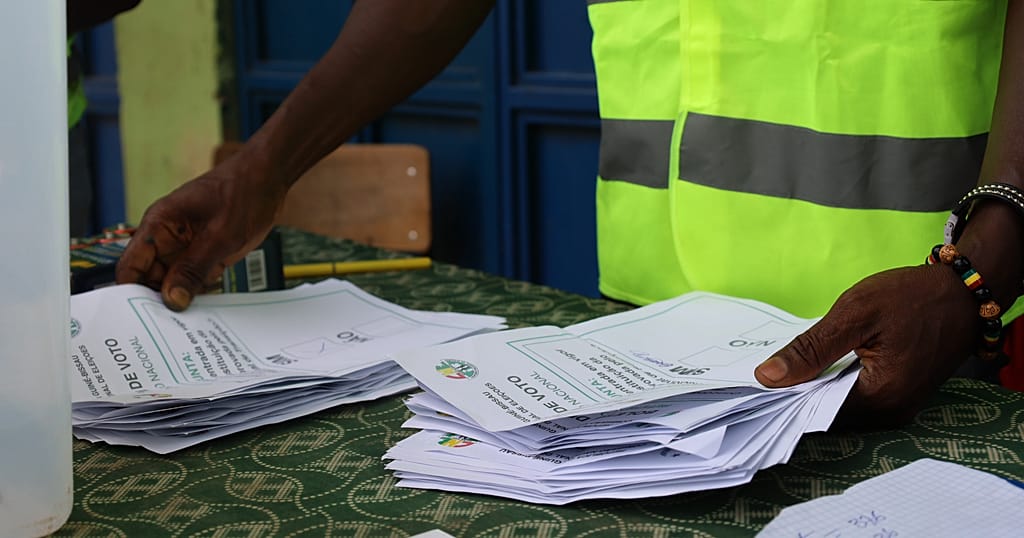
Ballot counting begins in military-run Guinea-Bissau after voting ended in a referendum that could expand the president's powers, ahead of a general election later this year aimed at restoring civilian rule. Ballot counting began in military-run Guinea-Bissau as voting ended in Sunday's referendum, which could give the president more powers ahead of a general election meant to restore civilian rule later this year. Security was stepped up at strategic points in the capital, with members of the national guard and the police stationed at key locations. Voting booths closed as planned at 5:00 pm local time, with the first provisional results due on Tuesday. Idrissa Djalo, executive secretary of the National Electoral Commission, told a press briefing Sunday evening that turnout had "exceeded" 55 percent. The commission believes that "on the whole, voting took place without any incidents that would call into question the credibility of the vote," he added. The referendum came less than 10 months after a coup in which the military seized power in the impoverished Portuguese-speaking west African country. Shopkeeper Halimatou Traore told AFP she hoped the new constitution would bring positive changes. "The successive crises the country has gone through have had a very negative impact on my earnings," she said as she waited to vote. "If everything goes well, Guinea-Bissau will set off on new paths." Braima Seidy, 76, a veteran of the war of independence against Portugal, emerged smiling from the polling booth. "I truly believe that this new Constitution can bring stability to the country," he told AFP. Presidential system The junta says the change seeks to stabilise institutions before new presidential and parliamentary elections designed to hand power back to civilians scheduled for December 6. But the political climate is tense in the coup-prone coastal nation. The opposition has urged voters to boycott the referendum "in a context of restrictions on public freedoms." Junta leader and transitional president General Horta N'Tam called on young people to vote "massively" as he cast his own ballot on Sunday. "What we want after this referendum is to allow whoever wins the elections to see out their mandate without hindrance," he said. Under the transitional charter he upholds, the general is barred from running for election. The junta has unanimously approved a constitutional amendment for the country to switch to a presidential system from a parliamentary one, and was asking the public to back it. The new text proposes abandoning the old system whereby the prime minister came from the parliamentary majority, which has led to uncomfortable power-sharing. It would also allow the head of state to appoint and dismiss the prime minister and members of the government, and to dissolve parliament. On Sunday, voters had to answer "yes" or "no" to the question: "Do you agree with the entry into force of the new constitution approved by the National Transitional Council?" 'Dribs and drabs' The army took over power just days after a presidential election, overthrowing then-president Umaro Sissoco Embalo and suspending the electoral process. Following 2023 legislative elections, Embalo himself dissolved the opposition-dominated parliament in response to what he described as an attempted coup. He then ruled by decree until he was ousted by the army. In five Bissau polling stations visited by AFP in the afternoon, voters turned up irregularly in small numbers. Intense rain in the morning had dissuaded some. "Voters are coming in dribs and drabs," said the head of one of the stations. "The rain has kept things low-key." Guinea-Bissau, which is one of the world's poorest countries, has experienced five coups and a series of attempted coups since 1974. This referendum comes after several other African countries including Zimbabwe and Chad amended their constitutions in recent years to extend term lengths, remove age limits or strengthen powers of the executive.
Vote counting underway in Guinea-Bissau referendum that could expand presidential powers
Full Article
Original Source
Read the full article at Africanews →KhanList aggregates and links to publicly available news content. We do not host full articles from third-party sources. Always verify important information with original sources.