
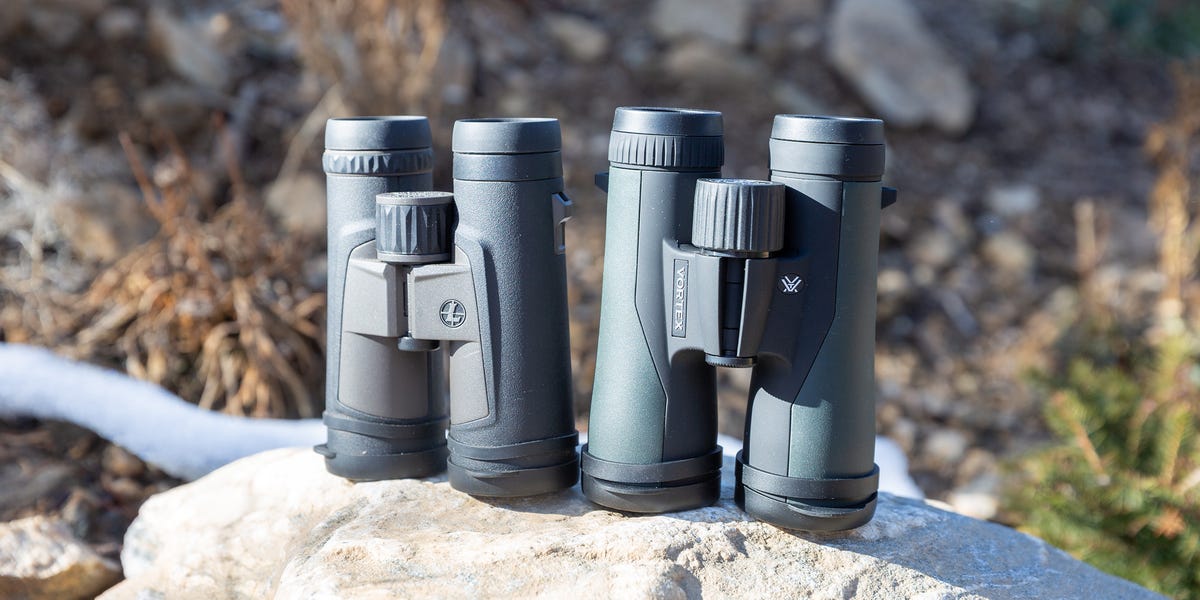
6 min readWhether you’re spotting deer while on a hunt or identifying backyard birds, a trusty pair of 10x42 binoculars is a must-have for the outdoors. The 10x magnification isn’t too tight for closer quarters—think birdwatching—but gives you enough reach to spot animals 1,000 yards away, and it’s even sufficient for casual stargazing. The 42 mm objective lens (the one farther from your eyes) is wide enough to let in lots of light while keeping the field of vision natural.Most people want a pair of binoculars that is decent, but not so exceptional that they have to spend thousands. I recommend the $150 to $300 range to get high-quality glass with coatings and enough performance that you won’t ever feel the need to upgrade.Both the Vortex Crossfire HD 10x42 ($300) and the Leupold BX-3 ($230) fall right in this entry-level sweet spot. We tested both for our Best Binoculars buying guide and selected the Leupold BX-3 10x42 as our favorite binocular overall, but the Vortex Crossfire HD 10x42 performed very well, considering the price (often available for much less than retail, as it’s an older model than the Leupold, which debuted this year). As such, we compared the two head-to-head to identify meaningful differences. Here’s what we found.Vortex Crossfire vs. Leupold BX-3ProsLightweightSlightly larger center area of sharpness than the CrossfireComes with two swappable eyecup optionsProsCompactGreat option for most usersConsLower light transmissionSpecsLeupold BX-3 Alpine HDVortex Crossfire HDLength5.7 in.6 in.Weight22.6 oz.23 oz.Eye Relief16 mm15 mmField of View (@ 1,000 yd)342 ft.325 ft.Close Focus Distance6.2 ft.6 ft.I tested the Crossfire and BX-3 both handheld and tripod-mounted side-by-side in a range of conditions including sunset low-light environments, dense forest, long-distance expanses in the mountains, and several specialized setups designed to test things such as chromatic aberration, color fidelity, and image sharpness.Justin ParkThe Vortex Crossfire HD 10x42, which sits in between the company’s Viper and Triumph models, is an entry-level pair in terms of price but offers enough in performance that it’s likely to be all the binocular most people need.Price and Performance TierTruly objective stats about binocular performance can be hard to come by, so the somewhat arbitrary “tiers” of binoculars defined by price and place in a company’s lineup can serve as useful shorthand for how impressive the optical quality is.Leupold’s BX-3 Alpine HD 10x42 binos are on the lower “budget” end of the company's numbered BX lineup that goes all the way up to the $3,999 BX-6 Range HD RangeFinder 10x42 binoculars. Still, I would argue that this tier of binocular at 10x42 offers you most of the performance of the high-end models. The higher you go in price, in my experience, the smaller the gains in clarity and performanceVortex has many different lines, each one representing small jumps in features and optical quality. The Vortex Crossfire HD 10x42 sits between its Triumph and Viper lines—the Triumph is our Best Budget and the Viper is Best for Hunting. The Crossfire HD 10x42 is entry-level in terms of price but is likely to be all the binoculars most people need, and still feels like a significant cost if binoculars are a nice-to-have item for you.In terms of size and specs, the Leupold BX-3 10x42 is likely most comparable to the Vortex Viper HD 10x42, but at $749 MSRP doesn’t feel like an apples-to-apples comparison. The Viper HDs are great binoculars, especially for hunters who demand the dawn and dusk performance, but their price is more than double that of the BX-3 Alpine HD.Note that both brands’ binos are usually available at retailers for much less than the MSRP on the official sites. At the time of this writing, the $230 Crossfire can be had in several places for $150 while the $299 BX-3 binos are consistently $199 at Scheel’s and Cabela’s, making the two models fairly close on real-world price.Justin ParkIn terms of build, weight, and design, both the Crossfire and BX-3 binos cater to the hunting community. The Crossfire features a slightly flared look from eyepiece to exit lenses; the BX-3 is straighter. The Crossfire is also slightly longer.Size, Weight, and Form FactorBoth brands market to the hunting community and it shows in these fairly similar designs. The roof prism design on both the BX-3 and Crossfire is near-standard in this type of binocular and it helps keep the size and weight down compared to bulkier designs used in the cheapest binos.The Crossfire binos have a slightly flared look as you move from the eyepieces to the exit lenses while the Leupold are straighter, but the overall form factor is very similar. The Vortex Crossfire is slightly longer at 6 inches compared to the 5.7-inch Leupold BX-3.Practically, these are both relatively compact, lightweight binos that will fit in most any aftermarket chest harness and won’t cause neck strain as quickly as bigger glass. The Crossfire is 0.4 ounces heavier than the BX—not really a meaningful difference in practice.Both have hard plastic eyecups by default, which are more durable than the floppy rubber ones that often come on the cheapest binos. Leupold’s BX-3, however, comes with two other swappable eyecup options. During sunrise and sunset glassing, when low-angle sunlight constantly sneaks into your peripheral vision and nukes contrast, the alternate eyecups block the intrusions, making a legitimately noticeable difference.Justin ParkI noticed few differences in object sharpness and color. Both binos produce refreshingly neutral, natural colors in a range of light conditions.Optical QualityThis is the most important aspect of binoculars and also the hardest to objectively compare. Testing binoculars in person is always a smart idea if possible, as a few minutes scanning store shelves under artificial light isn't a great real-world test.Image SharpnessBoth models provide decent center-image sharpness, especially considering their low cost. Moving closer to the edge of the image, clarity degrades in any binocular. The Leupold BX-3 binos have a slightly larger center area of sharpness than the Crossfire, perhaps 80 percent versus 70 percent.A small but noticeable difference that subtly adds to the comfort of using them and gives Leupold an edge. In real-world use spotting animals such as bighorn sheep at long distances, I didn’t even notice. Like many marginal improvements you get with better binos, the sharper image just adds subtly to the overall picture clarity. For hunters, it’s unlikely to be the difference between success and failure, but it may make long sessions a touch easier and more enjoyable.Justin ParkTesting the Vortex Crossfire HD. The 10x42 configuration of binoculars is popular for a reason. They’re ideal for nature walks, stargazing, hunting, sporting events, and backyard birdwatching.Chromatic AberrationI expected much more noticeable color fringing with the Crossfire HD, but it wasn’t pronounced in either pair. This defect in imagery in binocular views and photography occurs when light gets distorted and unnatural colors appear, usually around the edges of objects such as dark hair on an animal appearing blue or purple.Both the Crossfire and BX-3 have HD in the name, which most likely refers to the glass elements and coating that help reduce glare, fringing, and generally produce a sharper image. For the most part, I noticed few differences in object sharpness and color. Both binos produce refreshingly neutral, natural colors in a range of light conditions.GlareGlare was less pronounced in the Leupold BX-3 Alpine HD than the Vortex Crossfire HD. Neither was able to eliminate glare entirely in challenging conditions such as pointing roughly 20 degrees off from the sun near sunset. But the portion of the view obscured by glare was smaller in the BX-3. It was also less hazy and diffuse, which left the portion of the view not obscured by glare clearer. This is, again, not a massive difference but adds incrementally to a slightly better optical quality overall for the BX-3.Low-Light PerformanceDusk, dawn, and dark forests are an extreme that can expose cheaper binoculars. For hunters, the crepuscular hours are when animals are usually most active—and when they’re hardest to pick out through your optics. Birdwatchers and casual users will be less affected if a bino struggles to gather dwindling light, but performance in these conditions is a reasonable indicator of overall optical quality.The Leupold BX-3 was noticeably better in the worst, last-minute-of-the-day conditions, but the differences were only pronounced at the extremes. The brighter image wasn’t noticeable until well into the “blue hour” that comes before sunrise and after sunset. This makes using brighter optics much easier for hunters desperately scanning dwindling light but might not sway more casual users. The brightness of the two pairs was mostly indistinguishable in midday sun.Which Should You Buy?These are fairly closely matched binoculars, though the Leupold was the better pair whenever there was an edge to be had. The most meaningful separators were low-light brightness and center-image sharpness.I didn’t find this surprising as the Leupold BX-3 Alpine HD costs more, and the Vortex Crossfire HD is more of an entry-level option that sits maybe one level below the BX-3 in the loose optical hierarchy of grades of binoculars. Rather than an apples-to-oranges comparison, testing these side-by-side served as a reminder of how subtle the improvements are between tiers and price jumps in the binocular world.While dedicated hunters and birders might be willing to pay $50 to $100 more for the jump in quality to the BX-3, the affordability of the Crossfire HD will appeal to those who don’t need 10 percent better. Either pair presents a good value in their respective categories, but you’ll have to decide which you value more—a lower price or better performance in challenging conditions.Justin Park is a working journalist with more than 20 years experience covering politics, environmental issues, hunting and outdoors, sports, and fitness for newspapers, magazines, and digital-first outlets. Since earning his M.S. in New Media from Syracuse University's Newhouse School in 2008, he's also applied his storytelling skills to video, producing, shooting, and editing for PBS, USA Today, Reebok, and more. He received the 2016 Associated Press Sports Editors' Investigative Award as part of a team covering the Rio Olympics for USA Today Sports.Jamie, Senior Reviews Editor, joined the Hearst Enthusiast Group in 2021. She has covered technology and consumer lifestyle gadgets since 1995—and shared her expertise in print, digital, and in broadcast originating the role of The Gizmo Girl for ESPN’s Cold Pizza. She has written about, tested, and reviewed everything from turkey fryers to high-definition TVs. Her byline has appeared in TWICE, Sound & Vision, Consumer Reports, and many others. In her free time, Jamie is in a yoga class, searching for the perfect matcha latte, or walking the boards.
Vortex Crossfire vs. Leupold BX-3: Compact, Lightweight, Affordable Options That Offer More Than What Most Need
Full Article
Original Source
Read the full article at Popularmechanics →KhanList aggregates and links to publicly available news content. We do not host full articles from third-party sources. Always verify important information with original sources.