
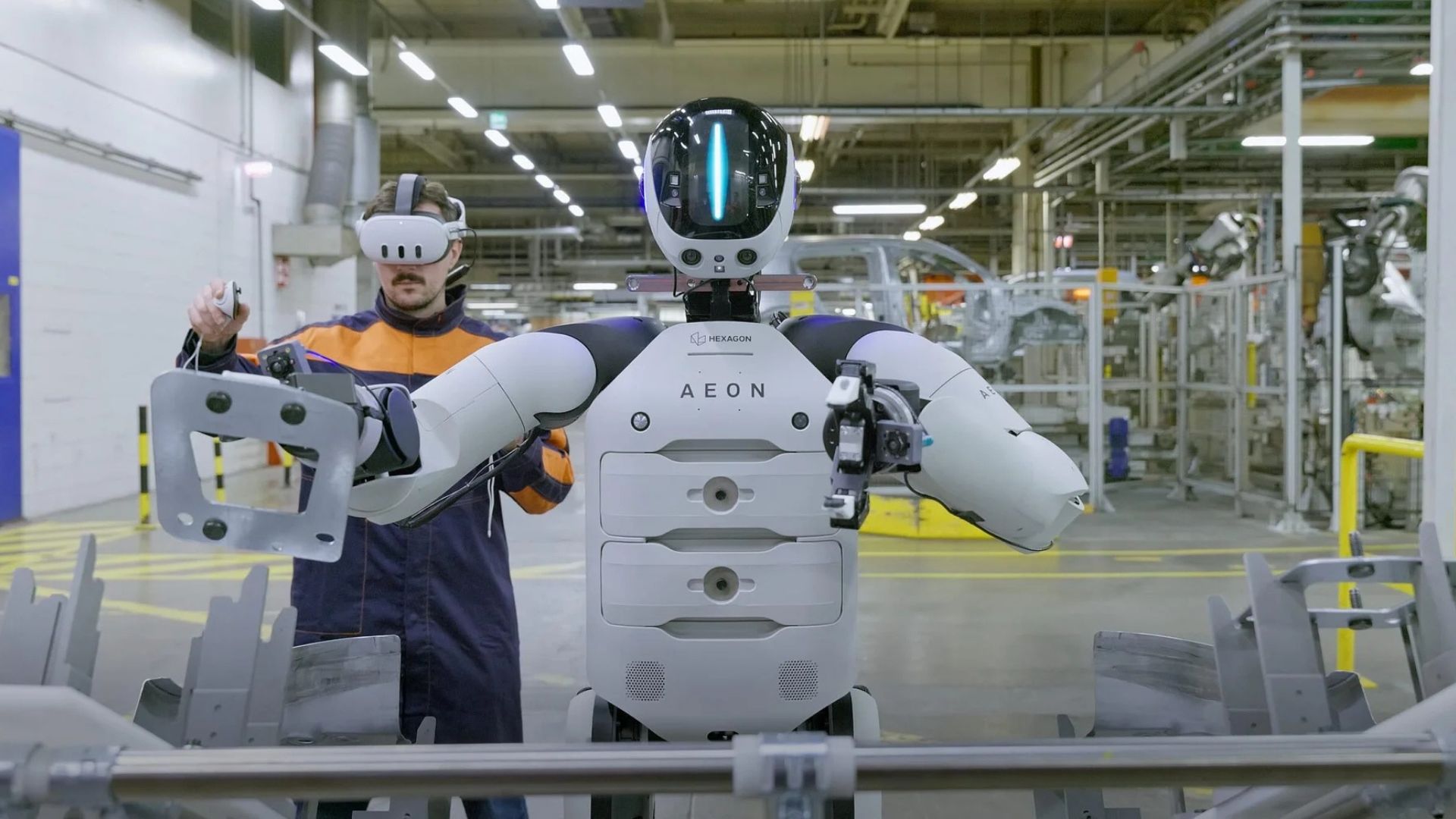
Volvo Cars is training humanoid robots at its manufacturing plant in Ghent, Belgium, as the automaker explores how human-shaped machines could take on repetitive and physically demanding tasks on factory floors. The Swedish automaker has introduced AEON humanoid robots, developed by technology group Hexagon’s Robotics division, at the facility. The machines are being trained and validated on real industrial tasks alongside employees and existing automation ahead of a planned factory pilot in 2027. Ghent is the first Volvo Cars manufacturing plant to test the humanoid robots. The initial training focuses on placing components into two fixtures with high precision, using a technique called imitation learning. Under this approach, robots learn tasks by observing and copying how people perform them. Volvo’s team is working with Hexagon Robotics to gradually increase the complexity of the assignments as each step is validated. Future tasks could involve handling multiple components, navigating the production area, and interacting with automated factory systems. Robots learn factory tasks The introduction of humanoid robots addresses a limitation of conventional industrial automation. Fixed robotic arms are effective at performing repetitive operations in controlled environments, but they cannot easily adapt to tasks that require greater flexibility or movement between different work areas. Volvo believes AEON’s human-like form could allow it to operate alongside workers and existing machinery without requiring extensive changes to factory layouts. “AEON’s humanoid design means it can fit into our production as it is today, alongside our teams and existing automation,” said Magnus Nilsson, chief manufacturing officer at Volvo Cars. The company aims to use the robots for some of the most physically demanding assignments, potentially improving workplace ergonomics and reducing employees’ exposure to repetitive tasks. AEON stands 1.65 metres tall and weighs 60 kilograms. It uses cameras and sensors to understand its surroundings and handle components with precision. Unlike humanoids that walk on two legs, the robot moves on wheels and can reach speeds of up to 2.4 metres per second, roughly the pace of a light jog. It can carry a payload of up to 10 kilograms and is designed as a multipurpose platform that can be trained for different industrial applications. Production pilot planned Volvo and Hexagon are preparing to expand the program beyond its initial training assignments. More AEON units are expected to arrive at the Ghent facility during the first half of 2027 for a factory pilot involving a wider range of tasks. The automaker aims to introduce the robots into real production operations from mid-2027, although the rollout will depend on how successfully they complete the training and validation process. “The purpose of humanoid robotics is to deliver business value to our customers,” said Arnaud Robert, president of Hexagon Robotics. He added that working with Volvo’s manufacturing teams would help ensure AEON can perform practical tasks that support factory operations. The program forms part of Volvo Cars’ broader investment in advanced manufacturing. It also highlights a growing interest among automakers in humanoid robots that can adapt to existing industrial environments rather than relying exclusively on purpose-built machinery. For now, AEON remains in the training and validation stage at Ghent. Its planned factory pilot will help determine whether humanoid robots can reliably take on a wider range of manufacturing tasks alongside human employees. Get the latest in engineering, tech, space & science - delivered daily to your inbox.With over a decade-long career in journalism, Neetika Walter has worked with The Economic Times, ANI, and Hindustan Times, covering politics, business, technology, and the clean energy sector. Passionate about contemporary culture, books, poetry, and storytelling, she brings depth and insight to her writing. When she isn’t chasing stories, she’s likely lost in a book or enjoying the company of her dogs.
Volvo trains humanoid robots to handle factory tasks, targets production in 2027
Full Article
Original Source
Read the full article at Interestingengineering →KhanList aggregates and links to publicly available news content. We do not host full articles from third-party sources. Always verify important information with original sources.