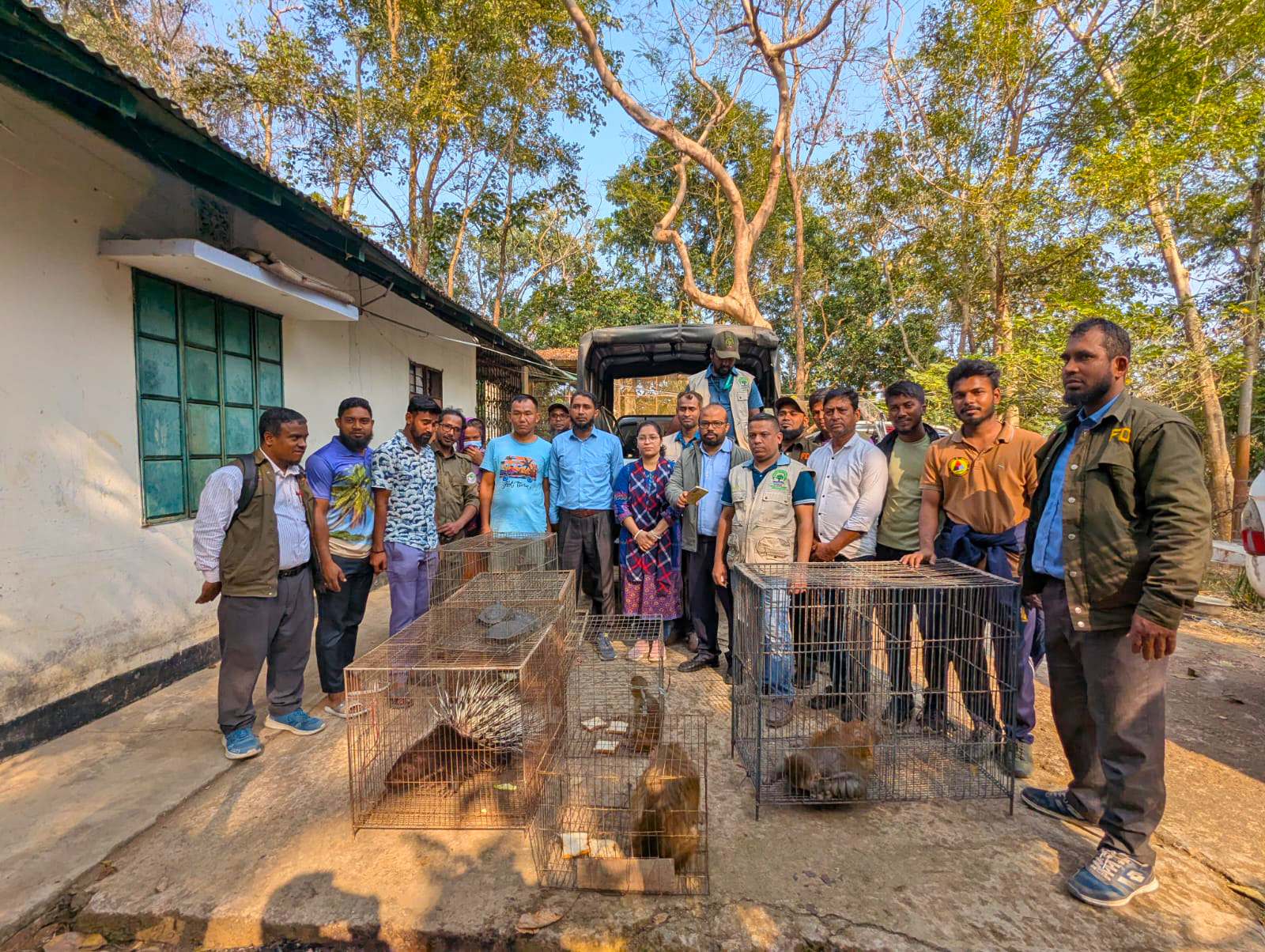
The government in Bangladesh has recognized the collaboration between the wildlife crime control force and volunteers by awarding one of the pioneering volunteers with a national prize.Risking their own lives, the volunteers collaborate with the Forest Department by sharing information about poachers and smugglers; often, they help arrest criminals.The Forest Department has launched a volunteer registration process, which, however, fails to attract prominent volunteers. A handful of animal lovers, mostly representing the youth community, spread across Bangladesh, have become crucial arsenals of the Forest Department’s wildlife crime control efforts. Despite not being assigned by the state, like the responsibilities a crime control force shoulders, the animal lovers help the Forest Department trace stressed wildlife in traps, cages or enclosures of poachers and smugglers. Primarily, they share intel information about any potential wildlife crime. Often, they join the wildlife inspectors of the department, act as undercover buyers, reach the crime scene, and help arrest the criminals. All things they do are under life threats — voluntarily. The Forest Department’s Wildlife Crime Control Unit (WCCU), established in 2012, conducted more than 3,000 raids against wildlife criminals between July 2012 and March 2026. Almost all raids were planned with volunteers’ tip-offs. Chief conservator of forests, Md Amir Hosain Chowdhury, told Mongabay: “Volunteers are our crucial partners [in wildlife conservation].” The government of Bangladesh has also recognized the collaboration between the WCCU and the volunteers. The WCCU and wildlife photographer and conservationist Faisal Bin Azad, better known as Adnan Azad, were honored with the National Wildlife Conservation Awards 2026 on July 9. Azad is one of the pioneers in non-government campaigns for nature conservation and was one of the original volunteers with WCCU. Local volunteers and Forest Department officers pose for photographs with an administration officia after two pooches were detained while possessing a macaque illegally. Image by Siddiqur Rahman Rabbi. The Forest Department on Nov. 6, 2025, issued a public notice, inviting volunteers for registration under its forest conservation, wildlife protection and rescue, and awareness-building activities. Over the next eight months, more than 1,000 individuals responded positively to the notice, according to officials. However, some prominent wildlife conservation volunteers have questioned the idea of registration and whether the process maintains any filtration against poachers in disguise as volunteers. The bonding of WCCU and volunteers Between July 2012 and March 2026, the WCCU conducted 3,190 raids across Bangladesh, rescuing 41,536 birds, 18,104 reptiles, and 1,508 mammals. During the raids, 1,406 wild trophies were recovered, while 222 criminals were arrested, according to WCCU officials. The achievement in wildlife crime control, so far, is the outcome of building the network of volunteers, which began at the onset of WCCU. Tangail divisional forest officer, Abu Naser Mohsin Hossain, who served as the first director of WCCU, said, “We motivated the village market management committees against illegal wildlife trading, ran extensive awareness campaign around the crime hotspots, and opened a nationwide hotline, with support from a private tele service operator to get intel information from the grassroots. The initiatives resulted in widening the network of volunteers.” During the establishment of WCCU in 2012, only a handful of non-government individuals were working to protect wildlife and nature. Azad said, “I was one of them. I volunteered in various ways — rescuing wildlife by myself and handing it over to the WCCU and providing them with intelligence about trafficking after receiving information about different consignments and smuggling operations.” Sometimes, he shared the experience of successful operations with his social media followers. After rescuing parakeets from the possession of bird poachers, local volunteers along with Forest Department officers pose for photographs in Chattogram. Image by Siddiqur Rahman Rabbi. Because of the easy availability of social media, many more young people became inspired to do similar work. “Over time, countless volunteers and nature lovers across the country began assisting the WCCU. That is how the work has continued,” Azad said. Azad is the president of Save Wildlife and Nature (SWAN), which he founded in 2014. He has also been working as the convener of the Bangladesh Animal Welfare Association (BAWA), a group of 15 wildlife and nature conservation organizations. What is it like for volunteers? Azad described the July 2 raid against one wildlife-smuggling den on the outskirts of Bangladesh’s capital city, Dhaka. That night, WCCU officials recovered 1,104 animals from a warehouse and arrested Kazi Shajid Ullah Dastagir on allegations of smuggling the animals, media outlets reported. “At first, we saw an advertisement for the sale of tortoises on Facebook. After seeing the advertisement, we contacted the sellers posing as customers. Once we contacted them, they showed us photographs of the products they had in their collection,” Azad said. “The photographs were shared with the WCCU officials. Then we planned how we could rescue the animals. We then sent a fellow volunteer posing as a buyer to make the purchase and followed him. We went there and caught one person red-handed.” Volunteers do not need an academic background in zoology or biology, according to Azad. “Volunteers have greater love, affection and compassion for animals than zoology students,” he said. ”For them, zoology is academic knowledge. What we do, however, is based entirely on practical knowledge.” Local volunteers handing over rescued brides to administration officers in Chattogram. Image by Siddiqur Rahman Rabbi. According to Azad, when volunteers or people working with wildlife and nature conservation come together, animals become the subject of their entire conversations. He said animal welfare organizations conduct special campaigns in different areas and neighborhoods, particularly in places where a specific animal is found in large numbers or where it is being hunted or trafficked. Volunteering amid life risks On June 16, the WCCU rescued 18 native birds, including 17 mynas, from Dhaka-neighboring Gazipur district. BAWA volunteers were actively involved in the raid. During the raid, two suspects were detained on an allegation of possessing the animals illegally. Azad said, “However, they were released on bail from court the next day. After that, they individually attacked our Facebook profiles and threatened us, saying that they would deal with us. We regularly face such incidents.” President of the Nature Conservation Alliance, Siddiqur Rahman Rabbi, who has long been involved in wildlife rescue activities in Bangladesh’s southern Chattogram region, said, “We live with death threats. But the hope is that local wildlife criminals are also aware that we may get informed in advance about their plan to harm us, because some of their associates also volunteer with us.” Forest Department officials along with local volunteers after rescuing a king cobra. Image by Siddiqur Rahman Rabbi. Registration of volunteers According to the conservator of forests for the Wildlife Conservation Circle under the Forest Department, Sanaullah Patwary, who oversees the registration of the volunteers, 1,240 individuals have registered between Nov. 6, 2025, and July 9, 2026. “This number will grow over time,” he said. However, WCCU officials say the number of volunteers is much more than the registered ones. The national award-winning Azad and Rabbi have not officially applied for registration. “I have no idea whether this registration process will filter the wildlife criminals or their associates. Unwanted intruders may leak crucial intelligence. Real conservationists may fall in danger,” Rabbi said. Patwary admitted concern over the real volunteers’ protection is valid. He said there is no plan for providing the volunteers with state-funded protection right now. “But the discussion must start so that we can arrange this, even under any project, for the future,” he said, adding that the Forest Department will soon train the registered volunteers on personal safety and protection and guide them on how they can assist the department as informers without risking their own lives. Banner image: Forest Department officials along with local volunteers pose for photographs after wildlife of several species were rescued. Image by Siddiqur Rahman Rabbi. Bangladesh cracks down on illegal wildlife captivity — but what happens after? Bangladesh gets ready for its first release of tiger rescued from poachers’ trap FEEDBACK: Use this form to send a message to the author of this post. If you want to post a public comment, you can do that at the bottom of the page. Cite this articleSadiqur Rahman (2026). Volunteers play crucial role in Bangladesh’s wildlife crime control efforts. Mongabay Conservation news. DOI: https://doi.org/10.66709/news-324467 Credits Topics
Volunteers play crucial role in Bangladesh’s wildlife crime control efforts
Full Article
Original Source
Read the full article at News →KhanList aggregates and links to publicly available news content. We do not host full articles from third-party sources. Always verify important information with original sources.