
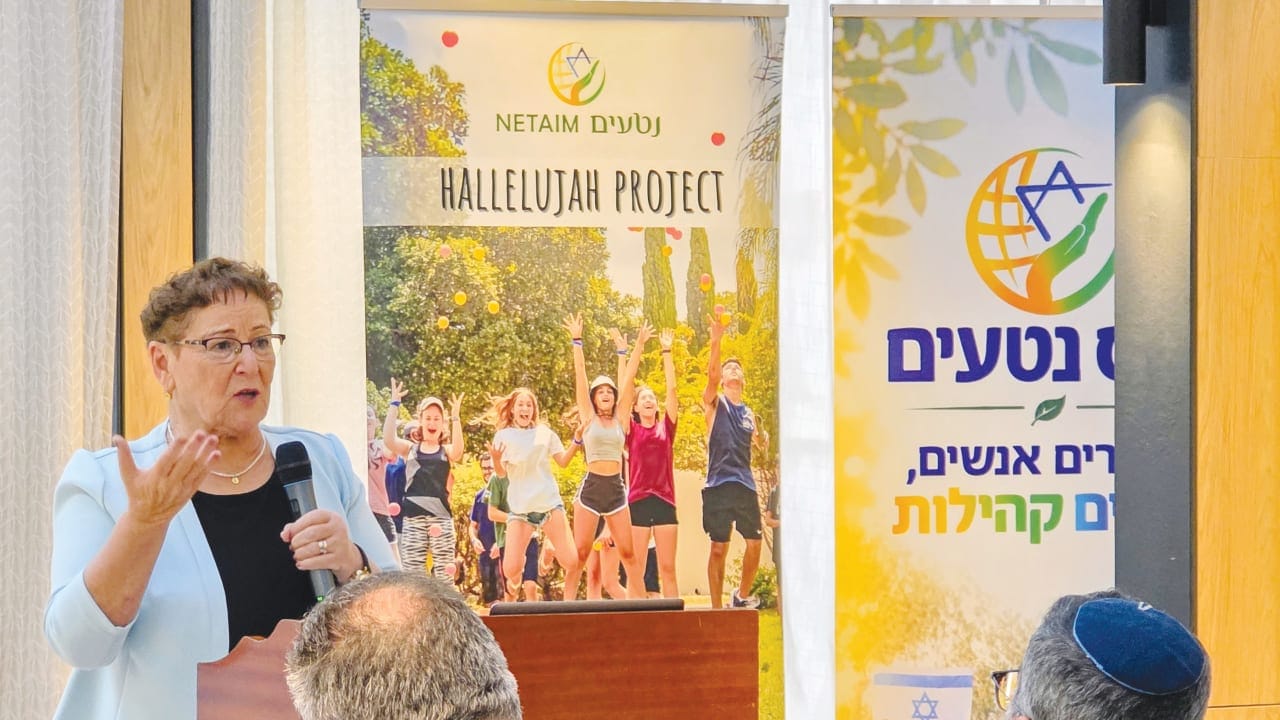
NOVEMBER 22, 2026 08:00Memory and Zion came together in a most memorable way in Prague.The door in DobojIn a town in northern Bosnia and Herzegovina, Doboj, a man told me about the door before he told me about himself.The old synagogue in his town burned to the ground in the Holocaust. When the community built a new one in 2003, someone found the original wooden door and stood it beside the new building.Dario Atijas mentioned it the way you mention a family photo on the wall. Then he turned back to the Shabbat table in Prague, where he sat beside Jews from Venice, Uzbekistan, Skopje, and Munich.THE NETAIM CONFERENCE 2026 opened that morning, Friday, October 30, under the title Connections: Connecting People, Building Community. About 500 people from 42 countries came for one Shabbat. Many of them lead Jewish communities of a few hundred people. Some lead a few dozen.The formal welcome came from Israel’s ambassador to the Czech Republic, Amir Weissbrod. “We can’t look at our relationship as something that is given. We have to invest in it, and invest big time,” he said, calling for more municipal cooperation and investment in the next generation.NETAIM CEO Shiri Madar addresses about 500 Jewish leaders from 42 countries at the Netaim Olami conference in Prague, a gathering of a network she has grown to 155 small Jewish communities worldwide. (credit: NOAM BEDEIN)The local Jewish leadership stood alongside. “One of the positive effects after Oct. 7 was that we came closer together,” said Michael Mishek, CEO of the Federation of Jewish Communities in the Czech Republic.“We saw that we have the same mission, we are the same people, and we are on the same boat.” Kobe, director of the Prague JCC and our host for the weekend, was with them.Prague holds both threads of the story Netaim tells: Jewish memory and the bond with Zion. In the Altneuschul hangs a community flag bearing a Star of David, granted in 1650 after the city’s Jews helped defend Prague against the Swedes.The walls of the Pinkas Synagogue carry the names of more than 77,000 Czech Jews who never came back. Of some 120,000 Jews who lived in the Czech lands before the war, about 3,000 registered members remain today, in 10 communities.And a plaque from the Hagana veterans still thanks Czechoslovakia for the pilots, paratroopers and weapons that helped Israel win its War of Independence in 1948. Small communities survive, this city seems to say, when they hold on to both.The dreamer from Sha’ar HanegevFor me, this weekend was personal. As former director of international relations at the Sha’ar Hanegev Regional Council, I came close to the story and legacy of Ofir Libstein, the council head who was murdered on Oct. 7, 2023, defending Kibbutz Kfar Aza.His son Nitzan, 19, was murdered that day too. At the council, I met Shiri Madar, Netaim’s CEO, whose life’s mission inspired me from the start. This weekend I saw the full scale of her work: a global Jewish gathering I have not seen anywhere else in the Diaspora.The conference was dedicated to Ofir’s memory. People called him a “practical dreamer.” He founded the Darom Adom festival, built tech start-ups, and pushed for innovation along the Gaza border.Netaim began as a gift for his 45th birthday, an idea passed between friends, and Shiri turned it into an international network.His sister, Racheli Yaniv Libstein, who hosted the conference and volunteers to lead Netaim’s growth abroad, told us how Shiri nearly quit. Years before the war, she came to his office on a Friday, which they called “dream day,” ready to resign. A box of almonds and a big hug were waiting on his desk.An hour later, Shiri was at the whiteboard drawing Netaim’s three-year roadmap.“He made me believe that what we do is bigger than any one of us,” she said. “And even though the dreamer is no longer with us, his dream keeps living, growing and touching more and more people.”Nineteen people came to Netaim’s founding conference in Bulgaria. Three hundred came to last year’s conference in Bucharest. About 500 came to Prague. Netaim now works with 155 small communities, most with fewer than 2,000 people, and is moving toward 200.Large organizations tend to focus on big communities in big cities. Netaim goes the other way, with a strong focus on Central Europe.Netaim World works to build a living bridge between Israel and the Diaspora, and its community arm, Kehilor Netaim, puts that vision into practice through direct, ongoing contact with each community, learning what it needs and shaping its work around it.Throughout the year, and especially around the holidays, Kehilor sends delegations of volunteer emissaries, teachers and educators, working with partner organizations and Israel’s national institutions. The result is a human, educational, and community bond that lasts well beyond a single visit.After Ofir’s death, Asif Izek, head of the Hof Hacarmel Regional Council and a son of Argentine immigrants who came through Habonim Dror, became chairman of Netaim World.Participants made a point of thanking Shiri and Chen Dor, the manager who runs the network and operations day to day. Ofir’s widow, Vered Libstein, who heads the Kibbutz Movement’s society and community division, was in the room with the extended Libstein and Epstein families.“Long before Oct. 7, Ofir understood the meaning of standing together as a community,” she said. “In the kibbutzim, we deal with growth out of crisis.”Asif shared what a member of the Kfar Aza standby squad told him two months after the massacre: “When I left the house that morning, I went out to defend Kfar Aza. Only later, after I brought my family back, did I understand that I went out in the name of the whole Jewish people.”The programs grow from that idea. Hallelujah brings together teenagers from 14 to 16 countries. Hamsa supports 150 lone soldiers for five years, including three on a kibbutz with an adoptive family.Keren Or Ofir, a leadership program run with Gesher, takes 25 people aged 35 to 50 from about 300 applicants, starting on the Gaza border and continuing in Budapest. Maslool, run with Masa, lets young Jews build their own year in Israel.Yaakov Hagoel, chairman of the World Zionist Organization, described his friendship with Ofir.“Ofir came from the heart of the kibbutz movement, from a humanist world of values. I come from other roots,” he said. “On paper we should have been having ideological arguments. But Ofir taught all of us what leadership is.”Reaching communities with no organized Zionist presence, Hagoel said, “builds a living bridge,” with a clear goal: “so that, in the end, the Jewish heart will pull the body back home.”President Isaac Herzog sent a video greeting. “If I had to choose one word that best reflects the essence of Netaim,” he said, “it is without doubt the word connections.”Miriam Peretz and the suitcase of tunaAt 4:24 p.m., Miriam Peretz lit the Shabbat candles. Netaim’s president, an Israel Prize laureate, had just led a musical Kabbalat Shabbat with Shai Abramson and taught the weekly Torah portion.“There is a leadership code in it, three times,” she said. “One small, simple word: Hineni. Here I am, for any task you need me for.”Ofir, she said, “did not look only at the national level. In his soul there was a commitment to the Jewish people, also in the Diaspora, and he would reach every community, small and large.”She almost said no to him. Miriam grew up in the Hatzerim transit camp in Beersheba in the 1960s and was raised to see the kibbutzim as another world. She wondered what a religious woman of Mizrahi background shared with a kibbutznik from the Gaza border.Ofir told her he could not ignore any part of the Jewish people. “He had a quality that brings down every leader in the world when it’s missing,” she said. “Humility.”Asif told a story about her that brought the longest silence of the weekend. At 72, Miriam travels alone between small communities abroad, four on one trip, changing three trains and buses.In her suitcases, she carries cans of tuna, corn, and crackers from Israel, so she can celebrate Independence Day and the holidays with communities where no Israeli official ever sets foot.“This land does not belong only to the Israelis,” she told the hall. “It belongs to every Jew who lives anywhere in the world. Our connection to the communities is a connection to home.” She ended with Abraham’s words: “For we are brothers.”That night I saw what she meant.At dinner I sat with the representative of Venice’s small community, delegates from Bulgaria, couples from Uzbekistan and Munich, and people from North Macedonia, Kosovo, Bosnia, and Ukraine.Secular and religious, Reform and Orthodox, all singing the same songs.“We are thirsty for unity, for a togetherness that isn’t divided,” one participant told me. It was hard not to feel the contrast. This celebration of Jewish unity came just days after Israel’s divisive October 27 election.Voices from the edge of the mapAtijas is the secretary of the Beit Shalom community in Doboj, in Bosnia’s Republika Srpska. His Sephardi family is part of some 500 years of Jewish history in Bosnia that, he says, local schools do not teach.In the 1990s, his father and uncle pushed for laws to return Jewish property and raised money for a synagogue. Beit Shalom opened in 2003, the first Jewish building constructed in Bosnia since World War II.Dario made aliyah during the Bosnian war, studied at a youth village in Jerusalem, served in the IDF, and went to the Hebrew University. When the synagogue was finished, he went back.He grew up in communist Yugoslavia, with postcards of IDF soldiers and his uncle’s stories about a relative: former IDF chief of staff David “Dado” Elazar.Today, the synagogue courtyard has a biblical garden built with KKL-JNF and, with help from the Jewish Agency’s Emergency Fund, armored doors and cameras.Whenever news about Israel appears, hate floods the center’s Facebook page, and Dario cleans it by hand each day. His answer is school tours that visit a synagogue, a church, and a mosque on the same day.“We are small, but part of a whole people scattered around the world,” he told Racheli on the conference podcast. “Let people know that in Bosnia and Herzegovina and in every corner of the world, there is always a Jewish corner where you can find brothers and sisters.”Then, more quietly: “Just keep working. Life is not simple. We have to hold together.”Between sessions, the hall turned into a fair of 13 organizations working with the Diaspora. Ivritli, an online Hebrew school founded by Israelis in Barcelona, teaches children in communities abroad.Tutterra, a young Israeli start-up, offers an AI-based app where teenagers tutor teenagers. Herzog Global, the international arm of Herzog College, trains Jewish studies teachers worldwide.The TALI Education Fund brings pluralistic Jewish studies to schools in Israel and abroad, and the National Library of Israel opens its manuscripts, maps and photographs to Jewish educators everywhere.Others bring people to Israel: Masa Israel Journey, with long-term programs for ages 18 to 30; Israel Experience, the Jewish Agency’s educational travel company; Momentum, founded by Lori Palatnik, which brings Jewish mothers on eight-day journeys; Reichman University, with English-language degrees at its Raphael Recanati International School; and Ofek Israeli, set up by the World Zionist Organization and the Jewish Agency to help families considering aliyah.Memory had its own corner. The March of the Living brings students to walk from Auschwitz to Birkenau each Holocaust Remembrance Day.Zikaron BaSalon, represented by Shai Levi, turns that day into small gatherings in private living rooms. And The Journey to the Land of Possibilities, Naama Dahan’s book and enrichment program, teaches elementary school children to think positively.At the fair, I met Effie Nagal. He and his wife, Reut, came with their children Tzuf, Noga, and Avichai from Madeira, the Portuguese island in the Atlantic that sits closer to Morocco than to Lisbon.About four years ago, they arrived for a one- or two-year adventure and stayed. The island had no Chabad house and no Jewish institution, so they opened their home for Shabbat and holiday meals.Today the community numbers about 200 Israelis and about 150 other Jews, many of them retirees from the US, Russia and Ukraine. There is no budget, no synagogue, and no kosher food.Before every holiday, Effie looks for a donated hall. On Hanukkah, they light candles on separate nights for Israelis, singles, Jews from abroad, and their children’s non-Jewish school friends.He keeps the community without a label on purpose. “If I bring in Chabad or Reform, a lot of people won’t come,” he said. “I don’t have many people, so I don’t want to give up on anyone.” He came to his first Netaim conference alone.“When I got back, I felt like a million dollars. I had this flame to revive the community.” This year he brought his family. “Sometimes you feel a little isolated. And when she comes here, she sees that lots of people are doing this. It strengthens me a lot.”From Hungary came the organizational director of a Jewish secondary school with 404 students, a Netaim partner for six or seven years. Hungary had 825,000 Jews before the war; in the last census, only 7,635 people identified as Jews.“Teaching Judaism happens in a classroom,” she said of the Israeli mentors who come to her school. “What your people do with us goes far beyond the classroom. It is how to live a Jewish life.”And there was Rachel, Netaim’s Balkans director, who met Leka from Kosovo in person for the first time. Rachel’s grandfather survived the Holocaust thanks to a Righteous Among the Nations. Leka is that rescuer’s direct descendant.A generation under pressureThe weekend was warm. The data was not. In a session called “The Missing Pieces,” Gusti Yehoshua Braverman, a longtime member of the World Zionist Organization’s leadership, and N12 correspondent Elad Simchayoff laid out the numbers.In a survey of 1,727 students in more than 60 countries, 78% said they had hidden their Jewish identity and 81% their Zionist identity. In the US, 37% of young Jews expressed sympathy for Hamas, mostly those with a weak Jewish education.US campuses recorded 2,334 antisemitic incidents in one year, a tenfold rise. And 37% of Israelis say they never learned anything formal about Diaspora Jewry.Braverman’s answers include a podcast, The Israeli Puzzle, and projects linking Israeli classrooms with Jewish schools abroad.“You cannot defend an identity you barely know,” she said. “If you decide to be an educator or a leader, it is not optional. It is a duty.” She closed with: “There is no tikva if you don’t make it.”Simchayoff was physically attacked while covering a London protest after Oct. 7. He noted that #standwithpalestine drew 2.9 billion views on TikTok, against 200 million for #standwithisrael.Yet in a study of 250 Berkeley students, 85% backed the slogan “From the river to the sea,” though many could not name the river or the sea. After seeing basic historical facts, 68% changed their minds.KKL-JNF chairman Eyal Ostrinsky described the threats plainly, from the 15 Jews murdered in a terror attack in Australia to synagogue attacks stopped at the gate in Manchester and Michigan.KKL-JNF’s education budget grew from NIS 65 million in 2021, with NIS 12 million for the Diaspora, to more than NIS 300 million a year, about NIS 100 million of it for Diaspora Jewry.It is building a global center for community security and resilience with the Jewish Agency and has committed NIS 35 million a year over five years to Masa.“For years we received from Diaspora Jewry,” he said. “The whole State of Israel in its early years was built with the strength of Diaspora Jewry. Now it is time to give back.”He also named Israel’s blind spot: “One of our challenges is to expose young Israelis and Israeli leadership to what world Jewry is, in all its colors. Knowledge leads to connection, and connection leads to action.”Bridges in both directionsNetaim also brought a delegation of 13 mayors and deputy heads of regional councils from Israel, Emek Hefer among them. These are people who spend their days on roads, schools, and budgets.In Prague, they listened to leaders of communities they had never heard of, talking about Facebook hate in Bosnia and kosher food in Madeira.That was the point of the ambassador’s welcome. Weissbrod described plans to link Israeli regional councils directly with Czech towns beyond Prague, and a joint initiative with the Czech police, welfare services, and education ministry to protect children from online bullying.Naama Dahan presented her project on the tiny Torah scroll that survived Bergen-Belsen and that Ilan Ramon carried into space. Prague added a chapter.Ramon also took aboard Columbia a copy of Moon Landscape, a drawing by Petr Ginz, a Jewish boy from Prague who was murdered in Auschwitz. Columbia broke apart on February 1, 2003, on what would have been his 75th birthday.In the closing session, one line stayed with me: “Community is the strongest movement I know. It can survive anything.”I thought about Effie searching for a hall before every holiday, about Dario cleaning hate from his Facebook page each morning, and about Miriam Peretz on a regional train with a suitcase full of tuna.I also thought about Ofir. Most of these communities will never make the news, and hardly anyone visits them. Netaim decided to see them. In Prague, for one Shabbat, they saw each other. ■The writer is a travel photojournalist, explorer, and Israeli storyteller who has led NGOs on the frontlines and brought Israel’s most pressing stories to international audiences.Follow us on Google
Voices from the edge of the map: A diverse group of Jews gather in Prague to learn about Israel
Full Article
Original Source
Read the full article at Jpost →KhanList aggregates and links to publicly available news content. We do not host full articles from third-party sources. Always verify important information with original sources.