
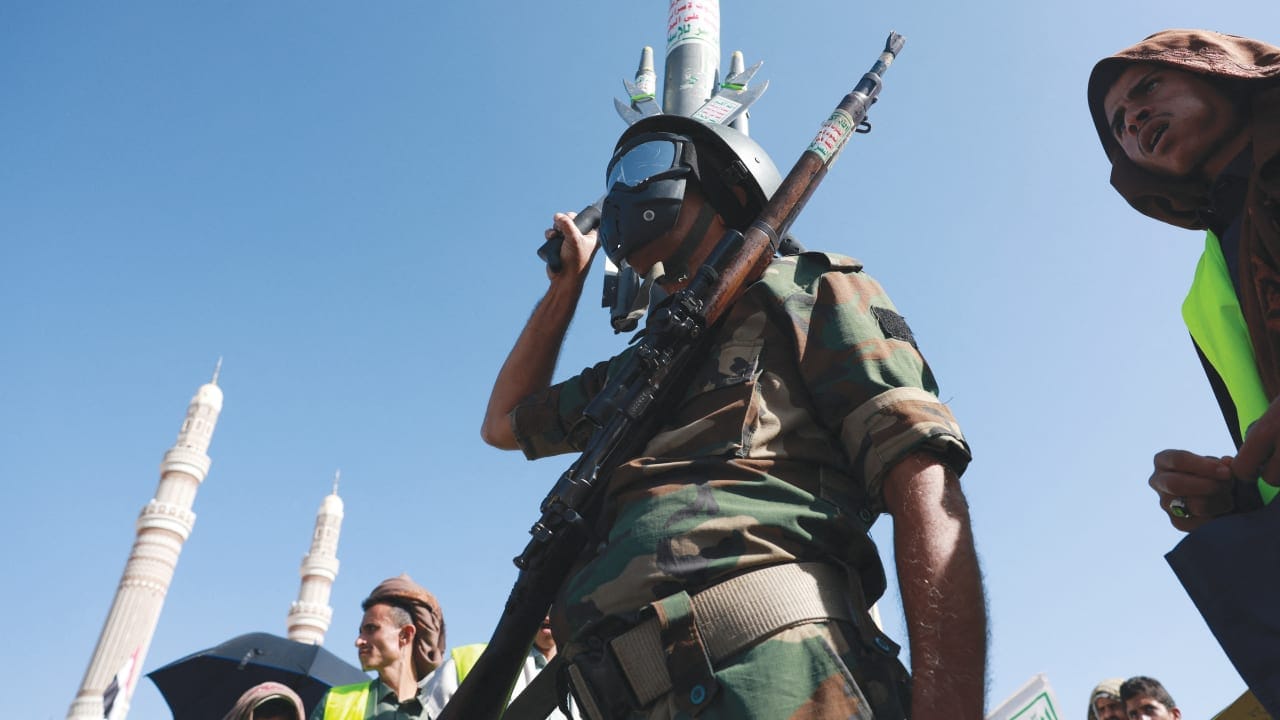
Retaking Sanaa: Like Liberating DamascusAsharq al-Awsat, London, October 10For more stories from The Media Line go to themedialine.orgThe current war in Yemen could bring about historic change, just as happened in Syria with the overthrow of another Iranian-backed regime.Yemen’s internationally recognized government now controls more than two-thirds of the country and is fighting to reclaim the remainder. But that final third will be no walk in the park, given the terrain and military challenges involved. It may not be decided quickly, despite the gains achieved in the north and southwest.This is a war against Iran’s Revolutionary Guard and Lebanon’s Hezbollah, whose operatives serve within the Houthi leadership and ranks.This war differs in several important respects from the previous Yemen war, which began in 2015.For years, the Houthi militia has operated under the supervision of Iran’s Revolutionary Guard. Its fighters are not the barefoot cave dwellers some portray them as. They have trained in Lebanon and Iraq and spent years preparing for this confrontation, making it another regional war with Tehran.Kurdish special forces patrol the outskirts of Erbil, Iraq, Sept. 22. (credit: Khalid Al-Mousily/Reuters)Reliable reports indicate that Abdul Reza Shahlai, a commander in Iran’s Quds Force, directed the Houthis’ latest offensive on the Tihama plain.Several new factors distinguish today’s war from yesterday’s.The international community, once divided, is now almost united against the Houthis and increasingly convinced that this is a just war on behalf of the Yemeni people. The conflict has also become a matter of regional security and international trade. There is now a desire to end Houthi control, as part of a broader effort to reduce Iranian influence in the region, an effort that reached a milestone with the fall of Bashar al-Assad’s regime nearly two years ago.During the previous war, Britain and the US sought to prevent an advance toward Hodeidah and Sanaa, believing that a political settlement through the Stockholm negotiations would achieve the desired outcome.After nearly a decade of Houthi rule, however, it has become clear that the movement differs little from terrorist organizations such as ISIS and Hezbollah. It is another branch of the Iranian regime’s network, notwithstanding certain differences.The Houthis have become an even greater international threat this year, as the Bab el-Mandeb Strait has grown in strategic importance.With the Strait of Hormuz nearly closed because of the war with Iran, the Red Sea has become an alternative outlet for energy exports.US Defense Secretery Pete Hegseth delivers his 2026 ‘State of the Force’ address to the Marine Corps Base in Quantico, Virginia, Sept. 30. (credit: Evan Vucci/REUTERS)In coordination with Tehran, the Houthis announced their intention to close the strait. Consistent with Iran’s attacks on oil shipments, they declared a naval blockade against Saudi Arabia and began targeting its tankers. It was for this purpose that they seized Perim island and the Mocha area last month, both of which have recently been liberated.Previously, the international community showed little interest in correcting Yemen’s disastrous situation. That changed when the crisis ceased to concern only Yemenis and their neighbors and became a threat to international shipping. The European Union, Britain and the American administration quickly condemned the Houthis and offered logistical support for operations against them.If the current war achieves its objectives, it will end Houthi domination of the Yemeni people and bring relief to millions. Some 22 million Yemenis living under Houthi control could be rescued from the brink of famine and epidemics. According to World Health Organization figures, cholera cases have tripled in just three weeks. Millions of children could return to school after years without education.The extremist religious movement has also transformed Yemen into a transit route for people fleeing wars and famine in East Africa, a corridor for drug smugglers and a haven for al-Qaeda and ISIS, both of which operate there and maintain dealings with the Houthis. The movement also has an arms-smuggling relationship with the Somalia-based terrorist organization al-Shabaab.Twelve years have passed since the Houthis forcibly seized Sanaa. Like Lebanon’s Hezbollah, they imposed their rule through coercion, adopted a similar name – Ansar Allah – and displayed portraits of their leaders.This war is different from previous wars and skirmishes. For the first time, Yemen’s legitimate government is fighting as a unified force, bringing together diverse Yemeni factions under one banner. Earlier confrontations were largely fought by the Arab coalition alongside government forces with limited domestic reach.The coming weeks and months could prove decisive. The chairman of Yemen’s Presidential Leadership Council has clearly identified the objective: the liberation of Sanaa.Supporters of Egyptian president Hosni Mubarak display his photo during his burial ceremony, east of Cairo, Feb. 2020. (credit: MOHAMED ABD EL GHANY/REUTERS)If Yemenis succeed in defeating Iran’s proxy, it will constitute a major regional victory, much like the achievement of Ahmed al-Sharaa’s forces when they advanced from Idlib province and liberated the Syrian capital from Assad’s regime. – Abdulrahman Al-RashedIraq’s Kurds: Little Choice But To Work With BaghdadAn-Nahar, Lebanon, October 9As Iraq celebrates the withdrawal of coalition forces from its territory, Iraqi Kurds are hardly in a celebratory mood. A Kurdish researcher at the London Dialogue research center believes the withdrawal calls for a funeral rather than a celebration.“It is not good, but it is an Iraqi decision,” said Sirwan Barzani, a Kurdish military commander turned businessman. “They asked them to come to their country, and now they are telling them they are no longer needed.”Barzani warned of renewed activity by ISIS terrorists. His forces and those of the Iraqi government have observed four or five Islamist cells operating near Makhmour in Nineveh province after months of inactivity. This is an alarming development.“We know what happened in 2014. There will certainly be terrorist cell activity now, and we can already see it.”Iraqi and Kurdish forces are nevertheless better trained and organized than they were in 2014, when ISIS captured a third of Iraq and extensive areas of Syria. The organization was eventually driven out of Iraq in 2017 and Syria in 2019 through counteroffensives by local forces supported by the international coalition.In 2024, Iraqi and Iranian officials agreed that coalition forces would withdraw from Iraq by September 30, 2026.Today, however, the greatest threat to Iraqi Kurds is not ISIS but continuing Iranian drone attacks, occurring amid the confrontation between Washington and Tehran and the possibility that Iraqi Kurds could help their Iranian counterparts conduct operations against the Islamic Republic.On the very day coalition forces withdrew, an Iranian drone struck a civilian camp housing Iranian Kurds near Iraqi Kurdistan.Since February 28, when the US and Israel launched their attack on Iran, the Kurdish Region of Iraq has faced approximately 1,000 drone and missile attacks from Iran and Iraqi armed groups loyal to it. These attacks have killed around 32 people, including 19 members of Iranian Kurdish parties.In March, rumors circulated that Iranian Kurdish forces would launch a ground invasion of Iran with American and Israeli backing, but no such operation materialized.On September 27, the Kurdistan Regional Government’s media office confirmed that Iranian Kurdish groups were aware of the 2023 security agreement between Erbil, Baghdad, and Tehran, intended to prevent armed Iranian Kurdish organizations from attacking neighboring countries.Meanwhile, Iraq had set September 20 as the deadline for disarming Iraqi militias in response to American pressure, only to postpone it until June 30, 2027.“The foremost internal Iraqi threat comes from pro-Iranian militias, which have attacked Iraqi Kurdistan and neighboring countries more than 100 times this year,” said retired US Army Col. Myles Caggins, a former coalition spokesman.Baghdad faces a substantial challenge in confronting these illegal militias, which continue launching drones without serious consequences.Barzani therefore believes the Kurds must be provided with air defenses. After all, this is Iraqi airspace. Even if Iraq itself lacks adequate defenses, it will remain vulnerable to these threats, and the hope is that any new air-defense systems supplied to Baghdad will also be extended to Kurdistan.Joey Hood, a former senior State Department official for Near Eastern affairs who also served in Iraq, considers it unlikely that Iranian attacks across the Middle East, including Iraqi Kurdistan, will cease.Iran has targeted not only American troops but also American interests, using that justification to strike a power station in Kurdistan and a water-analysis facility in Kuwait.The federal government in Baghdad and the regional government in Erbil must work together, with partners such as the US, to acquire and deploy air-defense systems capable of countering these attacks.Even before the American-Iranian war, Iran and its affiliated groups targeted positions belonging to Iranian opposition forces, Kurdish oil and gas facilities, and Kurdish businessmen.On January 16, 2024, for example, Kurdish billionaire Peshraw Dizayee and his 11-year-old daughter were killed in a ballistic missile strike that Iran justified by claiming it had targeted an Israeli espionage headquarters.On September 30, US Central Command chief Brad Cooper stated that Iraqi security forces, including the Kurdish Peshmerga, now possess the capabilities, leadership, and operational independence needed to confront threats to their territory. Yet another CENTCOM officer expressed concern that Baghdad would show little interest in protecting Kurdish areas, particularly amid fears of incursions across their boundaries.The Kurds must therefore increasingly rely on themselves and on their relationship with Baghdad, according to a coalition official who previously advised the Peshmerga.Unfortunately, the coalition is now leaving. Its continued presence would have been valuable both for confronting ISIS and for maintaining military assistance. Only time will tell whether these concerns prove justified.At a farewell ceremony for American troops, Kurdistan Region President Nechirvan Barzani acknowledged one reality the Kurds cannot avoid: their growing dependence on Baghdad. This means entering a formative stage in which Iraq itself must assume an active and meaningful national role. – Sarkis NaoumResuming the Iran War: Congress vs PentagonAl-Ittihad, UAE, October 10Developments within the Pentagon and Congress, alongside competing centers of influence in the American decision-making establishment, particularly the administration itself, reveal a growing dispute over how the war with Iran should be managed, how much should be spent on it, the mechanisms of oversight, and the limits of authority in conducting military operations.Differences over the war have spread from Democratic leaders to figures within the Republican Party, many of them supporters of President Donald Trump. The debate also involves military and political leaders and reaches as far as Defense Secretary Pete Hegseth himself.At the heart of these disagreements are the war’s cost and the prospect of continued operations. Expenditure had already reached $43 billion by September, including additional costs and nearly $28b. for replenishing ammunition and other requested allocations.This has prompted lawmakers from both parties to demand comprehensive accounting of operational costs, damage sustained by American bases, and the expense of repairing aircraft, ships, and other equipment.The Congressional Budget Office has also presented estimates of the war’s costs and its impact on military stockpiles, further complicating the administration’s request for at least $67b. in additional funding. This comes alongside a proposed defense budget that could reach $1 trillion in 2027, with the possibility of still greater spending should full-scale war resume.The central disagreement is that the Pentagon seeks additional resources, while Congress wants to define the objectives for which money may be allocated and restrict its use. Lawmakers from both parties may not fully appreciate the breadth of the military requirements involved.The War Powers Resolution of 1973 will undoubtedly remain a source of contention if war with Iran resumes, particularly over whether Congress must approve a declaration of war or provide explicit authorization for military action.There is also concern about the effects of renewed military operations on the armed forces themselves, the performance of the defense secretary and senior commanders, and the broader turmoil within the military establishment. Recent dismissals and resignations, together with delays in military appointments, point to the possibility of further confusion and even disorder within one of America’s most strategically important institutions.Members of Congress are therefore pressing for serious consultations and a firm approach rather than direct confrontation, especially as the US faces challenges extending well beyond the Middle East. These include the Indo-Pacific, the growing demands posed by China and Russia, and security concerns closer to Europe.Washington must consider its readiness to confront multiple contingencies, including the possibility of simultaneous military engagements in different regions.Congress is consequently moving to rebuild a framework of understanding with the administration without waiting for the midterm elections. Several military priorities cannot be postponed, including investment in strategic programs such as missile defense, interception systems, early warning capabilities, and space technology.Congress is also expected to examine the scale of American military deployments worldwide.Virtually every major military issue may now be reopened as Congress moves urgently to reaffirm its political role in national decision-making, while the Pentagon continues operating with Trump’s direct support.The consequences will be felt in both funding for military operations and the authority to wage war. Proposed increases in the 2027 defense budget, particularly for research, development, and procurement, underscore the scale of the decisions awaiting lawmakers.The disputes between Congress, the Pentagon, the administration, and influential military institutions are unlikely to disappear. All sides may also be waiting for the midterm elections before reassessing their policies. Each has its own priorities, and reconciling them will require greater agreement, candor, and transparency, as American military involvement in the Middle East continues and the possibility of renewed war with Iran remains.For now, the major policies under consideration will remain politically contested. – Tarek FahmyHosni Mubarak, Military CommanderAl-Masry Al-Youm, Egypt, October 8The anniversary of Egypt’s great October victory has arrived, and we have heard much said about it, yet almost nothing about Hosni Mubarak. I mean Mubarak the commander of the Egyptian Air Force during the October War, not Mubarak the politician, whose legacy remains controversial and always will.It is the military commander who concerns me here, for one simple reason: we should imagine what might have happened had the airstrike he led at the opening moment of the crossing of the Suez Canal failed. Any ground forces fighting on the battlefield remain exposed to the enemy unless they have air cover protecting their positions.The initial airstrike under Mubarak’s command provided that protection. Without it, our forces would have found it extremely difficult to cross the Suez Canal itself, let alone penetrate the earthen defenses of the Bar Lev Line. This was Mubarak’s contribution, alongside the airmen under his command, and it deserves to be remembered.One of the principal reasons for the crushing defeat of June 5, 1967, was that the enemy struck our aircraft while they were still on the ground. Once our air force had been neutralized, the enemy knew our ground forces were completely exposed. What followed were horrors almost beyond belief, as anyone reading the political memoirs of those dark days can attest.The heroic Anwar Sadat absorbed that lesson, as did the Egyptian Air Force. When our army went into battle and secured victory on October 6, 1973, every soldier knew that Egyptian aircraft were protecting him from above. Our ground forces advanced and kept advancing because Mubarak and his pilots provided a protective aerial umbrella.Nor was that his only achievement. The Battle of Mansoura was also fought under his command, and anyone familiar with its details knows that it stands almost without parallel in the history of aerial warfare. Military academies continue devoting extensive attention to it when teaching the landmark battles of military history.Israel launched 120 aircraft to destroy air bases in the Nile Delta, only to find our air force waiting for them. An extraordinary aerial battle followed, lasting a full 53 minutes. By its conclusion on October 14, 1973, the Israeli aircraft had been divided into two groups: those destroyed and those forced to flee. Mubarak led that effort.The Koran teaches: “Do not let the hatred of a people prevent you from being just.” In other words, disliking someone must not keep us from giving them the credit they deserve. Another verse instructs us: “Do not deprive people of what is rightfully theirs.”We have deprived Mubarak the military commander – not Mubarak the politician, I repeat – of the recognition he deserves in many respects.– Soliman Gouda ■Translated by Asaf Zilberfarb. All assertions, opinions, facts, and information presented in these articles are the sole responsibility of their respective authors and are not necessarily those of The Media Line, which assumes no responsibility for their content.
Voices from the Arab press: Yemen’s fight to retake Sana'a mirrors Syria’s liberation of Damascus
Full Article
Original Source
Read the full article at Jpost →KhanList aggregates and links to publicly available news content. We do not host full articles from third-party sources. Always verify important information with original sources.