
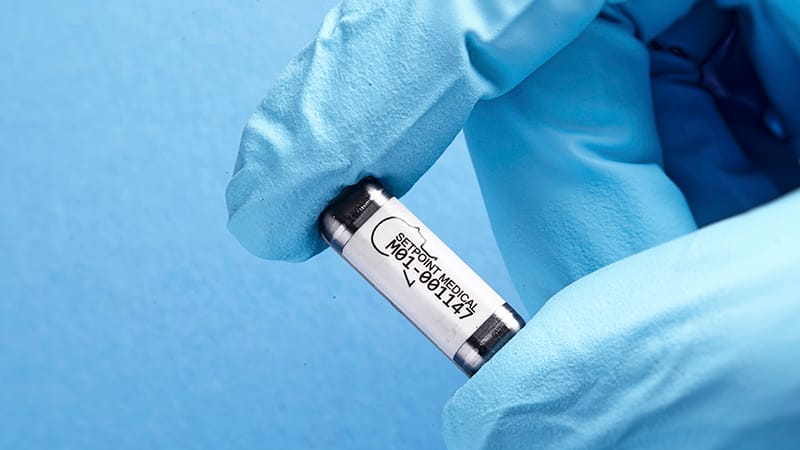
Rheumatologist Ann Igoe, MD, has lived with debilitating rheumatoid arthritis (RA) since she was a 10-year-old girl in Ireland, but since she received a vagus nerve neuroimmune modulation implant in July that’s specifically indicated to treat RA, she said, “I actually felt like I won the lotto.”That’s because her RA-related fatigue and cognitive issues have subsided. “I didn’t feel like I had like the flu, and I felt just a lot more alert,” she said. She had resigned herself to the lifelong effects of RA, even though she’d taken adalimumab, tocilizumab, and etanercept, with various effects. “I don’t have that aching in my elbows, and I don’t have aching in my hands and knees that I previously just attributed to degenerative arthritis.”Ann Igoe, MDIgoe, a rheumatologist at Arizona Arthritis & Rheumatology Associates in Prescott, Arizona, received SetPoint Medical’s vagus nerve neuroimmune modulation implant to treat her RA. The FDA approved the implant about a year ago for the treatment of RA, and in that time, more than 300 procedures have been performed, said David Chernoff, MD, SetPoint Medical’s chief medical officer.Igoe is one of the fortunate ones who broke through the barrier of prior authorization to get the device. John Tesser, MD, a colleague of Igoe’s at Arizona Arthritis & Rheumatology Associates in Avondale, Arizona, said he has referred 12 patients for the device in the past year since the FDA approved the device. Three of them have been approved.“This is a disruptor,” Tesser said. “It’s the first device ever approved for any autoimmune therapy.”Rheumatologists and neurosurgeons said that patients who have learned about the implant seem enthusiastic. “I’ve never had a patient population so excited about the idea of surgery,” said R. Webster Crowley, MD, a neurosurgeon at Rush University Hospital in Chicago.Chernoff said when the clinical trial was posted online, more than 20,000 people registered for the 250 slots.Here’s a look at how the device has fared over the past year, the experiences of the rheumatologists who prescribe it and the neurosurgeons who implant the device, and the economics of the device itself based on an early cost model study.The Details Behind the DeviceThe science behind SetPoint Medical’s device is based on decades of experience using vagus nerve stimulation (VNS) to treat other diseases. The FDA approved the device in July 2025 for treatment of moderate-to-severe RA based on results of a randomized, double-blinded, sham-controlled trial of 242 patients.David Chernoff, MDThe FDA approved the first implantable VNS device for treating drug-resistant epilepsy in 1997 and since then other VNS devices have been approved for treatment-resistant depression, migraines and cluster headaches, and chronic ischemic stroke. “There are 200,000 patients walking around with batteries in their chest,” Chernoff said. Igoe noted that trauma therapists have studied vagal nerve therapy for “a very long time.”“Vagus nerve stimulation is a treatment that is quite familiar for neurosurgeons because it has long been approved for the treatment of epilepsy,” said Ellen Air, MD, PhD, a neurosurgeon at Henry Ford Health in Detroit. “The vagus nerve is a very integral nerve and modulates immune activity as well as neural activity.”The SetPoint Medical device is an inch-long pod that encases electrodes and a rechargeable battery. Two loops attach it to the vagus nerve. Its surgical implantation requires one incision where the neckline meets the chest, whereas existing VNS devices require two incisions, one for the device, the other for the battery, which are connected via a wire.SetPoint Medical deviceTwo weeks after implantation of the SetPoint Medical device, the patient goes to the rheumatologist to have the device turned on. The device delivers electrical stimulation to the vagus nerve for 1 minute once a day. To recharge the battery, the patient must wear a recharging collar for an hour once a week. The battery is designed to last for up to 10 years, Chernoff said.The implantation surgery takes about an hour and can be done in a standard operating room; it does not require any proprietary equipment, Chernoff said. Igoe said her incision healed in 7-10 days. Crowley said he does the procedure on an outpatient basis.At Dignity Health - St. John’s Regional Medical Center in Oxnard, California, Akinwunmi Oni-Orisan, MD, has done about two dozen SetPoint Medical device implants. “Overall, I’m pretty impressed with the technology. The device is really straightforward for me to implant, and it’s really straightforward for patients to get the procedure, to recover.”In the pivotal clinical trial, 35.2% of the SetPoint Medical device implant recipients had at least 20% improvement in American College of Rheumatology (ACR20) response criteria at 3 months vs 24.2% of sham recipients (P = .0209). In an open-label extension, the ACR20 response rate improved to 50% at 6 months and to 52.8% at 12 months.No device removals have occurred since it became commercially available, Chernoff said, but six of 242 patients in the clinical trial had device removals at 12 months. The explanting surgeons reported the vagus nerve appeared to be normal. About 98% of the patients continued to receive therapy at 12 months.Tesser, who led the clinical trial, and neurosurgeons who have implanted the device said that the response rate improves over time. “Typically, it takes about 6 months for people to see a benefit, so we don’t have a lot of information in terms of tolerating the procedure and tolerating the implant,” Oni-Orisan said.“The whole issue of compliance is eliminated,” Tesser said. “The patient can’t control it. They have no way of turning it on, turning it off, or changing the parameter.”“What’s required now,” Chernoff said, “is a lot of education.”Adopting VNS for the Rheumatology PracticeTesser advised that rheumatology practices interested in pursuing this option should go to the company’s website, which offers a link to contact a company consultant.John Tesser, MDSetPoint Medical has identified neurosurgeons who have experience with vagus nerve procedures to set up surgical centers for the implantation and can connect rheumatologists with them, Chernoff said. The procedure is available in eight states — Arizona, California, Illinois, Minnesota, New York, New Jersey, North Carolina, Oregon, and Texas, according to SetPoint Medical — and the company has an agreement with Lovell Government Services, a government services vendor, to connect with federal healthcare providers, such as the Veterans Administration and the Military Health System.For rheumatologists, the referral process is similar to that for any advanced RA therapy, Chernoff said. “The key difference is, instead of sending a prescription to a specialty pharmacy, the rheumatologist sends a referral with medical history to a SetPoint-trained surgeon,” he said. The surgeon and surgical facility handle the prior authorization not the rheumatologist. Once the patient’s insurance approves the procedure, SetPoint Medical works with the surgeon and rheumatologist to coordinate the implant procedure.After the implant procedure, patients return to the rheumatologist, who uses an iPad app to activate their 1-minute daily therapy, Chernoff said. SetPoint Medical provides the charger and an iPad to the clinic and trains the clinic’s staff on the activation procedure. “The therapy activation typically takes only a few minutes and can be performed by either the physician or allied healthcare providers,” he said. Once the therapy is activated, rheumatologists can continue to see patients based on their own routine follow-up protocol.Disruptive TherapyThe novelty of the device makes it a challenge to get insurance coverage, Tesser said. “What this tells you is the great difficulty of getting a new therapy adopted and approved by insurance,” he said. “Although, interestingly enough, it’s less expensive than a year of a biologic or advanced targeted therapy.”He said the approval process for a patient to get an implant can take 3-6 months.R. Webster Crowley, MDThe preauthorization process is one downside, said Crowley, the Rush neurosurgeon, noting that the waitlist at Rush University Hospital is over 50 patients. Crowley said that Medicare is “the most receptive” to covering the device, for which the Centers for Medicare and Medicaid Services in November 2025 granted Transitional Pass-Through payment status, a temporary Medicare add-on payment for new medical devices used in hospital outpatient settings. And although Blue Cross/Blue Shield plans have been “unwilling to consider” coverage, Crowley said, “some of the other commercial insurances are coming along.” Oni-Orisan in California said, “We do currently have a fairly long backlist.”Insurance companies are not the only stakeholders slow to embrace the technology. “To be honest with you, a lot of my colleagues ask, ‘Where do I put this? When do I order this? What is the right patient to order it for? And how am I going to integrate this into my armamentarium of other therapies?’” Tesser said.The Right PatientThe device’s approved indication is for patients with moderate-to-severe RA who have not responded to — or cannot tolerate — biologic or targeted synthetic disease-modifying antirheumatic drugs (DMARDs). “Essentially, we’re selecting patients that have been on maximal medical management and despite that continue to have symptoms or are having side effects to their medications,” Oni-Orisan said.At some point, patients who have tried many different drugs run out of therapeutic options, Tesser said. “In every patient who’s failed multiple drugs, the next drug therapy has less chance of succeeding, just by our own experience,” he said.Crowley cautioned that the procedure is “not a cure-all,” but he estimated 60%-70% of patients seem to respond well.Tesser listed a host of patients who would potentially benefit from the implant. Topping that list are patients at risk for or who have already had a serious infection that makes them averse to immunosuppressive therapy. Others include patients with concurrent conditions.The list also included “patients who have major atherosclerotic disease who may have a risk particularly for major cardiovascular events or venous thromboembolic events — those patients you may not want to put on a JAK inhibitor or an interleukin-6 inhibitor” — and patients at risk for malignancies, Tesser said.Another group would be patients with neurologic demyelinating disease or other central nervous system peripheral neuropathies for whom “you’d rather avoid” putting on an anti-TNF agent or interleukin-6 inhibitor, he added.For “needle-phobic” patients who don’t want to give themselves home injections or patients who have access issues, such as those “who live hundreds of miles away and can’t get to your office very frequently for proper monitoring of drug therapy, this may be a perfect alternative therapy,” Tesser added.While a percentage of patients who get the device might be able to discontinue their DMARDs, people who get the device but need additional control of their RA can take DMARDs to supplement the effect, Tesser said.However, any patient who has had a splenectomy cannot get the device, Crowley said. Surgery or radiation in or around the neck is “not a deal breaker,” he said, but that must be taken into consideration when planning the procedure.The Potential EconomicsThe device costs about $59,500, according to a cost-effectiveness study earlier this year. Chernoff confirmed that is in “the ballpark” of its average selling price. The same study estimated the cost with implantation to be $64,263, including the facility and physician fees and the device cost. The study also estimated the annual cost of DMARDs, based on the Veterans Affairs federal fee schedule, at $64,100.Ellen Air, MD, PhDThe upfront costs are significant, said Air at Henry Ford Health, who led the cost model study. “But once the upfront cost is assumed, then the ongoing costs are baked in,” she said. “There are no additional ongoing costs.”The cost-effectiveness study created a model to evaluate the comparative cost of the device and medical therapy and quality of life. It found the device was cost-saving at less than 2 years and associated with a cost savings of $25,397 at 2 years and $197,000 at 10 years.The study evaluated the cost-effectiveness per quality-adjusted life year (QALY) gained, which amounted to almost a full year (0.87) overall, 0.10 at 2 years, and almost a half QALY (0.46) at 10 years.“When we think about new treatments, we want to make sure that we are responsibly choosing them, both for their efficacy and safety, but also for the long-term impact that we want,” Air said.“This analysis is an important piece of determining the long-term benefit of this [device], not just looking at the efficacy but looking at [what] the broader impact is,” she added. “This is the optimal way that any new technology should be brought to the fore.”Anecdotally, Chernoff said that about 50% of the implant recipients discontinue their RA medications by year 2.Looking AheadThe published evidence supporting the effectiveness of the SetPoint Medical device is limited, but Tesser said he is looking forward to seeing the 2-year data readout scheduled for later this year.Crowley added: “ The initial results are really encouraging, but it will be interesting as we get more real-world experience.”Igoe, Crowley, and Oni-Orisan reported having no relevant financial relationships. Tesser reported being a consultant to SetPoint Medical. Chernoff reported being an employee of SetPoint Medical. Air led the cost-effectiveness study that was funded by SetPoint Medical.Richard Mark Kirkner is a medical journalist based in the Philadelphia area.
VNS for RA a Year After Approval: Where Do Things Stand?
Full Article
Original Source
Read the full article at Medscape →KhanList aggregates and links to publicly available news content. We do not host full articles from third-party sources. Always verify important information with original sources.