
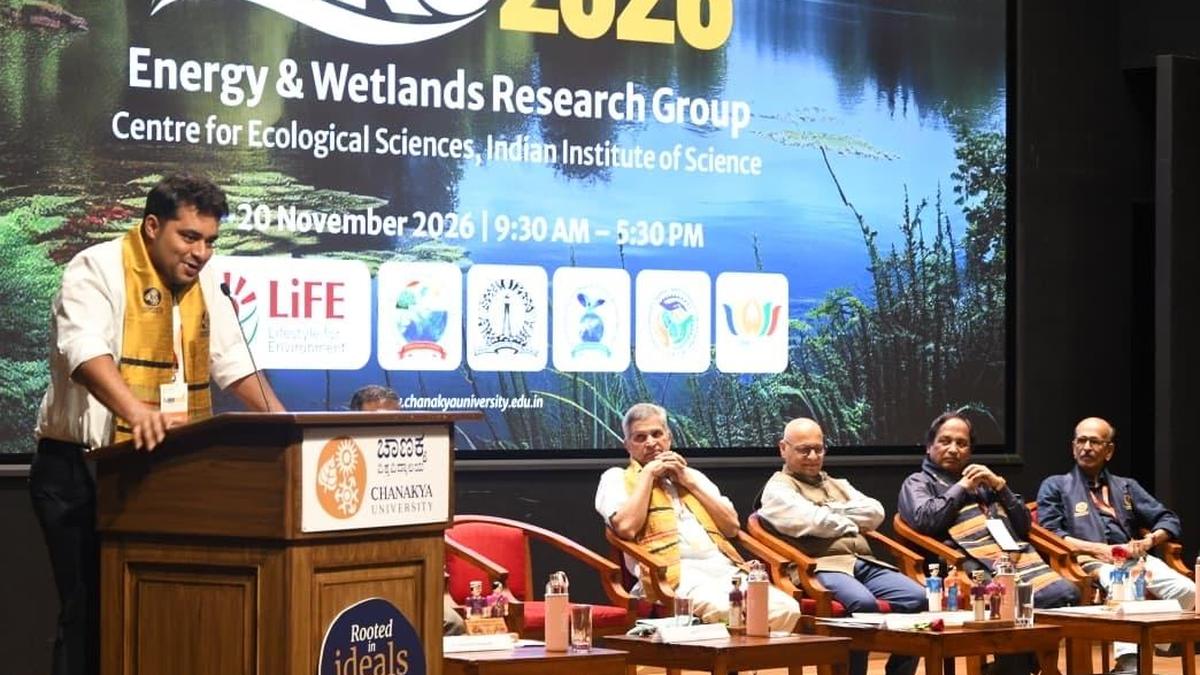
Alva’s Education Foundation Managing Trustee M. Vivek Alva speaks at the 15th Biennial Lake Symposium 2026, organised by Chanakya University’s School of Engineering, Bengaluru and the Energy and Wetlands Research Group of the Centre for Ecological Sciences, Indian Institute of Science (IISc), on November 18 in Bengaluru. | Photo Credit: SPECIAL ARRANGEMENT Alva’s Education Foundation Managing Trustee M. Vivek Alva on Wednesday (November 18), said development initiatives in ecologically sensitive regions, including the Western Ghats, must be guided by scientific assessment and a balance between environmental conservation and people’s livelihood.He was speaking at the 15th Biennial Lake Symposium 2026, organised by Chanakya University and the the Centre for Ecological Sciences, Indian Institute of Science (IISc), at Bengaluru.While several regions in the world have only 30 to 40 species of plants and animals, the Western Ghats are home to nearly 6,800 species, of which around 3,500 are in the Ghats adjoining coastal region, he said. Living in such an ecologically sensitive region also places a greater responsibility on its people to protect the environment, he added.Highlighting environmental initiatives undertaken by Alva’s Education Foundation, Mr. Alva said the institution regularly conducts cleanliness drives with the larger objective of bringing about a change in people’s attitudes towards cleanliness and environmental responsibility. In association with the Paryavarana Samrakshana team, the Foundation has been implementing the ‘Hasiru Samvada’ initiative across 56 villages to make environmental conservation a community-driven movement.Yettinahole projectExpressing concern over the environmental implications of major developmental projects, Mr. Alva said that the impact of the Yettinahole project on the fragile ecosystem of the Western Ghats required serious consideration. He pointed out that the Nilgiri Marten, a rare mammal reportedly sighted earlier in the Yettinahole and Bisle Ghat regions had not been sighted for nearly 15 years. Such changes in wildlife presence should serve as a warning about the consequences of ecological disturbances.He also referred to objections raised by the Union Ministry of Environment, Forest and Climate Change regarding aspects of the project. Mr. Alva also expressed concern over the proposed 2,000 MW Sharavathi Pumped Storage Hydroelectric Project in the Sharavathi valley, warning that large-scale interventions in the ecologically sensitive Western Ghats could further threaten its fragile biodiversity.Acknowledging the severe water needs of drought-prone regions, including Kolar, Mr. Alva said ensuring adequate water for farmers and safeguarding agricultural livelihoods were important responsibilities of the government. Their water requirements must be addressed through permanent and scientifically sound solutions. However, the water needs of one region should not be met at the cost of damaging the fragile ecosystem of another, he said.Mr. Alva urged students and young researchers to ensure that their academic projects went beyond theoretical exercises and addressed real-world challenges. Research should contribute to society, encourage community participation and evolve into initiatives that support local development, he said.Former Chairman of the Western Ghats Task Force and environmental activist Ananth Hegde Ashisara, Chanakya University Vice-Chancellor Yashavantha Dongre, T.V. Ramachandra of IISc and others were present. Published - November 19, 2026 04:22 pm IST
Vivek Alva stresses the need for striking balance between environment conservation and people’s livelihood
Full Article
Original Source
Read the full article at Thehindu →KhanList aggregates and links to publicly available news content. We do not host full articles from third-party sources. Always verify important information with original sources.