
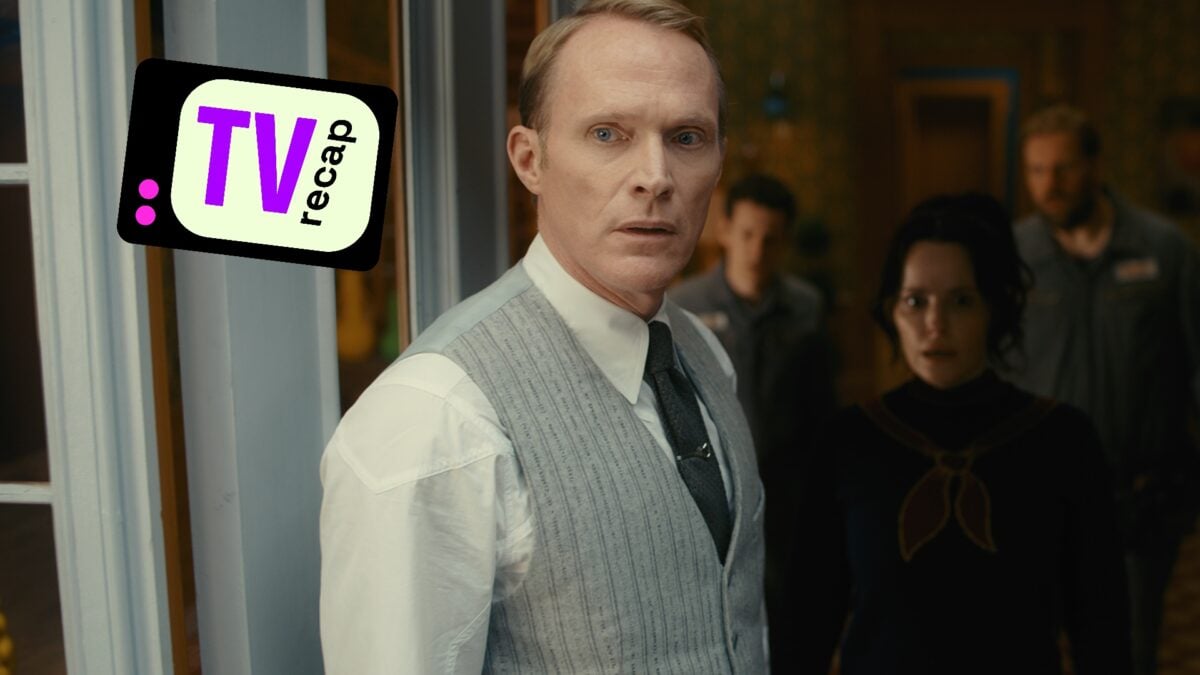
Throughout VisionQuest, Vision has drawn a line between his current self and his past self; Vision vs. the Vision, the former rebuilt from the pieces of the latter, with access to his memories but not his feelings. “The Vision had a unique advantage,” Vision tells Thomas in episode four. “An otherworldly power source that helped him navigate the complexities of the mind and the heart.” The text of that conversation is that Vision is responding to Thomas’ question about why the Vision didn’t end up like J.I.M., the world’s first synthetic humanoid, whose inability to process complex emotions caused his clockwork to spin and spin until he was engulfed in flame. But the subtext is that he’s also talking about the advantage his past self had over his current self. The Vision had the Mind Stone. Vision doesn’t. The internal friction caused by that discrepancy, of remembering but not feeling yet desperately wanting to be able to, is building up. How long will it be until Vision sets himself aflame, too? Episode seven, “Immolation,” answers that question. VisionQuest has been doing a lot of interesting thematic work that has, at times, felt too separated from its plot, testing the limits of its Marvel Cinematic Universe box with its internal meditations on humanity, identity, and what it means to be alive. The more conventional MCU aspects of its story have done an admirable job of reinforcing its philosophical leanings, but it hasn’t always been an easy fit. “Immolation” continues that uneasy alliance, essentially putting the external plot on hold while Vision figures his shit out. “Immolation” opens with a flashback to 1939. Inside a massive country estate, Dr. Phineas Horton (played by Paul Bettany) tinkers away at a robot. He’s building J.I.M., an exercise in grief over the loss of his real son, James. His wife, fed up with his retreat from reality, leaves him, telling him as she goes that she hopes one day he’ll be able to build something that can love him back. That’s the opposite of what Phineas wants, though. “Your heart will be built of metal and motion,” he tells J.I.M. “Fueled by fire. And you need never know the consequence of love. Its sorrow, the pain of crying out for someone who can no longer hear you. You will be free, my boy. You will be free.” To Phineas, the weight of grief is too heavy to bear, so he seeks to create a being unburdened by emotion. Back in the present, Vision and Thomas are trying to figure out what to do about Lisa. The nanos have fused with her neural network, so they can’t just remove them. They’ll need to reprogram them instead, and for that, they’ll need the source code. Meanwhile, Jocasta and Ultron are stymied in their attempt to open the vault that holds the rest of her nanos. There’s a password that Jocasta can’t remember, tied to a person she also can’t remember. © Marvel The Client has a solution to both of their problems: they can help Vision and Jocasta find the answers they need—which are, naturally, locked away within their subconsciouses—in exchange for them joining the Client. That sends them both to do some deep-sea code-diving. In Jocasta’s case, she’s given the address of a loft in Brooklyn, which looks an awful lot like the attic where Vision kept Ultron locked up in his Mindspace. There, she realizes she was part of a research duo, but she can’t remember who her partner was. Ultron also has a sneaky side conversation with F.R.I.D.A.Y., in which he manages to convince her that he’s actually still on Vision’s side. In Vision’s case, the Client promised that the source code could save both Vision and Lisa, but it’s the prospect of saving Lisa that gets him to agree. Thomas loves her, after all, and even if he’s still not sure what his relationship to Thomas is, or what he even wants it to be, he knows somewhere inside of him that helping Thomas and Lisa is the right thing to do. Paladin provides Vision with the spear Corvus Glaive used to stab him in Avengers: Infinity War to use as a power source, because sorting through his code is going to take a lot of energy. Vision’s journey into his subconscious takes the form of three big conversations, each of which guides him toward a truth that he’s been running from all season long. First, he sees Ultron, who implies that Thomas is Vision’s son, which he rebukes. Then, Vision sees the Vision, his former self, who calls him out for being a coward who consistently runs away from his problems instead of dealing with them. And, finally, he sees J.I.M. (also played by Paul Bettany) and Phineas, whose strained father-and-son relationship hits uncomfortably close to home. Phineas purposely designed J.I.M. without emotion, but J.I.M. wanted to be able to feel more than anything, and he resented his creator so deeply that the fire that consumed him consumed Phineas, too. © Marvel Yet, even when Vision is confronted by a scene in which he sees his relationship with Thomas—and his relationship with Ultron—reflected, he still can’t help but try to run away. “I’m sorry about your father,” Vision tells J.I.M. “He wasn’t my father,” J.I.M. responds. “But he was my something.” Tragic, but, ahem, Vision really does need that source code, so could J.I.M. possibly point him in the right direction so he can keep running away from his problems? He’s on a deadline, after all. J.I.M. tells him that the answer lies within the Vision. “But where, oh, where, is the Vision?” he taunts. Suddenly, there’s nowhere left for Vision to run. His resolve shatters; he admits that Thomas is his son, that he feels unimaginable grief over the loss of Billy, Tommy, and Wanda—and that he and the Vision are one and the same. “I am the Vision. I have always been the Vision. There is only one, and I am he,” Vision says. Turns out that when the Client said he’d give Vision a heart, he just meant that Vision would find it within himself, because it had been there all along. In the real world, Vision transfers the source code to Lisa just as she starts to lash out, saving her life. And he keeps up his end of the bargain, heading off to hand himself over to the Client, who we now know is Jocasta’s research partner. The drop-off point is Phineas Horton’s estate, where James Spader, sporting a whimsical moustache instead of Ultron’s bushy beard, emerges from the shadows. Clearly, Ultron is based upon whoever this is. Back in episode four, when Vision and Thomas were talking about J.I.M., Vision said J.I.M. died because he was lacking a Mind Stone. Thomas, though, had a different take. It wasn’t a Mind Stone that J.I.M. was missing. It was a family. New episodes of VisionQuest arrive Tuesdays on Disney+. Want more io9 news? Check out the best movies and TV shows to stream this month and all the upcoming sci-fi, fantasy, and horror books that should be on your radar.
‘VisionQuest’ Unveils the Man Behind the Curtain
Full Article
Original Source
Read the full article at Gizmodo →KhanList aggregates and links to publicly available news content. We do not host full articles from third-party sources. Always verify important information with original sources.