
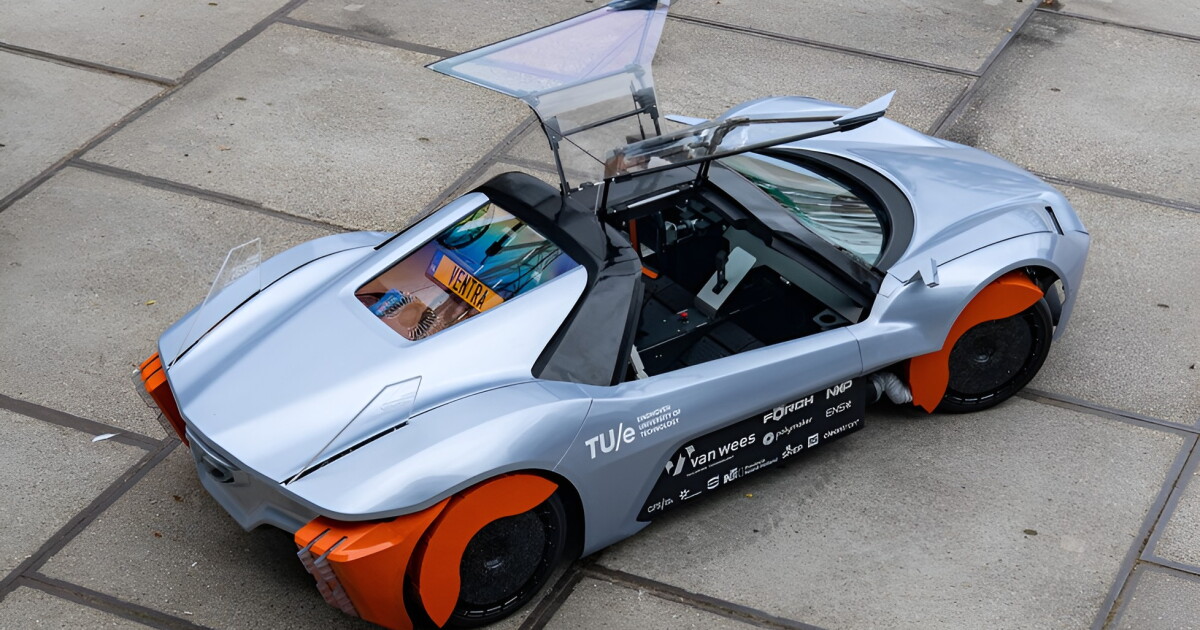
Electric cars don't cough out exhaust, but their tires and brakes are still shedding a nearly invisible haze into the air. A team of Dutch students has built a concept that gives those particles a static charge, then sticks them to a grounded surface, like a balloon grabbing lint.The car is called Ventra and is the latest prototype from TU/ecomotive, the student team at Eindhoven University of Technology. Instead of tackling exhaust, it targets particles worn off tires and brakes as the car rolls."Just because there are no tailpipe emissions doesn't mean there are no emissions," says team manager Tim Spencer. He argues the problem could be even bigger for electric vehicles (EV), since they tend to be heavier and wear tires more when accelerating. Much of the chassis uses carbon-fiber-reinforced panels, which the team says shave nearly 100 kg (about 220 lb) off the carSarp Gürel/TU/ecomotive Some of this dust can be small enough to reach the lungs and, depending on size and composition, the bloodstream. The team links this to a higher risk of cardiovascular and respiratory disease. Regulators are starting to look down at the wheels, too. Europe's Euro 7 rules will set the first requirements for brake and tire wear emissions from November 2026.To catch these particles, Ventra’s system works on the air around each wheel, where the dust is born. It gives the particles an electric charge, then draws them to a grounded surface (one connected to the earth, so charge can drain away), where they stick.The collecting surface can be vacuumed or rinsed, and the captured material can be recycled. They reused some in the cabin, making the interior a quirky tribute to brake dust.Simulations suggest that between 31 and 50 mph (50 and 80 km/h), about 24% of particles would end up in the collector. At lower speeds, it's 42%, but the students don’t say what "lower" means, so real-world traffic performance is unclear.Even in the best simulated case, more than half the dust still gets away. So the team also tries to make less of it. Much of the chassis uses carbon-fiber-reinforced thermoplastic panels, which shave nearly 100 kg (about 220 lb) off the car's weight. Less mass means less pressure on the tires and less wear. Ventra targets dust worn off tires and brakes as it rollsSarp Gürel/TU/ecomotive A driving-coaching system called Clean Drive also watches how the car is driven and flashes on-screen prompts to smooth out acceleration, braking and cornering. The students say this extends the life of tires and brakes.Ventra follows a line of unconventional student cars. Earlier ones can pull CO2 from the air while driving, are built from ocean-recovered waste, or are designed to last a lifetime. Last year's ARIA (Anyone Repairs It Anywhere) is a modular EV that owners can fix themselves.Like its predecessors, Ventra is more provocation than product. It's a demonstration, built to plant an awkward question in the industry's mind. “With Ventra, we want to show what solutions are possible and encourage the automotive industry to look beyond the exhaust pipe when it comes to emissions,” Spencer says. The answer will depend on the next step, taking the idea out of simulations and onto real roads.Source: TU/Ecomotive
Visionary coupe self-cleans the emissions EVs still create
Full Article
Original Source
Read the full article at Newatlas →KhanList aggregates and links to publicly available news content. We do not host full articles from third-party sources. Always verify important information with original sources.