
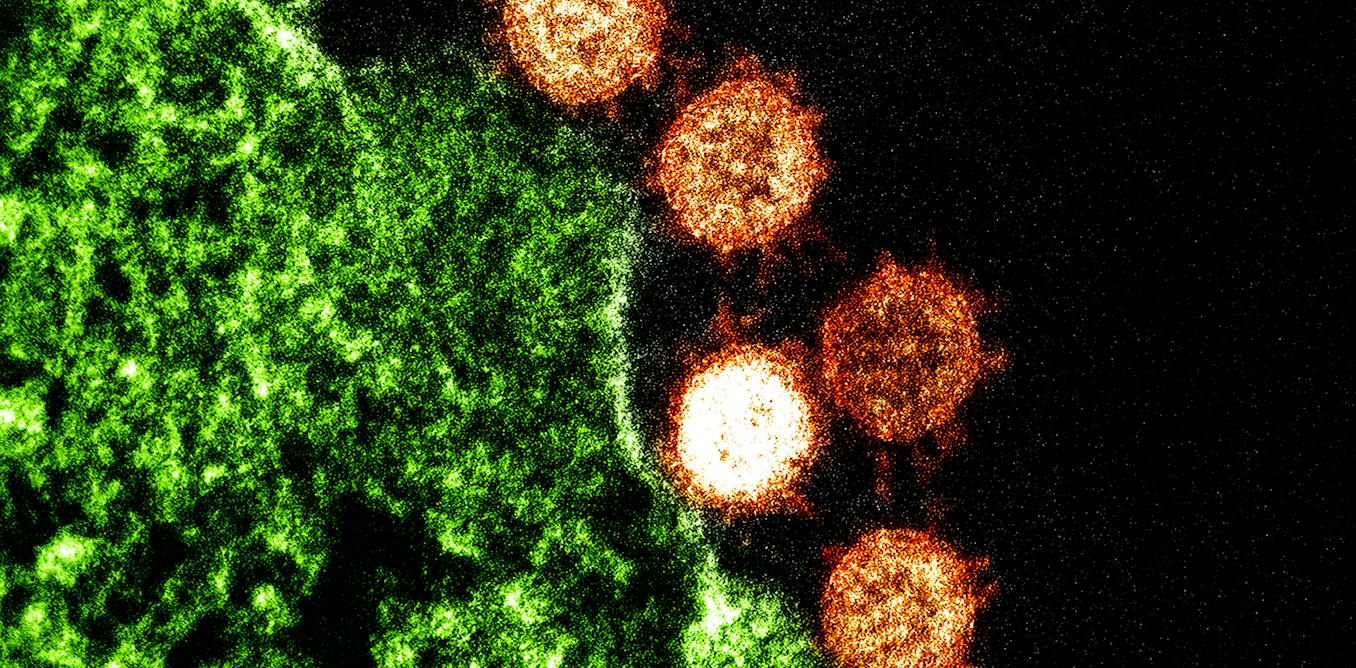
The beauty of physics at the cellular scale is part of what draws biomedical engineers and biologists like us to the field of mechanobiology: the study of how physical forces influence biology. Physics holds relevance everywhere. You can see physics at work on how the cells lining your veins and arteries feel the flow of your blood, the cells of your spinal discs carry the weight of the vertebrae surrounding them, and the cells of your lung cyclically stretch with every breath. If each and every building block of the body experiences some combination of these physical forces, then the viruses that infect them must contend with a variation of those forces, too. How viruses interact with these forces affects how well they can infect cells and cause severe illness. How viruses exploit cellular machinery When microscopic virus particles enter the body, they rely upon the mechanical machinery of the cells they infect to continue their life cycle. Many viruses will first latch onto receptors on the cell’s surface. Movement of the cell’s membrane – driven by its internal cytoskeleton – will bend and wrap around the invading particle, pinching off a tiny bubble that carries it inside. In this process of endocytosis, the cell swallows the virus. Once inside, the virus is shuttled along the cell’s internal scaffolding. It releases its genetic material and hijacks the cell’s machinery to make copies of itself. New virus particles will then exit the cell to infect its neighbors. This video shows an immune cell engulfing MRSA bacteria (green) – a form of endocytosis. Each of these steps is physical at its core. The tautness of a cell’s membrane could make it easier or harder to wrap around a virus. The cytoskeleton that transports these virus particles is the same lining that cells use to sense and push against their surroundings. What’s more, the stiffness of a cell’s environment will shape how the cell spreads and organizes itself, which may change how susceptible it is to an invader. A healthy individual often can quickly recover from an infection. However, for someone with a preexisting condition such as pulmonary fibrosis – where the tissue of the lungs has stiffened and can no longer stretch to full capacity – a viral infection may make their condition worse. This mechanical predisposition of tissues to infection is one reason health professionals urge the public when sick to avoid the elderly and immunocompromised. Bringing bodily forces into the lab Our laboratory looks into the mechanobiology of different types of tissues to understand how the physical forces people endure in daily life can worsen disease. Repetitive lifting and loading can wear down the discs of the spine, for example, and mechanical ventilators can overstretch and injure lungs. But growing cells in a plastic petri dish – the standard method in most virology labs – shows only part of the story. Tissue culture plastic is significantly stiffer than living tissues, closer to a countertop than a lung. Cells notice the difference during experiments; the stiffness of their surroundings can change both how they behave and how they respond to an infection. To bring the mechanics of the human body into the lab, we grow lung cells on thin layers of a flexible, silicone-based polymer called PDMS that we fine-tuned to match the softness of actual lung tissue. These sheets sit in small chambers that will cyclically stretch and relax on command from a computer that sets how far and how long they stretch. This allows us to mimic the physical movements of breathing. Monitoring cell mechanics We can use a virus engineered to make infected cells glow red under a microscope to monitor how it spreads among cells. But how can we monitor how the mechanics of a cell change during infection? Our team follows the activity of two important proteins, YAP and TAZ, that act as the cell’s force sensors. When a tissue experiences stiffness or tension, these sensors will move into the nucleus and turn on genes tied to growth and repair. When those forces are lacking, as is generally the case in softer tissue, YAP and TAZ remain inactive and stay put outside of the nucleus. People with pulmonary fibrosis have much stiffer lungs than those without the condition. National Heart, Lung and Blood Institute (NIH)/Wikimedia Commons Some viruses are known to tap into this same signaling pathway, so examining YAP and TAZ may offer a window into whether mechanical forces and infection influence one another. Using the gene-editing tool CRISPR, we can attach a fluorescent tag onto YAP or TAZ and watch their activation in real time under a microscope as they react not only to mechanical forces but potentially to infection as well. With this platform, we can better answer questions such as whether lung cells will respond to infection differently under different forces or whether these forces will change how well viruses infect. Thus far, our early findings suggest that the stiffness of a cell’s environment affects how heavily cells become infected: Lung cells grown on stiffer, fibrosis-like surfaces appear to become more heavily infected. Mechanics matter during outbreaks Understanding the mechanics of viral infection is of particular interest to researchers and clinicians, given the persistent prevalence of respiratory infections worldwide. The common cold, COVID-19 and the flu represent merely a drop in the viral infection bucket: More than 200 species of virus are known to infect humans. Mechanobiology may be just as important to the cycle of infection as its biochemical or immunological aspects. Under a microscope, the differences are clear between a stiff, overworked lung and a soft, healthy lung, and viruses may navigate these environments in adaptive ways. As scientists map these mechanical signals, new possibilities for preventing and treating infection are opening up. Among them are therapies that could reduce the physical strain on tissues or even biomarkers that could tell patients whether they are susceptible to tissue stiffening or certain infection paths and the possible damage they may cause. The human body is just as mechanical as it is chemical, and so, too, are the infections it encounters.
Viruses obey the laws of physics – studying how can help researchers understand why they infect people differently and lead to better treatments
Full Article
Original Source
Read the full article at Theconversation →KhanList aggregates and links to publicly available news content. We do not host full articles from third-party sources. Always verify important information with original sources.