
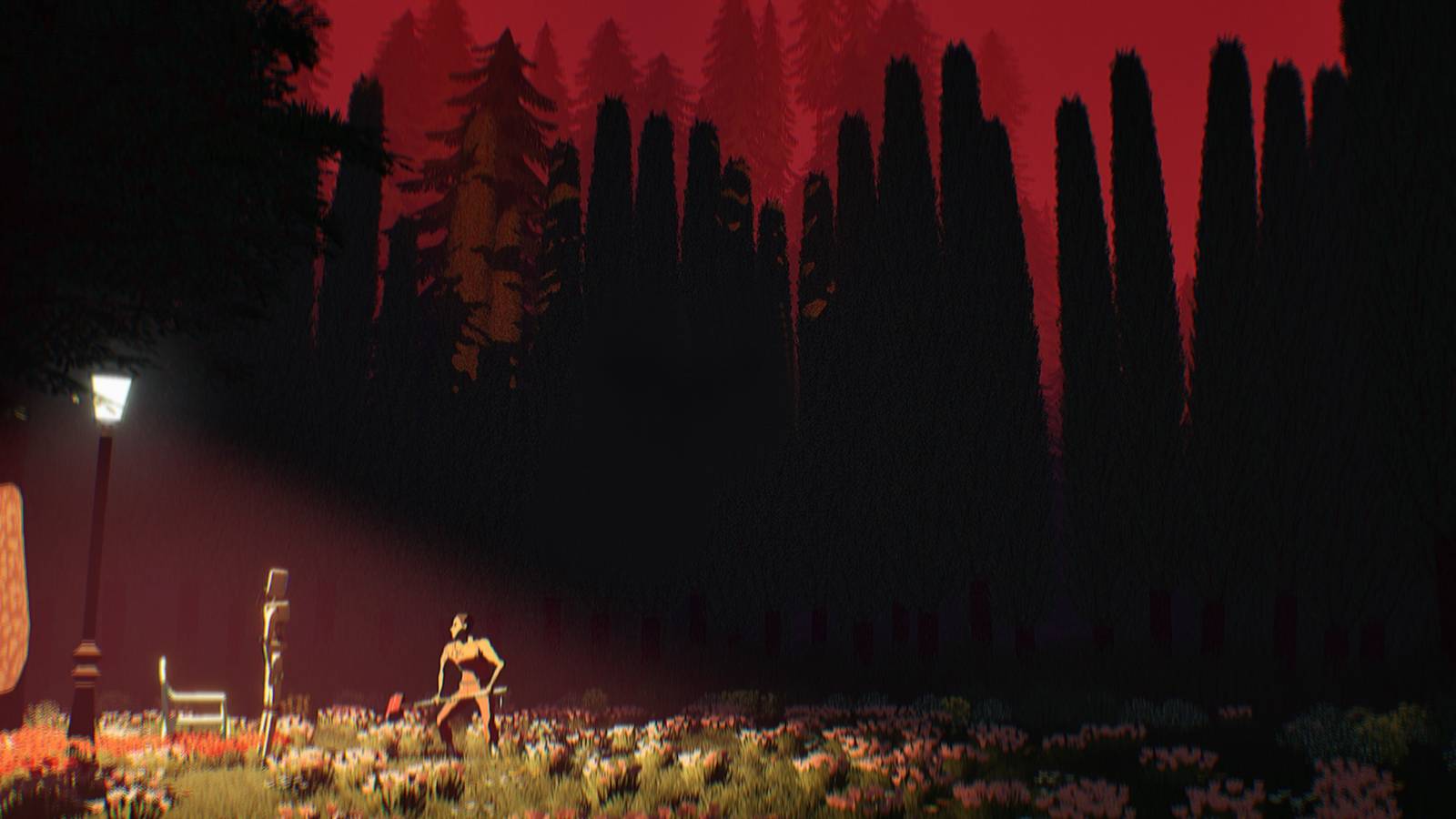
I took a lot with me to Virtue and a Sledgehammer, left muddy tracks on the carpet, dirty dishes in the sink. This new experimental narrative by Spanish studio Deconstructeam with Selkie Harbour—their recent compatriots in three-dimensional ludology—is a ferocious void scream, an Artificial Intelligence effigy held in hands while it burns. It’s a tricky, inimitably personal project to objectively regard, but that’s probably why it will find exactly who needs it. Deconstructeam has always told difficult stories, but Virtue remains a conspicuous standout within that standard. Centered on cathartic destruction, its gameplay is concentrated down to a single repetitive verb: smash. More incidentally action-packed than your typical walking sim, Virtue and a Sledgehammer’s compact structure can veer off into monotony, but its emotional payload is shattering. The City On The Sledge of Forever Pratelle’s back in her rural Spanish hometown with a hammer and an iron will. The old buildings of Virtud with their barrel tile roofs are unchanged, but the former inhabitants have been replaced with robots running casual routines of the living past. Some water plants, pray at church, or lazily gossip outside markets and cafés. Generously, they could be taken as intricate homages to the dead. By all accounts, Nina is a genius. With her devil’s bargain tech route to peaceful immortality, Pratelle’s sister transformed the townies into “digital beings,” their pasts and personalities eternally intact. In the face of the hammer, some try and negotiate, others beg for deliverance, feebly attempt to defend themselves, or simply retreat into a trembling crouch of abject surrender. I admit that I wavered in my mission. Some of these clankers made good points and, even though a few retain the nasty prejudices they presumably transitioned with, most are gentle, non-combative, even ruminative. One way or another, they chose this fate, opting for an inconsequential eternity of gardening and conversation. It does have a nice ring to it. We anthropomorphize nearly everything, and Virtue and a Sledgehammer anticipates the trap of this tendency. For Pratelle, her town’s mechanical denizens are not real, so she never dignifies their prattle with a single uttered response. Your only discourse is the sledge and the only resolution is debris. When All You Have Is A Hammer... There’s no running or jumping or climbing trees in the game, and priming your hammer beyond a hasty shove into a mighty swing or overhead smash takes a few good seconds to charge. It’s just slow enough to be meaningfully intentional, but this can also make smash-heavy sequences drag, rendering the game’s iconic snail a little on the nose. Besides the robots, you’ll spend equal hammer-time on Virtud's architecture. The echoing crackle of collapsing masonry is unbelievably satisfying, which helps carry the inherently repetitive task through the few hours of a playthrough, and ricocheting a robot into a house as the roof caves in upon them is a joy, pathos be damned. Catharsis is the carrot, and if this demolition wasn't so gratifying, the experiment would similarly collapse. That being said, I’d warn away anyone expecting the immersive verisimilitude of Teardown or Red Faction: Guerrilla, and there’s plenty in the game that you can’t destroy: cars, mountainsides, trees, or even chain-link fences. A Slow Path Of Destruction Virtue and a Sledgehammer’s environment is oddly circuitous, and later exploration seems to indicate that the town itself may not even be outright real, as it were. Consider the presence of floating red and blue statuary; break enough red ones or a single blue pulls up a short flashback. That's where you’ll learn more about Pratelle, Nina, and mother Merche, tracking the sisters through intimate micro-scenes as they develop their identities, contend with their mother’s death, and nurture entrenched resentments. Jordi de Paco is an agile scribe with a knack for resonantly capturing conversation, something Deconstructeam’s releases often leverage at scale, with Virtue and a Sledgehammer’s word count a mere fraction of the studio's norm. Maybe that’s why I found the story so draining, with more than a few unusually wrenching coincidences, since the game’s comparably sparse narrative left available space to fill with my own. The studio's quintessential dialogue options remain, but they're much different here, maybe colder and crueler than what I've grown used to. I found myself repeatedly disagreeing with everything on offer, left to select the ones I found the least discordant. It doesn't help that both Pratelle and Nina wield sarcasm so deftly; selecting what I considered a biting insult often proved completely ineffective, but I worked on translating the sisters' shared coded language. Shattering Soundtrack For The Wasteland Combining three-dimensional models and pixel art presents a unique abstraction for this occasionally gory sci-fi family tragedy. I’ve always appreciated Marina González’s delicate character work and animation, but its effect is sapped slightly in this polygonal approach. With garbled IDEs for heads, the digital beings are effective clones, but even our main characters’ faces are simplified and severe, amplified by the camera’s proximity to these pixelated textures. Explosive, caterwauling synths rage against the dying of the light, get cut to shreds with icy piano, then suffocate under a disintegrating bassline blanket. Parts of the OST feel like being compacted into the center of an over-capacity party and hopelessly squeezing your way to the exit, getting nowhere. While the game largely takes place outside, it's often claustrophobic. Garbage is everywhere, the waste products produced in manufacturing these machines and discarding their human wrappers are directly analogous to AI's disastrous ecological dawn. A sense of bitterness builds throughout and threatens to overwhelm, underlined by the game's core repetition; turning the trash-making trash into more trash predictably seeds despair. These Fragments I Have Shored Against My Ruins Destroying things can be fun for its own sake, Pratelle's sluggish movement and attacks can feel stiflin, even early on. Walking sims rarely prioritize player expression, and I don’t envision Pratelle as someone who is necessarily enjoying this process per se, but should the player feel likewise? Diverting paths in the open world are monotonous to explore and backtrack past, but it's a requirement if you plan to clear every flashback fragment. Nothing is carefully hidden, but the lack of any flashback or quest tracking made me feel routinely uneasy, like I left something behind many slow paces ago that I’d never come back for. There are no signposts in Pratelle’s warpath, but there are distinct chapters: the factory, the main street, the hospital, the graveyard. They accumulate to fill out the mystery over time, and I appreciate how its segmented nature is essentially free-form in practice, but it makes for a difficult game to pick up again after a break. An Elegy Written in Debris Virtue and a Sledgehammer is a mighty swing all told, and the target of its scorn feels keenly of its time. Opposing AI is not a controversial narrative risk in and of itself—and particularly poignant in this interactive medium—but I do find it interesting to compare with the sympathetic android Akara-184 from The Red Strings Club. I would warn against players seeking pure destructive distraction, however. While leveling a hometown seems immediately satisfying, you’ll quickly eat your fill of this bait, which leaves the rest of the game's emotional iron maiden to contend with. If you’ve ever cared for a parent with dementia, or detested a prodigal sibling who reflected that envy, or were ever left breathless by the venomous scorn of a small town, the game doesn’t pull any punches. It left me emotionally spent. As much as I appreciate the game and as fun as its action looks on the screen, it’s easily the least welcoming project in Deconstructeam’s catalog. In other words: you’ll have to meet Virtue and a Sledgehammer halfway and offer a piece of yourself besides. Select that journey carefully, and maybe you should also call your mom.
Virtue and a Sledgehammer Review: This Is Meant To Hurt You
Full Article
Original Source
Read the full article at Screenrant →KhanList aggregates and links to publicly available news content. We do not host full articles from third-party sources. Always verify important information with original sources.