
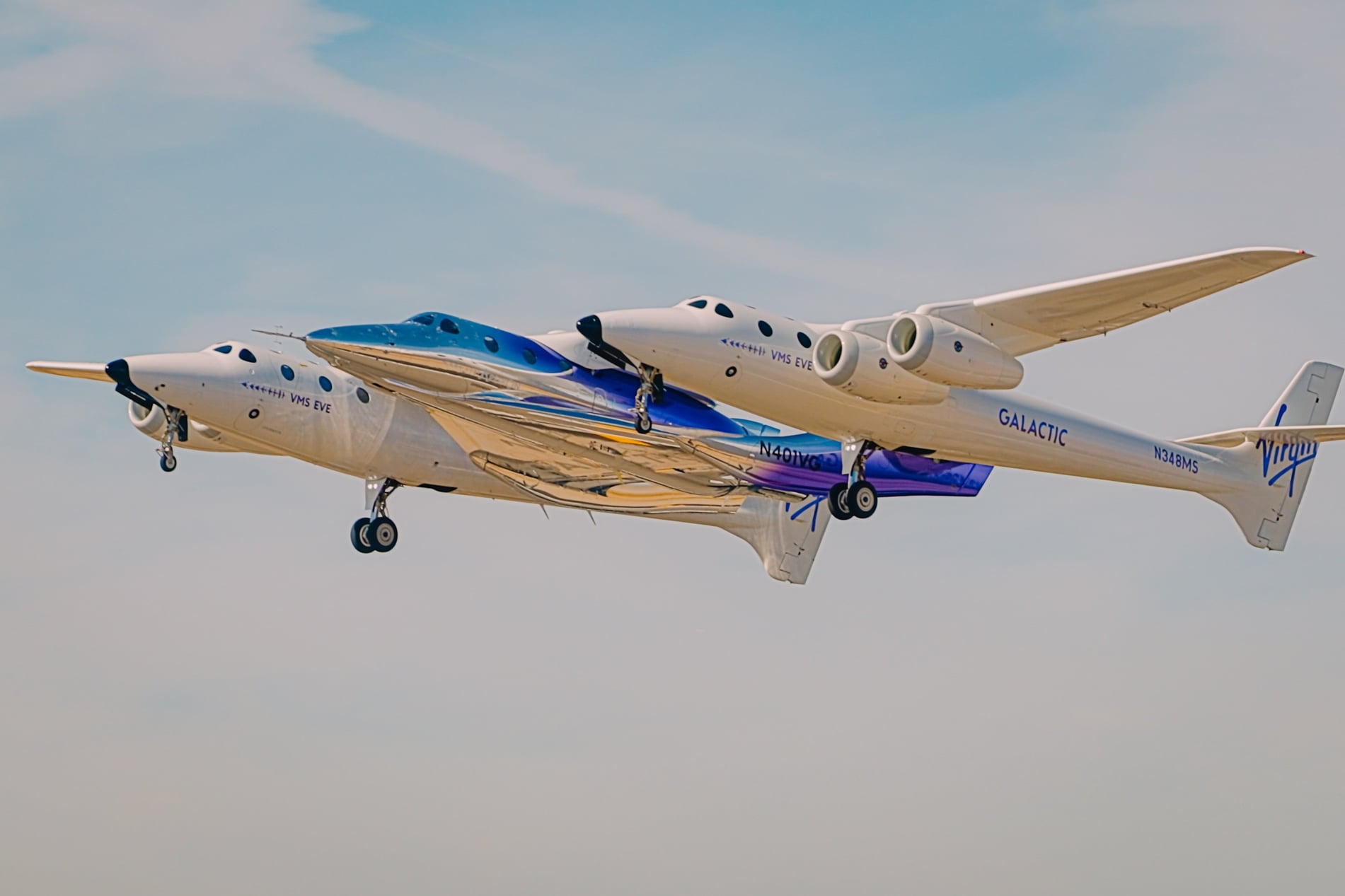
Virgin Galactic is back in the spaceflight spotlight with the unveiling of a shiny new object: an updated Delta-class suborbital space plane with an exotic name. More than two decades after SpaceShipOne won a $10 million X Prize for private spaceflight, Virgin Galactic flew its third-generation rocket ship from its factory in Mesa, Ariz., to its home base at Spaceport America in New Mexico on Oct. 28. The spaceship was named Apeiron in an online contest that attracted votes from people in more than 80 countries. Don't pronounce the word like "ape-iron"; it's actually "app-err-on," as in the Greek word for "Boundless." “This morning, we gave Apeiron a name. This afternoon, Apeiron came home,” Virgin Galactic CEO Michael Colglazier said. The new craft works on the same principles as the original SpaceShipOne: It will be launched from the belly of a twin-fuselage mothership at high altitude, blast itself upward to the edge of space, and fold its wings during descent to ease its gliding return to a runway landing. After SpaceShipOne's prize-winning flights in 2004, its design was modified to produce two SpaceShipTwo rocket planes for Virgin Galactic. The first SpaceShipTwo, VSS Enterprise, broke up during a flight test in 2014, killing one pilot and severely injuring the other. The second SpaceShipTwo, VSS Unity, successfully flew more than 30 spacefliers — including Virgin Galactic founder Richard Branson. Unity's last commercial spaceflight came in 2024, clearing the way for Virgin Galactic's Delta-class upgrade. The Delta-class design is aimed at beefing up the thermal protection system for Virgin Galactic's space planes, as well as streamlining the manufacturing and maintenance process. Virgin Galactic says it's aiming to launch each of its next-generation space plane twice per week, with a vehicle lifetime of more than 500 missions. The flight from Mesa to Spaceport America took an hour and a half, with Apeiron firmly attached to the underside of a mothership called Eve for the entire trip. Eve was piloted by Michael Masucci and Dan Alix, with flight test engineer Tori Crichton on board. “Seeing the ship fly beneath Eve to Spaceport America was a moment years in the making," Colglazier said. "To our team and our astronaut community: your Spaceship has arrived.” Now that Apeiron is at its home base, Virgin Galactic's engineering team will complete integration and validation of the avionics software while preparing for flight tests. By the middle of next year, the company plans to start flying customers who have paid as much as $750,000 for a suborbital trip to space. A second Delta-class space plane is already taking shape at Virgin Galactic's Spaceship Factory in Mesa, and teams are preparing a rocket motor assembly line. Apeiron's younger sibling — which hasn't yet been named — is expected to begin commercial operations in the latter half of 2027. If Virgin Galactic sticks to its schedule, it will have the suborbital spaceflight market all to itself, at least temporarily. Jeff Bezos' Blue Origin space venture sent 92 different people to the edge of space on its New Shepard suborbital rocket ship between 2021 and 2026. Some of those spacefliers were repeat customers. But after the 17th crewed mission in January, Blue Origin said it was putting its suborbital space program on hold for at least two years to focus on future missions to the moon.
Virgin Galactic Flies Next-Gen Space Plane to New Home With New Name
Full Article
Original Source
Read the full article at Universetoday →KhanList aggregates and links to publicly available news content. We do not host full articles from third-party sources. Always verify important information with original sources.