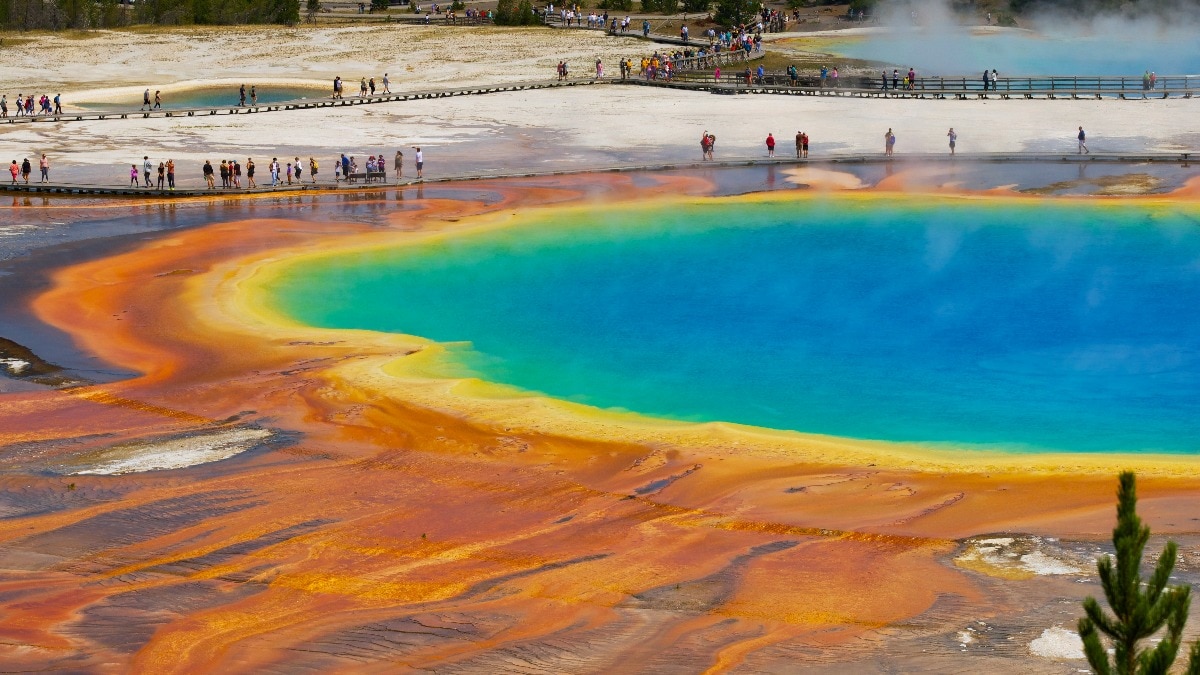
Tourists were filmed walking in a restricted area of Yellowstone's Grand Prismatic Spring, and the video has been viewed millions of times. Here is the science of why the rainbow colours are made of living bacteria, and why a single footprint can scar the spring for decades.Grand Prismatic Spring in Yellowstone's Midway Geyser Basin, where tourists were filmed walking in a restricted area. (Photo: Unsplash)Seven in the evening at Yellowstone National Park in America, and the light is doing what it does best. Steam lifts off Grand Prismatic Spring, a pool the size of a football ground, its water burning sapphire at the heart and bleeding into orange at the edges.Hundreds of people stand on the boardwalk with their phones raised. And then, out on the coloured ground where nobody should ever be, several figures are walking. Taking selfies.The video, filmed by a Montana visitor on July 18 and posted to Instagram, has since been watched millions of times. She later said she had tears in her eyes, and she was not being dramatic.What those two people strolled across is neither rock nor mud. It is alive. And it is one thin crust away from water that can cook a human being. We will come back to both of those. WHAT IS GRAND PRISMATIC SPRING?The breathtakingly beautiful spring sits in Yellowstone, which the world knows twice over: once as the first national park ever created, in 1872, and once as the setting of the Kevin Costner drama that made Montana ranch country television gold.Grand Prismatic is its most photographed feature and the largest hot spring in the United States, roughly 113 metres across and more than 37 metres deep, pushing out about 2,100 litres of water every minute. The temperature runs from around 70 degrees Celsius at the rim to close to 87 at the centre.WHY IS GRAND PRISMATIC SPRING SO COLOURFUL?The Grand Prismatic Spring is like a rainbow, but not because of minerals. The colours are microbes.The blue middle is the one exception. It is simply too hot there for almost anything to live, so the water stays perfectly clear, and clear deep water absorbs red light and scatters blue back at you. That is physics, not biology.Everything else is biology. The orange, yellow, brown and green rings are microbial mats, which are dense sheets of microscopic life stacked in layers, rather like a rug woven from trillions of living threads.The organisms that build them are called thermophiles, from the Greek for heat lover. They are bacteria and archaea, which are single-celled life forms so ancient that they occupy their own separate branch of the tree of life. The blue centre is pure physics, as clear deep water absorbs red light and scatters blue, while every other colour in the spring is made by living microbes. (Photo: Unsplash) Each species survives only within a narrow band of temperature, so as the water cools on its journey outwards, the cast of characters changes, and so does the colour.Synechococcus, a cyanobacterium, holds the hotter yellow-green zone. Phormidium and Calothrix take the cooler orange and rust rings further out.The warm tones come from carotenoids, the same family of pigments that colours carrots, working here as biological sunscreen against fierce ultraviolet light at altitude.Scientists can read the water temperature off the colours. The spring is, quite literally, a thermometer painted by life.WHY DOES ONE FOOTSTEP DO SO MUCH DAMAGE?The mat looks like damp sand. It behaves like wet tissue paper.A single boot crushes millions of cells outright. It compacts the mat, closing the microscopic gaps through which water, oxygen and nutrients move, so organisms that survive the impact may starve or overheat anyway.It tears the pigmented top layer away and exposes the pale layers beneath to raw ultraviolet radiation. The dent it leaves redirects the hot water flowing across the surface, cooling one patch and scalding another.And the sole of the shoe deposits soil bacteria, oils, sunscreen and repellent into a chemistry that has been stable for millennia. At roughly 113 metres across and over 37 metres deep, Grand Prismatic is the largest hot spring in the United States and discharges about 2,100 litres of water a minute. (Photo: Unsplash) These mats grow at a rate measured in millimetres a year. A footprint is not a smudge. It is a scar that can remain for years, and in bad cases, decades.There is also a debt owed here. In 1966, microbiologist Thomas Brock pulled a bacterium called Thermus aquaticus out of a Yellowstone spring.Its heat-proof enzyme, Taq polymerase, made PCR testing possible, which is the technology behind Covid-19 tests, DNA fingerprinting and modern genetics.Roughly every genetic test you have ever heard of traces back to a puddle of hot water in Wyoming.WHY IS WALKING NEAR A HOT SPRING SO DANGEROUS?Because the ground is a lie.The pale crust around thermal pools is sinter, a brittle shell of silica left behind as the mineral-rich water cools.It forms overhangs above hidden pockets of boiling water and steam, and in places it is only a few centimetres thick. It looks solid from above. It cannot hold an adult.At Yellowstone's elevation, water boils at about 92 degrees Celsius, and water well below that causes third-degree burns almost instantly. Each coloured ring marks a different temperature zone, with Synechococcus in the hotter yellow-green band and Calothrix and Phormidium in the cooler orange edges. (Photo: Unsplash) Hydrothermal features have killed more visitors than any other natural hazard in the park, bears included, a record documented in Lee H. Whittlesey's book Death in Yellowstone. Last June, a bison stumbled into Grand Prismatic itself and died.Under US federal law, foot travel in Yellowstone's thermal areas must stay on boardwalks. Offenders have been fined, jailed and banned.The boardwalk is not a suggestion. It is the only thing standing between a photograph and a funeral.- EndsPublished By: Radifah KabirPublished On: Jul 21, 2026 12:08 IST
Viral video: Tourists walk on Yellowstone's rainbow. It is alive, and can kill you
Full Article
Original Source
Read the full article at Indiatoday →KhanList aggregates and links to publicly available news content. We do not host full articles from third-party sources. Always verify important information with original sources.