
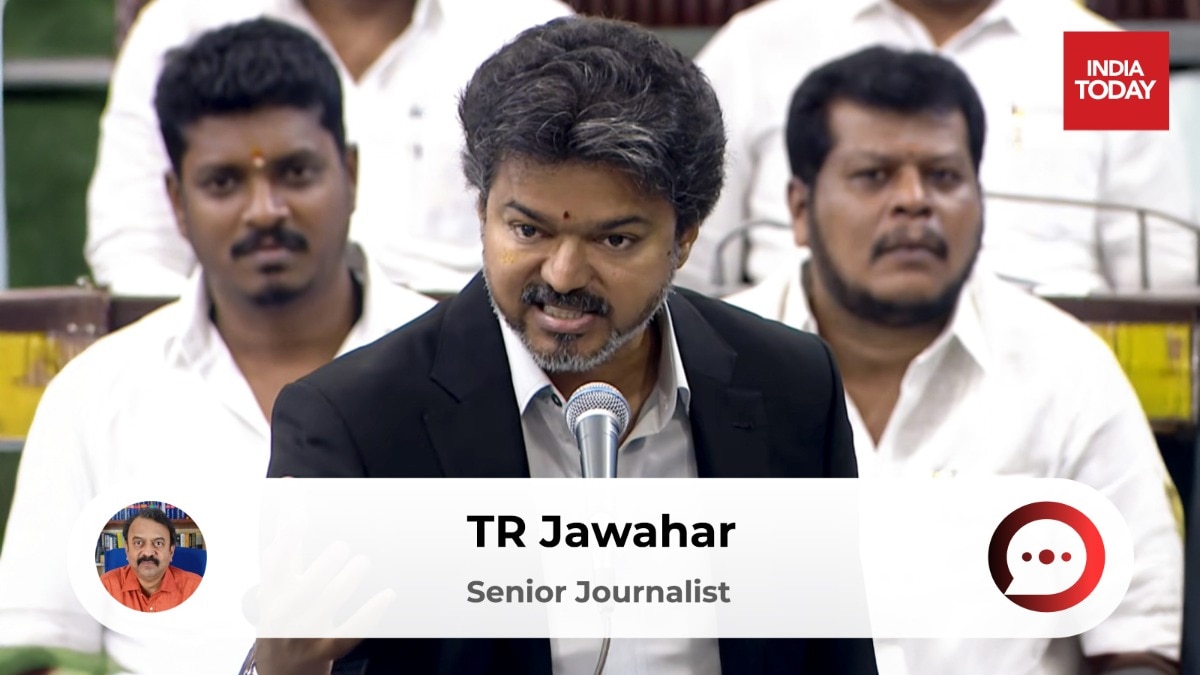
Governance in Tamil Nadu has long had the air of a matinee show. On Monday, the state Assembly had the anticipation of a Vijay release: a three-day build-up, an expectant House, a combative Opposition and a protagonist who knew precisely when to deliver the interval punch.The trailer had dropped on Thursday. Leader of Opposition Udhayanidhi Stalin charged the new government with failures in law and order, crimes against women, murders and custodial deaths, and challenged the Chief Minister to answer without running away. Vijay promised a reply on Monday and asked members not to leave before hearing it. Tamil Nadu politics had acquired that most cinematic of devices: the announced release date.Vijay arrived prepared. He had modulation, pauses, quotations, files, accusations, alliteration and the calibrated spontaneity of a performer who has spent three decades understanding when an audience is ready for the next line. He invoked Kannadasan and MGR-era song, reached into the Sarkaria archive, held up Enforcement Directorate material, named former minister V Senthil Balaji and turned a debate on Police Department grants into a broad prosecution of the DMK’s record.The actor in Vijay knew how to hold the scene. The politician knew how to wound the Opposition. The Chief Minister must now prove that the administration can deliver after the applause fades. FROM CHENNAI TO CALIFORNIAWatching from California among younger Tamils, I could see the speech cross not merely oceans and continents but a generation. The screen that once carried Vijay’s films from Chennai to California was now carrying its Chief Minister from the Assembly to the diaspora.The Bay of Bengal and the Pacific lay between the speaker and some of his audience. The algorithm removed both. Vijay’s films once travelled overseas after release. His politics now arrives live. The Assembly chamber contained 234 members; the digital gallery had no seating limit. What struck me was not simply that young viewers recognised the star. They followed politics. Names, commissions and controversies that belong to the muscle memory of seasoned journalists were reaching voters who were not born when some of those arguments began. For veterans, it was old wine. For younger voters, Vijay uncorked the bottle: the fizz was heady.Sarkaria is a distant past to an older generation, a footnote to the middle-aged and a search result to the young. Vijay converted the archive into ammunition. He did not discover the DMK’s baggage. He put it back on the political carousel and ensured that a new generation watched it arrive.For those well versed in Tamil Nadu politics, Monday’s cocktail contained familiar vintages – Sarkaria, TASMAC, the ED, prohibition and corruption. Vijay did not distil them. He mixed, shook and served them to a generation tasting the argument for the first time. It was educating, enlightening and, undeniably, entertaining for an audience that also happens to be the electorate.This is where dismissing his cinematic idiom becomes intellectually lazy. Tamil Nadu’s political speech has never been merely administrative prose. It has drawn upon theatre, cinema, poetry, oratory, song and satire. Annadurai made argument conversational; Karunanidhi could turn the Assembly into literature; MGR made a song sound like policy; Jayalalithaa combined icy authority with carefully staged symbolism. Vijay enters this tradition with a different instrument: the concise, repeatable, digitally portable line.Indeed, the Dravidian movement understood the screen long before political consultants discovered the “content strategy”. Cinema supplied not only celebrities but a common political vocabulary: the virtuous rebel, the unjust ruler, the suffering mother, the rescuing hero and the song that condensed a manifesto into three minutes. Vijay’s achievement on Monday was not to import cinema into a previously austere legislature. It was to update an old Tamil political technology for the vertical screen, where speeches are consumed as clips, subtitles and forwards before the official record has cooled.His Senthamizh may not climb the rhetorical towers familiar to the Dravidian veterans; it travels by a shorter staircase and reaches the balcony faster. Vijay did not enter the Assembly by leaving cinema at the door. He carried in its timing, recollection and democratic reach.THE CHALLENGER RECEIVES HIS REPLYThe DMK had invited the confrontation. Udhayanidhi had earlier mocked Vijay’s talk of corruption files, asking whether he was waiting for an astrologer to choose the date, and told him not to deliver cinematic punch dialogues in the Assembly. On Thursday, he broadened the challenge over policing and demanded an answer.Vijay supplied one with interest. “The DMK will be wherever there is wrongdoing, and wrongdoing will be wherever the DMK is,” he charged, accusing the previous regime of systematic or “scientific” corruption. He alleged extra collections of Rs 10 to Rs 100 on liquor bottles, invoked ED material on alleged TASMAC irregularities and referred specifically to Senthil Balaji. He also alleged that percentages ranging from 7.5 to 10 were extracted as party funds in contracts.The DMK asked Vijay not to run away. He arrived with a three-day trailer and a full-length reply; by the final reel, it was the Opposition heading for the door. The House was full, the Opposition walked out, and the speech walked straight into social media. Monday’s sitting began as a debate, acquired the pace of a screenplay and ended with the Opposition supplying the exit scene.The optics were damaging. A walkout can surrender the stage without surrendering the argument. The DMK looked forlorn under Monday’s arclights. But one badly reviewed show does not close a theatre with a sixty-year run.There was also an important procedural wrinkle. When DMK members demanded an opportunity to answer, Vijay asked that Udhayanidhi be allowed to speak. Speaker JCD Prabhakar declined amid the disorder, after which DMK members protested and walked out. That fact prevents a convenient but incomplete account in which the Chief Minister simply silenced his opponents. It also leaves the Opposition with a legitimate complaint about the management of the House, even if its disruption weakened its case.The DMK has survived greater reverses than an uncomfortable afternoon. It possesses organisation, experience, memory and a formidable instinct for counter-attack. Vijay won the scene decisively; he has not thereby settled every charge, closed every case or retired the Opposition. Democracy is not a single-screen theatre in which only one hero is permitted a speaking part.Nor should the Assembly become an elaborate studio for rival monologues. Its value lies precisely in interruption disciplined by rules: charge, answer, rebuttal and record. The government’s live telecast has enlarged public access, but transparency is more than switching on cameras. The citizen must be able to hear both the accusation and the reply. Otherwise, the lens may provide visibility while the procedure withholds perspective.FILES, FINDINGS AND THE BURDEN OF POWERThe Chief Minister’s corruption attack was politically potent, but potency is not proof. ED reports, agency statements, commission records and allegations placed in the Assembly may justify investigation; they do not by themselves constitute convictions.A report can reopen a political case; only due process can conclude a legal one. An allegation read from a file is not a finding written in a judgment. A punch dialogue can win applause; only a prosecution that survives appeal can establish guilt. If the files are on the table, the next act belongs to investigators, not scriptwriters.That distinction now matters more to Vijay than it did when he was in Opposition. Vijay once needed a microphone to make allegations. He now has departments, investigators and the law. Opposition politics asks questions. Government possesses the power, and therefore the obligation, to produce answers.If there is prosecutable evidence against former ministers, officials, contractors or party intermediaries, his government must place it before competent agencies and courts without delay or selective disclosure. If an officer named in an allegation is missing, locate the officer. If unlawful collections occurred in TASMAC, follow the money. If percentages were demanded for party coffers, establish the trail and prosecute those responsible.Corruption cannot be defeated by changing the party named in the allegation. Zero tolerance requires zero selectivity. The same vigilance must apply to the TVK’s ministers, legislators, functionaries and officials. Otherwise, yesterday’s “scientific corruption” will merely acquire tomorrow’s updated software.Vijay’s respect for M Karunanidhi, which he expressly stated while invoking official records, was a useful note of civility. Political inheritance can be examined without personal desecration. But historical references must be precise. The celebrated phrase “scientific corruption” has accumulated folklore through decades of partisan repetition. Any present charge must rest on the text and legal status of the material cited, not on the theatrical familiarity of the phrase.The anti-corruption ledger cannot be opened only at the DMK page. Jayalalithaa was convicted by a special court while serving as Chief Minister in 2014; although the Karnataka High Court later acquitted her and the Supreme Court proceedings against her abated upon her death, abatement was not exoneration.Nor can Vijay dismiss the AIADMK as a theerndhu pona katchi – a finished party – and then accommodate several of its politically burdened veterans: the party he pronounced empty has supplied his new establishment with surprisingly reusable parts.WHEN POLITICS ARRESTED POLICYThe irony of Monday was that it was a Police Department debate in which politics briefly arrested policy. The attack on the DMK dominated clips and conversation, while Vijay’s statements on vacancies, cybercrime, narcotics, women and children, police-public relations and custodial deaths deserved equal attention.The Chief Minister promised to fill police vacancies and strengthen the force against conventional and online crime. His call for digital-safety education beginning in schools recognises a transformation that policing everywhere is struggling to absorb. Crime no longer requires a street corner. Fraud, intimidation, sexual exploitation and theft can enter a home through a screen while the front door remains bolted.He called for police stations to maintain closer contact with people in their jurisdictions and said the police should be a trusted friend of those who respect the law. The language is familiar; its fulfilment is not. There can be no friendly police station for the law-abiding citizen if the lock-up remains hostile to the Constitution.Vijay also said crimes against women and children would be dealt with firmly and attacked degrading personal remarks against women in political discourse. That intervention was necessary. Freedom of speech does not include a licence to turn women – actors, activists, politicians or private citizens – into collateral material in male political combat.Civility cannot be a weapon used only against the incivilities of one’s opponents. A political movement that asks its leader to protect women must also ask its followers to respect them. The standard Vijay announced must therefore govern his own cadres, allies and online admirers as rigorously as it governs the DMK.His line on narcotics was more thoughtful than the usual declaration of war on drugs. Enforcement, he said, had cut only branches while the roots remained deep. He also cautioned against attributing every crime to drugs, noting the roles of family quarrels, property disputes and revenge. A government that arrests the peddler but cannot identify the patron has plucked a leaf and declared the tree defeated.Vijay cited 36 arrests in the murders of Kovai Amuthan and Chennai Dhanush Kumar and insisted that crimes committed during 2021-25 would not escape scrutiny merely because a hundred days of new government had elapsed. “All crimes did not emerge in the last 100 days,” was an effective political defence. Yet citizens do not elect a calendar. They elect a government to improve what it inherits.The Chief Minister also linked public safety with investment and industrial activity. That is sound economics. Capital seeks infrastructure and incentives, but it also seeks predictability, secure transport, reliable enforcement and social stability. Still, law and order cannot be measured by the decibel level of the Chief Minister’s assurance but by the conduct of the constable when no camera is present.THE LOCK-UP TESTCustodial death is the moment when the state becomes the accused inside its own police station. This was therefore the most morally serious part of Vijay’s reply, and the one against which his government must be judged most strictly.He said every custodial death would receive a transparent, impartial and legally mandated inquiry; that National Human Rights Commission procedures would be followed; and that post-mortems, magisterial inquiries and timely reporting would not be reduced to ritual. He promised that no officer found culpable would receive protection. He also spoke of prevention through monitoring, training, medical examination and technology.These assurances follow early criticism of his administration over alleged custodial deaths during its first weeks. That makes the pledge neither irrelevant nor sufficient. It converts silence into a stated standard, and the stated standard into a measurable liability.Tamil Nadu knows why this cannot be treated as a departmental footnote. Sathankulam entered the national conscience because the deaths of P Jayaraj and J Bennix exposed how ordinary custody could become extraordinary cruelty. Governments changed; the warning did not. Every subsequent death tests whether reform penetrated the station or merely passed through the news cycle.The NHRC framework requires custodial deaths to be reported promptly and places importance on magisterial inquiry, proper post-mortem documentation and videography. The Supreme Court has also directed CCTV coverage in police stations. Yet, CCTV can record brutality. Only command responsibility can prevent it.The test of impartial policing is not whether the government arrests its enemies, but whether it investigates its own uniform. A Chief Minister may control the House for an afternoon. Reforming a police culture requires control over every station after midnight.That requires more than cameras: functioning equipment, protected footage, independent retrieval, medical examination separated from police influence, swift suspension where evidence warrants it, witness protection, prosecution and public disclosure of outcomes. A death cannot be called transparent merely because the inquiry was announced transparently.Vijay said that every criminal would be equal before the law, irrespective of party. Admirable. Now comes the harder equality: the ruling-party organiser and the Opposition worker; the powerful officer and the frightened detainee; the celebrated case and the anonymous complaint. “No politics in policing” cannot remain a political slogan. It must become an administrative habit.BEYOND THE INTERVALVijay closed from a position he has cultivated since entering politics. “Tamil Nadu is my home and the eight crore people are my family.” It is a line designed for scale and intimacy at once. The star speaks to millions by calling them family; the Chief Minister accepts responsibility for every quarrel within that family, including those occurring in a police station.Monday demonstrated that Vijay had learnt the grammar of the Assembly without surrendering the grammar that brought him there. His sincerity, preparation, spontaneity and mass appeal were evident. The performance was not a decorative interruption of politics; it was political communication of a kind his opponents underestimate at their peril.But cinema also offers a warning. It can resolve corruption, crime, narcotics and injustice before the closing credits because the screenplay controls causation and time. Government possesses neither privilege. Files resist climax, institutions resist montage and reform has no background score.Cinema taught Vijay where to place the pause. The government will teach him that consequences do not arrive on cue. The camera loved him, the microphone obeyed him and the Treasury benches applauded him. The police machinery will be the less accommodating audience.The speech also widened national curiosity about Vijay. Tamil Nadu has repeatedly sent political forms into the Indian imagination – Dravidian social reform, linguistic federalism, welfare innovation and the unusually productive marriage of cinema and mass politics. Vijay’s ability to connect with young voters at home and abroad deserves study. It would, however, be premature to convert one commanding Assembly performance into a national destiny. Political futures are not Friday collections; they are audited across seasons.The DMK invited Monday’s encounter and lost the optics. Vijay carried the day singularly on his shoulders, but a democracy requires the government to carry more than the day. It must carry the burden of evidence, the discipline of due process and the unglamorous work of institutional repair.A matinee can be judged by the crowd leaving the theatre. A government is judged by the citizen entering the police station.Monday belonged to Vijay. Whether the argument belongs to history will depend on what his government does on Tuesday, and every untelevised day thereafter.- EndsPublished By: Prateek ChakrabortyPublished On: Sep 8, 2026 10:24 IST
Vijay's Monday Matinee: When the punch dialogue rocked the Assembly
Full Article
Original Source
Read the full article at Indiatoday →KhanList aggregates and links to publicly available news content. We do not host full articles from third-party sources. Always verify important information with original sources.