
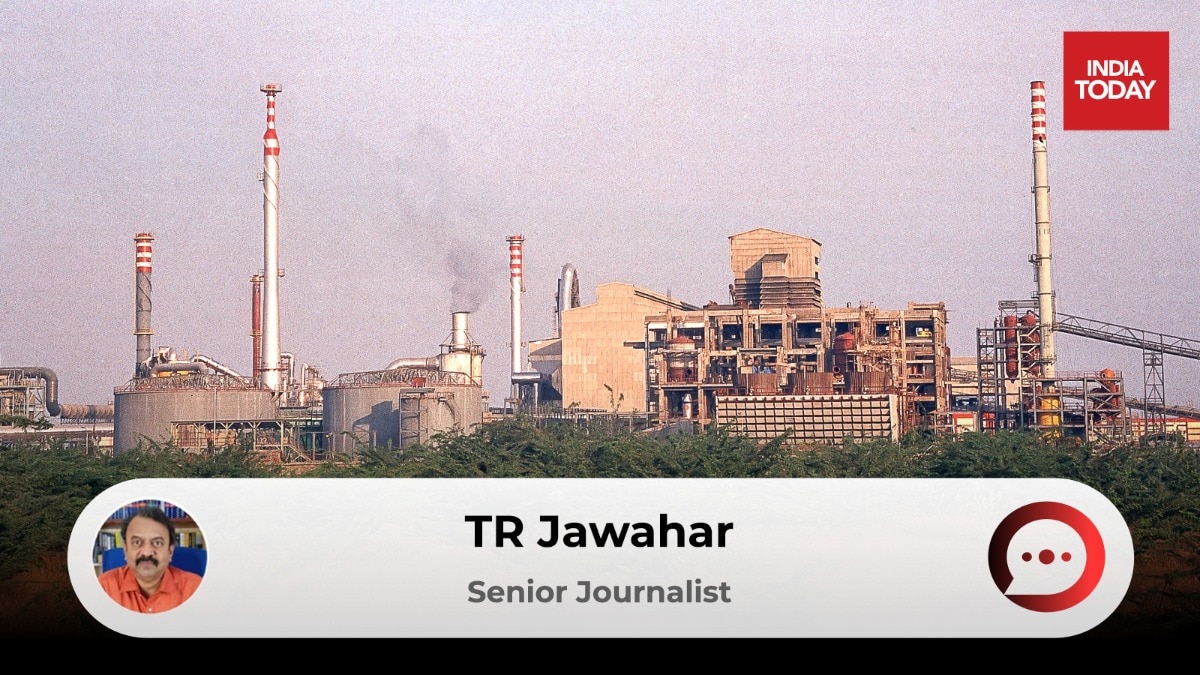
Long before copper became a strategic metal, an import bill or an environmental argument, it had entered the imagination of southern Tamil country. The Thamiraparani—the copper-hued, crimson river—flows through a landscape where civilisation, cultivation, commerce and industry have repeatedly met. Near its journey to the sea stands Thoothukudi, where copper would eventually create wealth, work, controversy and deep wounds.When Vijay entered Fort St George in May, he inherited not merely a government but Tamil Nadu’s unfinished argument over what constitutes development, who bears its cost and who possesses the right to say no. At Parandur, he has answered one part by abandoning the proposed airport site, standing by protesting farmers and promising an alternative location (here's a similar analysis on that subject by this author). Nearly 600 kilometres away, behind the sealed gates of Sterlite Copper, a more complicated test awaits him.For eight years, the gates have remained shut. The argument outside them has never closed.The old anger over pollution complaints, regulatory failures and the deaths of May 2018 has not disappeared. Nor should it. But it is now joined by other voices—from former workers, transporters, ancillary businesses, traders and some local representatives—asking whether closure was meant to become a permanent substitute for policy. Trade and business associations are preparing a fresh representation to the Chief Minister seeking reconsideration. Former workers and trade-linked groups have demonstrated in favour of revival, while a mass-signature campaign has supported reopening under a proposed “green copper” framework. None of this establishes that Thoothukudi has collectively changed its mind. It contains families who remember the fear of emissions and families who remember the certainty of a monthly wage; residents who believe the environment improved after closure and workers who saw their livelihoods disappear with the smoke. A responsible government cannot erase either memory.That is why the Sterlite question deserves neither an emotional reopening nor an emotional refusal. It requires something rarer in public life: an open mind applied to a closed case.FROM INDUSTRIAL PROMISE TO PUBLIC DISTRUST Sterlite’s difficulties did not begin in 2018. The project received its initial clearances in the mid-1990s, commenced production in January 1997 and soon entered a recurring cycle of complaints, inspections, temporary shutdowns, litigation and resumptions. There was an early gas-leak episode, adverse scrutiny by the National Environmental Engineering Research Institute and continuing concern about emissions, groundwater, hazardous waste and public health.Yet the facility grew into one of India’s largest integrated copper complexes. Its annual smelting capacity reached 400,000 tonnes, with a smelter, refinery, copper rod plant, sulphuric- and phosphoric-acid facilities and a captive power plant. Depending upon the year and measure employed, it accounted for approximately 36 to 40 per cent of India’s refined-copper production or capacity.Sterlite did not necessarily meet 40 per cent of every form of Indian copper demand, as loosely suggested. But it represented a formidable concentration of domestic refining capacity and helped transform Thoothukudi into an important node in India’s metals economy.The company employed modern technology, developed export markets, generated port and logistics activity, supported a skilled workforce and sustained contractors, transporters, suppliers and service businesses. For two decades, Sterlite was not merely a factory inside SIPCOT. It was an economic ecosystem extending through the district.Its record also contained serious environmental disputes. In 2013, the Supreme Court allowed continued operation but imposed compensation of 100 crore for environmental damage caused between 1997 and 2012. The order recognised the plant’s economic importance, but was not an environmental acquittal. The Tamil Nadu Pollution Control Board remained free to act against future violations. A sulphur dioxide episode that year revived health complaints. Sterlite disputed responsibility and argued that an industrial region containing numerous pollution sources had gradually assigned almost every environmental or health problem to one visible plant.That argument deserves examination. So do the company’s claims regarding internationally recognised smelting technology, environmental-control systems and zero liquid discharge. A plant functioning for over two decades cannot fairly be reduced to its failures alone. But awards, certifications and technical capability cannot erase regulatory findings or lived public distrust.Technology can be repaired faster than trust. Machinery responds to engineering; memory does not.WHEN THE ARGUMENT BECAME A WOUNDOpposition to a proposed expansion that would have doubled Sterlite’s capacity intensified the agitation. On 22 May 2018, the hundredth day of the protests, thousands marched towards the Thoothukudi Collectorate. Police opened fire. Thirteen persons were killed that day, and the eventual toll is generally recorded as fourteen. Many more were injured.The Justice Aruna Jagadeesan Commission subsequently found the firing excessive and unprovoked and recommended action against several officials. Legal responsibility for the firing belongs to the State and its machinery, not Vedanta. But the deaths transformed a long industrial and environmental dispute into a lasting moral wound.Vedanta cannot be assigned a legal liability that rests elsewhere. Equally, no discussion of Sterlite’s future can be detached from what happened outside its gates. The firing and the environmental controversy are legally distinct; in Tamil Nadu’s public memory, they have fused.The tragedy also exposed governmental failure. Regulators had not created confidence that compliance was being monitored transparently. Administrators had not built a credible channel through which local fears could be tested and answered. By the time the State acted decisively, it did so through force rather than persuasion.Thoothukudi’s wound is therefore not only industrial. It is institutional—the collapse of public faith in the authorities meant to regulate power before they deployed it.THE LEGAL RECORD—AND THE NEW OPENINGThe judicial history is frequently simplified. Supporters cite the National Green Tribunal’s December 2018 direction permitting reopening as proof of vindication. Opponents invoke later judgments as though they permanently prohibit every possible copper operation at the site. The position is more nuanced.The Supreme Court set aside the NGT order in February 2019 because the tribunal lacked jurisdiction to entertain Vedanta’s challenge to the State’s closure decision. It therefore cannot be presented as a surviving judicial certificate of compliance.Vedanta then approached the Madras High Court, which upheld the closure in August 2020 after examining the plant’s regulatory and environmental history. In February 2024, the Supreme Court declined to interfere, referring to serious and repeated violations. It also upheld criticism of the Tamil Nadu Pollution Control Board for failing to perform its regulatory functions with sufficient timeliness and conscientiousness.The courts have closed the route to restarting the old smelter on its former permissions. That conclusion must be respected. But judicial finality need not be mistaken for technological finality.In late 2025, the Madras High Court clarified that Vedanta could make a fresh application concerning its green-copper project and that competent authorities could decide it. The court did not order reopening, approve the process or certify its safety. The Pollution Control Board subsequently rejected the application, prompting a fresh challenge and a request for independent technical examination.The old plant cannot simply return under its old licence. But should Tamil Nadu refuse even to examine whether post-2018 technology, recycling, redesigned processes and enforceable safeguards can produce a materially different operation?Reconsideration is not exoneration. Examination is not approval.THE GREEN-COPPER TESTSterlite maintains that its Thoothukudi complex employed advanced technology. Its ISASMELT process, licensed from Glencore, is used internationally and associated with high efficiency and effective sulphur capture when properly designed, maintained and operated.That is a legitimate part of Vedanta’s case. So are its environmental certifications, zero-liquid-discharge claim, safety systems and contention that considerable improvement is possible after eight years of closure. Industrial technology has not remained frozen in 2018. Cleaner energy, improved capture systems, greater recycling, continuous digital monitoring and better waste recovery can materially alter a plant’s environmental profile.Yet technology establishes what a plant can do; monitoring establishes what it actually does.“Green copper” must therefore be translated into an exact engineering process. One description suggests recycled copper anodes or secondary feedstock handled mainly through the refinery, avoiding much of the conventional concentrate-smelting cycle. Another reportedly envisages a hybrid model using approximately 70 per cent primary copper and 30 per cent recycled material. If concentrate remains the principal input, questions concerning smelting, sulphur dioxide, slag, energy, water and hazardous waste return.Vedanta should disclose what will enter the plant, which units will operate and what will emerge from them: whether the smelter and captive power facility will restart, and the proposed capacity, recycled content, water balance, energy source, emissions and waste output.These questions do not pre-empt rejection; they enable a potentially improved proposal to distinguish itself from the past. If the concept is genuinely transformative, Vedanta should welcome exacting scrutiny. A corporation seeking a second chance must offer more than a second assurance.Tamil Nadu, meanwhile, cannot treat the company’s history as proof that improvement is impossible. Environmental regulation should punish violations and prevent recurrence; it should not become a doctrine that an industrial operator can never reform or submit a fundamentally altered proposal. A regulatory system incapable of recognising verified improvement is no more scientific than one incapable of detecting violations.Sterlite’s record prevents blind restoration. Its industrial importance prevents casual abandonment.A DISTRICT OF COMPETING MEMORIESEmployment estimates vary. Vedanta and pro-reopening organisations have referred to roughly 3,000 to 5,000 direct jobs and 25,000 or more indirect livelihoods. Wider claims involve around 400 ancillary enterprises and one lakh affected persons, while another economic-impact exercise estimated approximately 30,000 direct and indirect job losses.Permanent employees, contract workers, vendors, transporters and dependent families cannot be indiscriminately combined. The one-lakh figure should not be treated as settled without a transparent methodology. But disagreement over the highest estimate does not erase the loss.Thousands connected to the ecosystem were affected. Transporters lost contracts, vendors lost a major customer and skilled workers migrated, accepted lower-paying occupations or remained underemployed. The closure also affected port traffic, warehousing, freight forwarding, maintenance and numerous small services whose dependence on a large industrial unit rarely appears fully in employment registers.This explains the renewed calls for reconsideration. Former employees, contractors, trade unions, truck operators, traders and some fishing-community representatives have supported conditional revival, seeking local employment, healthcare, coastal welfare and strong environmental safeguards.Other residents, veteran campaigners and some NGOs remain firmly opposed.Neither side can claim exclusive ownership of Thoothukudi. A reopening campaign is not proof of district-wide consent; continuing opposition is not proof that everyone wants permanent closure. A district is not a single voice.Closure, too, creates casualties. They do not cancel the casualties that preceded closure.BEYOND THE CONVENIENT CULPRITThoothukudi is a major industrial and port cluster containing thermal power, fertiliser, mineral and chemical processing, coal handling, heavy transport and numerous red-category industries.Their existence cannot exonerate Sterlite. Pollution is not divided equally because several factories share the same official colour. But it is equally unscientific to attribute every poor air reading, groundwater change, disease incidence or climatic variation to one plant without establishing causation by conducting an apportionment study.An Anna University source-apportionment study for the Pollution Control Board identified resuspended mineral-rich road dust as a major contributor to PM10, while also recognising combustion-related and industrial sources. It demonstrates multiple contributors.Tamil Nadu still lacks a complete, continuously updated and publicly intelligible account of pollution across the industrial region. If Sterlite was wrongly made the sole villain, science should say so. If it was a major contributor, that too must be stated plainly. The public interest lies not in a convenient culprit but in an honest emissions map.INDIA’S NEED, TAMIL NADU’S LOSSCopper lies inside almost every ambition India now proclaims: renewable power, electric mobility, transmission networks, railways, telecommunications, electronics, defence production, housing and advanced manufacturing.Electric vehicles require substantially more copper than conventional vehicles. Solar and wind installations are more copper-intensive than traditional power systems. Grid expansion, storage and charging infrastructure will increase demand further. India cannot build an electric future while treating copper as an afterthought.The Union Ministry of Mines’ Vision Document records that India meets more than 95 per cent of its copper-concentrate requirement through imports and became a net importer of refined copper after Sterlite’s 0.400-million-tonne plant closed in May 2018. Before closure, India was a substantial net exporter. Production then fell sharply, exports collapsed and imports rose.Sterlite alone cannot deliver copper self-sufficiency. It relied predominantly on imported concentrate. Reopening would strengthen domestic smelting and refining capacity, not eliminate dependence on imported ore. Capacity that has been developed at Kutch Copper in Gujarat, recycling, overseas mineral partnerships, domestic exploration and diversified supplies are also essential to attain self-sufficiency.Yet Tamil Nadu’s loss extends beyond one balance sheet. Sterlite contributed industrial output, exports, port activity, tax revenue, logistics demand and skilled manufacturing employment. Its closure removed a major economic engine from southern Tamil Nadu, which has not enjoyed industrial concentration on the scale of Chennai, Hosur or Coimbatore.This matters for Vijay. His government has welcomed investment commitments and emphasised employment. But investor confidence is shaped not only by how a State receives new projects; it is also shaped by how it handles stranded assets, regulatory conflict and technological change. Environmental law cannot be diluted to impress investors. Industrial policy, however, requires predictable, evidence-based decisions rather than permanent political paralysis.Tamil Nadu cannot invite new factories with one hand while refusing even to examine whether an old one can be made new with the other.India’s copper insecurity is real, but strategic necessity does not grant any enterprise a waiver from environmental legitimacy. The challenge is to protect national and State economic interests without again asking Thoothukudi to accept assurances in place of evidence.FROM PARANDUR TO THOOTHUKUDIParandur offers an important but imperfect comparison. Vijay has demonstrated that a large project cannot be imposed regardless of agricultural land, waterbodies, habitation and livelihood. His government has abandoned that site while accepting Chennai’s need for greater airport capacity and promising an alternative.Parandur tests whether development can find another location. Sterlite tests whether a contested location can ever find another model.An airport can theoretically be shifted, although at enormous cost and delay. An integrated copper complex connected to a port, logistics, suppliers and specialised machinery cannot simply be relocated. Sterlite therefore presents the harder half of Vijay’s development doctrine: can environmental sensitivity become an accountable industrial solution rather than cancellation alone?The right to breathe clean air and the right to earn a dignified living are not rival slogans. A serious State must protect both.A THOOTHUKUDI COMPACTThe answer should not be an executive order reopening Sterlite, nor another summary refusal born of the fear that examination itself will be portrayed as betrayal.The Vijay government should constitute an independent multidisciplinary body of metallurgists, environmental engineers, public-health specialists, marine scientists and occupational-safety experts. Nearby residents, fishing communities, workers and traders must participate with access to data and the right to record dissent.Tamil Nadu should commission a cumulative environmental and health assessment of the entire industrial region. Vedanta must disclose the complete process, while baseline data on air, groundwater, soil, marine ecology and public health should be published in Tamil and English. If the proposal survives scrutiny, continuous tamper-resistant monitoring, independent testing, third-party audits and automatic consequences for breaches must become binding conditions.Vedanta may finance the assessment and safeguards, but must not control the experts, samples or publication. Commitments on worker safety, local employment, healthcare, insurance, remediation and vendor rehabilitation should be legally enforceable rather than discretionary corporate social responsibility.There is no social licence in a file stamped in Chennai. It is earned repeatedly in the neighbourhoods that live with the consequences.A factory that cannot survive scrutiny has no right to reopen. A district denied honest scrutiny has no reason to trust.VIJAY’S HARDER CHOICETamil Nadu’s earlier industrial model too often treated environmental clearance as a bureaucratic stage to be crossed. Protest politics then treated permanent closure as the only protection that could be trusted. Both approaches testify to institutional failure.The State’s task is not to choose between two slogans. It is to build institutions strong enough to make both slogans unnecessary.At Parandur, Vijay closed one contested route to development and promised another. At Thoothukudi, he must decide whether a closed industrial question deserves an open, independent examination. He need not promise Vedanta a future. He must promise Thoothukudi the truth.The past cannot be forgotten, diluted or relabelled green. The future cannot remain indefinitely sealed because the past was mishandled. A new government should possess the confidence to hear those who fear the plant, those who miss the jobs and those who believe modern technology can reconcile the two.Thoothukudi does not owe Vedanta forgiveness. Vedanta owes Thoothukudi proof. Tamil Nadu, however, owes both an honest hearing—and owes its industrial future the courage to distinguish an improved proposal from an inherited prejudice.The Thamiraparani has flowed past kingdoms, ports and political regimes, carrying its copper-coloured name towards the sea. Tamil Nadu must ensure that copper’s next chapter does not again leave Thoothukudi in an avoidable conundrum.A second chance cannot mean a second licence for the same mistakes. It can only mean a first experiment in doing development differently.(The author is a senior Chennai-based journalist and these are his personal views. His exclusive 50-part series, Time, Tide & Tamil specially commissioned by Indiatoday.in explores the deep history, culture, language, cinema, and political identity of Tamil Nadu. Access the series here.)- EndsPublished By: Dev GoswamiPublished On: Aug 31, 2026 12:24 IST
Vijay faces a Sterlite test after Parandur airport: Can he reopen a closed chapter?
Full Article
Original Source
Read the full article at Indiatoday →KhanList aggregates and links to publicly available news content. We do not host full articles from third-party sources. Always verify important information with original sources.