
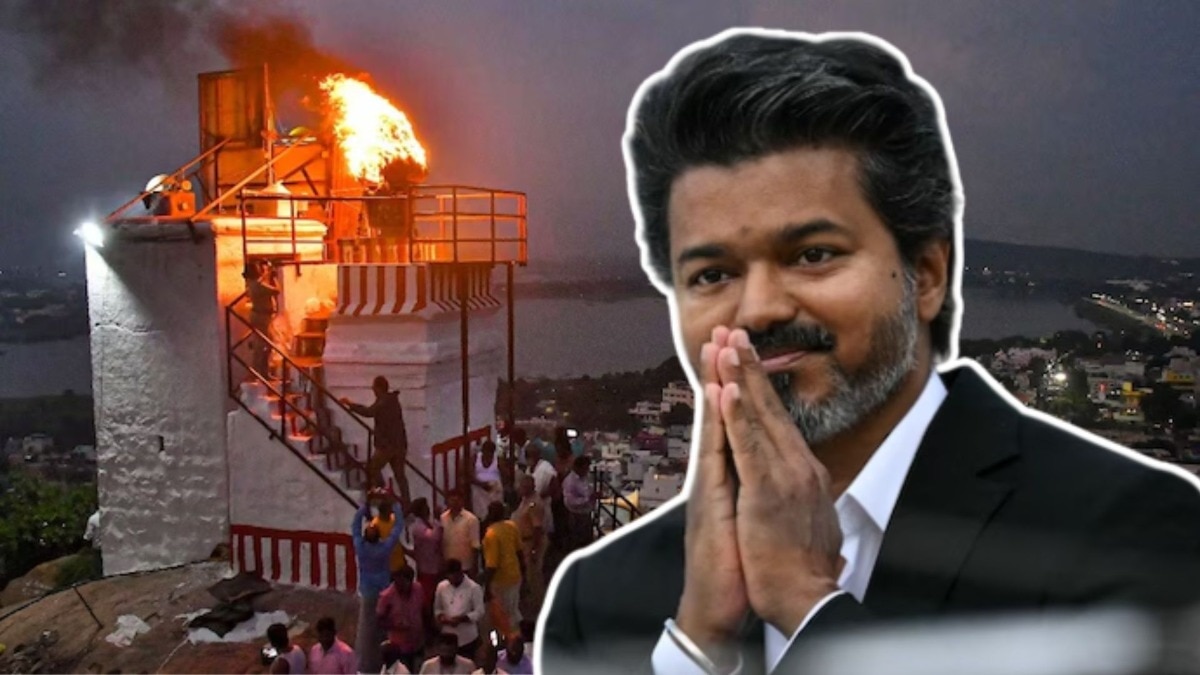
A religious lamp, a stone pillar and a hill shared by a temple and a dargah. What might appear to be a simple ritual has turned into a sensitive legal and political flashpoint in Tamil Nadu, with Chief Minister C Joseph Vijay's government moving the Supreme Court against an order allowing the lamp-lighting ceremony.The Tamil Nadu government has filed a review petition against the Supreme Court's November 20 interim order permitting the Karthigai Deepam lamp to be lit atop the Deepathoon, a stone pillar on Thiruparankundram Hill in Madurai, on November 24. The move comes even as the apex court allowed the ritual as a one-time measure, subject to safeguards.The move is significant because the Supreme Court had already attempted to address the state's concerns by restricting the exercise to authorised temple and government personnel and prohibiting public gatherings, processions and demonstrations at the site.Yet, the Vijay government wants the order reconsidered. Its objections go beyond the immediate question of lighting a lamp. So why is the TVK-led government challenging the Supreme Court's intervention? NO ESTABLISHED TRADITION AT THE DEEPATHOON: TAMIL NADU GOVTThe CM Vijay-led government's primary argument is that lighting the Karthigai Deepam at the disputed stone pillar is not an established temple tradition.According to the Hindu Religious and Charitable Endowments (HR&CE) Department, the lamp has traditionally been lit at the Deepamandapam near the Uchipillaiyar temple, above the sanctum sanctorum. The department says there is no documented instance of the ritual being performed at the Deepathoon. The government argues that changing the location would alter a long-standing religious practice without sufficient evidence to establish a customary right to perform the ritual there.It has also maintained that deciding the place and manner of temple rituals must rest with the temple authorities, in accordance with the Agamas and the opinion of its Sthanikars (temple administrators).GOVT WORRIES PROXIMITY TO A DARGAH AND COMMUNAL HARMONYThiruparankundram Hill is a sensitive religious location, housing the Arulmigu Subramaniya Swamy Temple as well as the Hazrat Sultan Sikandar Badusha Auliya Dargah.The disputed Deepathoon is situated close to the dargah, making the proposed change in the ritual location particularly sensitive.The government has argued that lighting the lamp at this spot carries a risk of disturbing the communal harmony that has prevailed in the area for years.It maintains that the festival can continue at its customary location without any disruption. The petition also warns that even a one-time exercise at the disputed location could create tensions locally and potentially have wider repercussions across Tamil Nadu.STATE GOVERNMENT'S FEAR OF A PRECEDENT FOR FUTURE CLAIMSThe Vijay government is also concerned about the legal implications of allowing the ritual at the Deepathoon.It keeps reiterating that there is no established customary or legal right to light the lamp at the stone pillar. According to the government, the petitioners have not produced documentary evidence establishing that the location was historically used for the ceremony.The government fears that carrying out the ritual under a court order could be interpreted as validating the claim, even if the Supreme Court has clarified that its interim direction does not establish a permanent right or precedent.TEMPLE AUTHORITIES, NOT INDIVIDUAL PETITIONERS, SHOULD DECIDE: TN GOVTTo strengthen its argument, the HR&CE Department has invoked provisions of the Tamil Nadu Hindu Religious and Charitable Endowments Act, 1959.Under Section 28(1), trustees are responsible for administering the affairs of religious institutions. Section 63(e) empowers the Joint Commissioner to inquire into and decide questions concerning established usage in a religious institution.The government believes that the question of where the temple's traditional lamp should be lit must be examined through the appropriate statutory and institutional process rather than determined through an interim judicial direction.SC HAS GRANTED FINAL RELIEF AT AN INTERIM STAGEThe Tamil Nadu government's strongest objection is that the Supreme Court has effectively granted the petitioners the relief they sought before the underlying dispute has been conclusively decided.The HR&CE Department has argued that the one-time permission amounts to granting final relief at the interlocutory stage itself.It has questioned whether a mandatory interim direction should have been issued without the petitioners establishing a strong prima facie case and demonstrating that the balance of convenience favoured them.The government has also pointed out that if the lamp is not lit at the disputed location this year, the petitioners lose no existing right. The festival can proceed at the traditional Deepamandapam, as it has in previous years.WHY THE ONE-TIME SAFEGUARDS WERE NOT ENOUGHThe Supreme Court's November 20 order attempted to strike a balance by permitting the November 24 ritual as a one-time measure, while restricting access and directing security arrangements. It also clarified that the permission would not determine ownership, establish a customary right or settle the larger legal dispute.But the Tamil Nadu government's review petition suggests that its concern is not limited to crowd management on the day of the festival. It is also about the possible religious, legal and administrative consequences of changing the ritual's location.The review petition puts these questions back before the Supreme Court, even as the November 24 festival approaches.- Ends
Vijay could have used SC escape route on Karthigai Deepam. Why did he seek review?
Full Article
Original Source
Read the full article at Indiatoday →KhanList aggregates and links to publicly available news content. We do not host full articles from third-party sources. Always verify important information with original sources.