
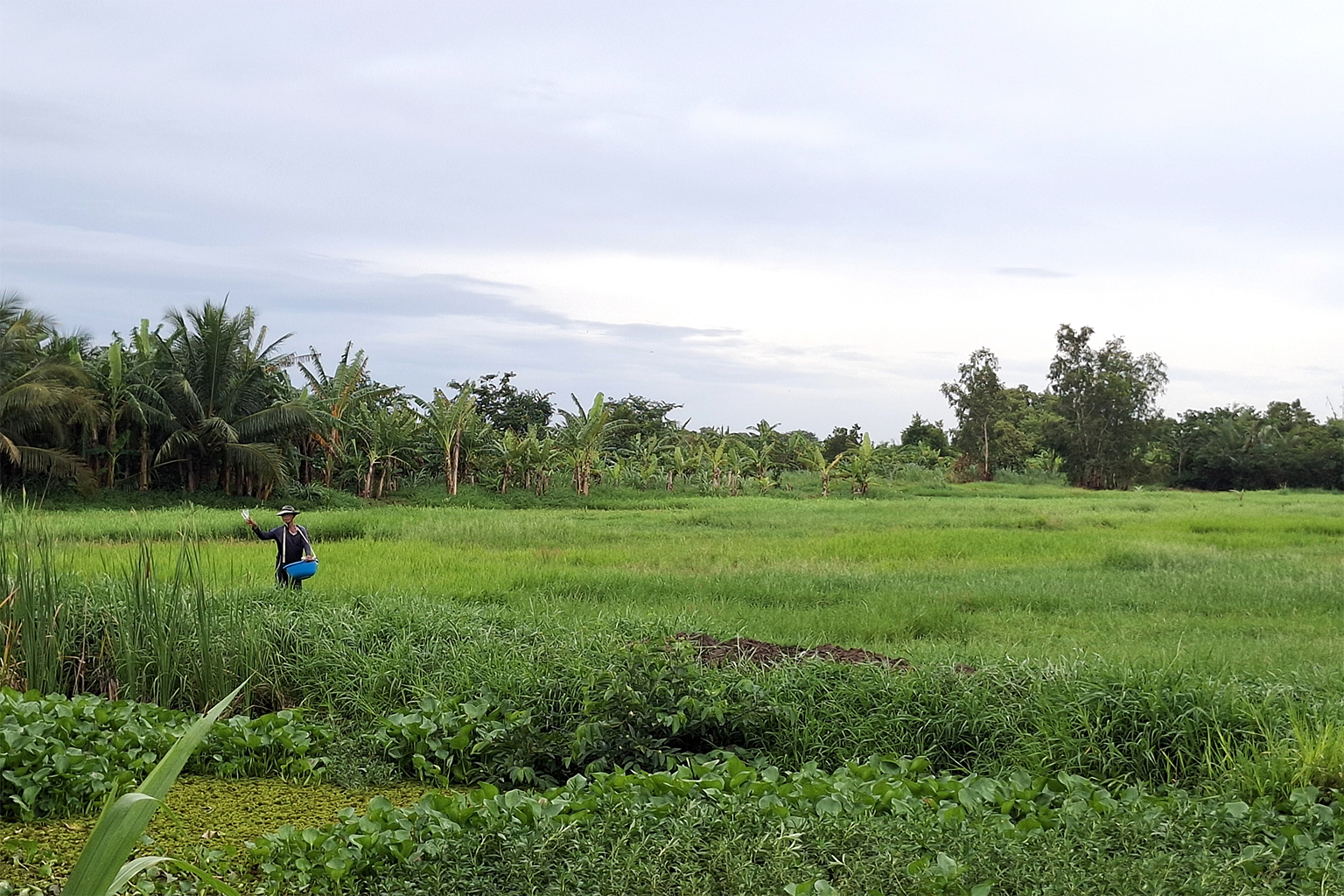
The Ba Lai sluice was built to convert the Ba Lai River into a year-round freshwater reservoir for rice cultivation in Bến Tre province, Vietnam.After more than 20 years in operation, the sluice has severed the river’s dynamic brackish ecosystem, caused serious pollution and worsened downstream erosion, and saline intrusion remains rampant.Facing low income from rice, farmers in the freshwater zone have drilled illegal saltwater wells to access saline water for unapproved shrimp ponds, prompting crackdowns by local authorities.A policy shift calls for treating saline water as an economic resource, but legacy mindsets centered on hard infrastructure persist. BÌNH ĐẠI, Vietnam — For centuries, the Mekong River emptied into the South China Sea through nine vast estuaries, earning it the name Cửu Long, Vietnamese for “Nine Dragons.” In the 1960s, natural deposition of sand swallowed the first dragon, the Bassac River. Now, human-made infrastructure is choking the second, the Ba Lai River. More than two decades after a sluice gate began operating near the mouth of the Ba Lai River in southern Vietnam, the river has turned into a stagnant lake, trapping pollutants and accelerating coastal erosion. Intended to protect the region from salinity, the megastructure has created problems and triggered conflicts between local farmers and authorities, sparking semi-open resistance that further destabilizes this already climate-vulnerable area. On a cloudy day in September, Nguyên, a shrimp farmer in Bình Đại commune in Vĩnh Long province, calculates when he should harvest his shrimp as he prepares to feed his two ponds. During the rainy season, water pollution is his primary concern, and a miscalculation can wipe out his entire stock. “This month, the sluice discharges water on the eighth, ninth, 21st, and 22nd, so I will harvest my shrimp on the fifth or sixth,” says Nguyên, which is not his real name. He asks to use a pseudonym due to the sensitive nature of the issue. “Fruit farmers in the freshwater zone use tons of pesticides and herbicides,” Nguyên tells Mongabay. “The chemicals linger on the ground. When it rains, the runoff flows into canals and the river, heavily contaminating the water with accumulated toxins.” Nguyên calculates when he should harvest his shrimp as he prepares to feed his two ponds in September 2026. Image by Nguyen Tra My for Mongabay. The Ba Lai sluice gate, which began operating in 2002, was built to prevent saltwater infiltration and retain freshwater for rice farmers in the upper course of the river. It was to convert the Ba Lai River into a year-round freshwater reservoir for Bến Tre City and four surrounding districts — Châu Thành, Bình Đại, Giồng Trôm and Ba Tri — shielding them from marine tides. The infrastructure, which cost 67 billion dong ($4.38 million in 2002), was supposed to supply freshwater to 193,000 hectares (477,000 acres) of land, including 100,000 hectares (247,100 acres) for upstream and midstream farms and 20,000 hectares (49,400 acres) for downstream aquaculture. Following Bến Tre province’s merger into Vĩnh Long province in 2025, Bến Tre City and the four districts changed administrative status and became wards and communes. Many residents still call the area Bến Tre, however, and the effects of the sluice gate linger. The sluice dam is a legacy of Vietnam’s post-1975 irrigation policy, which sought to transform land across the country into multi-crop rice fields to secure national food security, says Nguyễn Hữu Thiện, an independent ecologist specializing in the Mekong Delta. Under this “rice first” doctrine, saline water was “automatically considered an enemy,” Thiện tells Mongabay. For decades, Vietnam heavily invested in irrigation infrastructure to block saltwater and lock in freshwater for rice cultivation. On paper, the project appears successful. According to data from state-owned Bến Tre Irrigation Works Exploitation Co. Ltd., the dam cuts annual saline intrusion duration by a third and halves salinity levels. It also enables three rice harvests annually, supports crop cultivation and supplies domestic water for residents. Yet, on the ground, it is a different story. The Ba Lai sluice gate, which began operating in 2002, was built to prevent saltwater infiltration and retain freshwater for rice farmers in the upper course of the river. Image by Nguyen Tra My for Mongabay. Killing another dragon Because the sluice gate is closed most of the time, the Ba Lai River functions more like a lake. The gate traps toxins, fertilizers, weeds and domestic waste from upstream, causing severe organic pollution and eutrophication. During the early years of operation, vegetation died as the sluice gate changed the river’s brackish ecosystem to a freshwater one, Thiện says. Scientific research also documents biodiversity shifts: After the dam’s construction, the number of threatened fish species rose from one to six. Downstream farmers like Nguyên have seen their shrimp and blood cockle (Tegillarca granosa) ponds at risk. Once abundant, the blood cockle ponds have nearly disappeared, Thiện says. The dam fails to protect Bến Tre from saltwater intrusion. With the Ba Lai River blocked, sea tides travel up the nearby Mỹ Tho and Hàm Luông rivers, causing saltwater to enter the freshwater area in Giồng Trôm district through the 2.7-km (1.7-mile) Giao Hòa channel. When it rains, the runoff flows into canals and the river, heavily contaminating the water with accumulated toxins. Image by Nguyen Tra My for Mongabay. Severe saltwater intrusion has destroyed pomelo (Citrus maxima) orchards, forcing cooperatives selling Giồng Trôm’s most renowned fruit to close or farmers to switch to growing coconuts or other crops, Thiện said. Others, like Nguyên’s aunt, have built protective barriers for her pomelo orchards, the shrimp farmer says. Meanwhile, tidal waves hitting the sluice have intensified coastal erosion — and because the Ba Lai River’s current is very weak, sediment sinks to the bottom rather than replenishing eroded sand and mud, choking its mouth. The result is a river slowly approaching its death. “We have killed another dragon, so the Mekong is now the ‘Seven Dragon River,’” says ecologist Thiện. Lê Anh Tuấn, senior lecturer at the College of Environment and Natural Resources at Cần Thơ University in Vietnam, says Bến Tre authorities had spent approximately 900 billion dong ($35.3 million) on dredging to combat sedimentation, over 13 times the dam’s original construction cost. Nguyên previously grew watermelons in Ba Tri, earning only 30 million to 40 million dong ($1,175-$1,570 in 2010) a year. Around 15 years ago, he moved to Bình Đại and rented land downstream to farm shrimp, earning much more. “A successful harvest can earn me hundreds of millions of dong,” Nguyên says. Upstream farmers who cannot relocate like Nguyên have another strategy to survive. Taking advantage of Bến Tre’s unique estuarine hydrology, they drill wells to tap into saline groundwater sources to make “secret” shrimp ponds in the freshwater area, both upstream and midstream of the Ba Lai sluice, which violates the government’s designated land use policy. “They use drilling rigs to sink pipes into the ground, usually 50-100 meters deep, to tap into a saltwater vein,” Nguyên says. “They test the water for acidity, toxic gases, or impurities.” “If any of these are present, they drill deeper, testing every 3 to 5 meters until the water is clean. They then install the pumping system that will pump out saltwater at the flip of a switch.” Wells are carefully camouflaged using different techniques, he adds. Nguyên, the shrimp farmer in Bình Đại commune in Vĩnh Long province, checks his shrimps. Image by Nguyen Tra My for Mongabay. Nguyên says his uncle in Bến Tre ward hides his well under the floor of his farm hut. “He places a sleeping bed over it,” the shrimp farmer says. “Whenever authorities come around, he pulls out the pipe and stows everything away, so nothing is left in sight.” According to local media, in 2020, there were around 540 hectares (1,335 acres) of illegal shrimp ponds built by 1,500 households in the designated freshwater area in Bình Đại. Farmers raised whiteleg shrimp (Penaeus vannamei), which require low salinity levels, and earned 170,000 to 185,000 dong ($6.48-$7.16 in 2020) per kilogram. In the same year, rice was sold for only 4,983 dong ($0.19) per kg. “Rice prices have remained virtually unchanged for the past 15 years, while the costs of fuel, fertilizer, pesticides, and labor have all risen,” senior lecturer Tuấn says. “Rice farmers are perpetually poor.” Over the years, more and more farmers have turned their back on rice. Bến Tre’s rice-planted area and production, already the smallest and lowest among the Mekong Delta provinces, continued their downward trend after the sluice began operation in 2002. By 2024, Bến Tre’s rice-growing area had shrunk to one-seventh of the 2002 level, while output had dropped to roughly one-sixth, according to the National Statistics Office of Vietnam. Many current rice farmers in the freshwater area were once shrimp producers or practiced integrated rice-shrimp farming. After the sluice opened, they were forced to plant rice without financial assistance or support from local authorities to compensate for their substantially reduced income, according to a university researcher in the Mekong Delta, who asks to remain anonymous because of the sensitivity of the issue. Ecologist Thiện notes that historically, consultation with local communities was rarely ever part of the policymaking process, resulting in policies that often overrode their lives and livelihoods. Vĩnh Long province’s Department of Agriculture and Environment didn’t respond to Mongabay’s request for comment by the time of publication. Subtle resistance With little power to push back against the top-down policy, some farmers have engaged in what some scholars call “subtle, non-confrontational resistance,” such as digging illegal saltwater wells, despite land subsidence risks, and building secret shrimp ponds. In response, authorities have deployed patrol units to search for illicit wells. Farmers who were caught were fined, made to sign pledges not to reoffend and had their wells sealed with cement. Authorities also issued warnings that local agrarian policies did not cover “unapproved” shrimp farming, so farmers won’t get compensation if shrimp die-offs or significant stock depletion occur, the university researcher says. The crackdowns and threats appear to have worked. Nguyên says that some farmers abandoned their wells. Some cultivate coconuts, the crop Bến Tre is famous for, while others grow freshwater crops. “But they are dead poor now,” Nguyên says of the last group. Meanwhile, “those who keep resisting are pretty well-off.” Although the government has never publicly acknowledged the shortcomings of the sluice, there has been a policy shift. Severe saltwater intrusion has destroyed pomelo orchards, forcing cooperatives selling Giồng Trôm’s most renowned fruit to close or farmers to switch to growing coconuts or other crops. In this picture, rice gives way to coconuts. Image by Nguyen Tra My for Mongabay. Resolution 120, issued in 2017, is a landmark government policy that emphasizes sustainable development of the Mekong Delta. It recognizes saline water as an economic resource and warns against heavy-handed interference in nature. Local strategies now pivot toward aquaculture as a core priority, aiming to reduce water-intensive, low-value rice cultivation. Legacy mindsets persist, however. A recent proposal to turn the Măng Thít River in Vĩnh Long province into a “strategic ‘super reservoir’” to secure its freshwater supply has been submitted to the province’s Department of Science and Technology. “We have to be very careful when investing in such significant infrastructure in a sensitive area like the Mekong Delta,” senior lecturer Tuấn says. “In the future, we may wish that we never built it, but we are stuck with it anyway.” Banner image: Paddy field in Bình Đai commune, Vình Long province, Vietnam, in September 2026. Image by Nguyen Tra My for Mongabay. The world’s great deltas are sinking — and with them, a global food system Citations: Hoang, Q. H., Kubo, N., Hoang, N. G., & Tanji, H. (2009). Operation of the Ba Lai irrigation system in the Mekong Delta, Vietnam. Paddy and Water Environment, 7(2), 123-133. doi:10.1007/s10333-009-0155-0 Nguyen, D. X., Ngo, X. Q., Nguyen, T. M. Y., Tran, T. T., Tran, T. H. Y., & Pham, T. L. (2025). Change in fish composition and their distribution after twenty years of the Ba Lai Dam construction in the Mekong Delta, Viet Nam. Regional Studies in Marine Science, 93, 104669. doi:10.1016/j.rsma.2025.104669 Tran, T. A., & Pittock, J. (2024). When water policies derail livelihood aspirations: farmers’ agency in everyday politics in the Vietnamese Mekong Delta. Environmental Sociology, 10(3), 267–278. doi:10.1080/23251042.2024.2323601 Cite this articleNguyen Tra My (2026). Vietnam’s freshwater obsession leaves decades-long scars for Mekong Delta farmers. Mongabay Conservation news. DOI: https://doi.org/10.66709/news-335735 Credits Topics
Vietnam’s freshwater obsession leaves decades-long scars for Mekong Delta farmers
Full Article
Original Source
Read the full article at News →KhanList aggregates and links to publicly available news content. We do not host full articles from third-party sources. Always verify important information with original sources.