
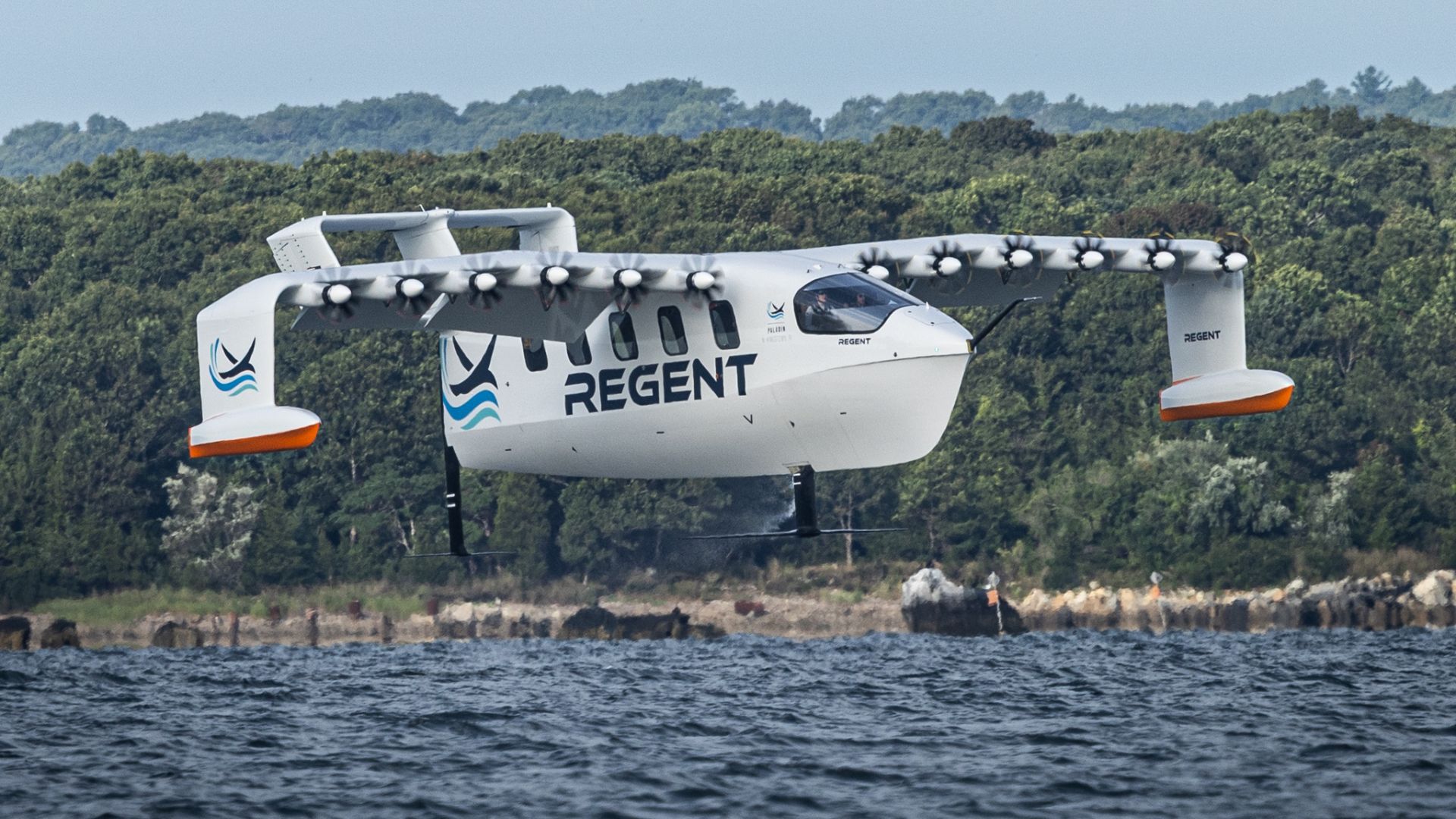
REGENT’s Viceroy Seaglider has completed its first crewed flight, with two captains flying above Narragansett Bay in Rhode Island during a 2026 test. The company says this is the “world’s first” crewed flight of a “flying boat.” During the 30-second test, the prototype flew 1,956 feet (596 meters) at about 33 feet (10 meters) above the water. This flight is a big step for REGENT as it prepares the Viceroy for the final phase of sea trials. The company is developing the vehicle as a new form of maritime transportation that can move from docks like a boat before transitioning into flight. Its 2026 testing campaign has combined real-world water trials with simulation work to improve the vehicle ahead of commercial operations. Two captains take the controls The crewed test came after earlier efforts to boost the Viceroy’s speed on hydrofoils. These trials helped get the prototype ready to move from traveling on water to flying. During the latest test, the vehicle demonstrated its ability to lift clear of the water and maintain controlled flight close to the surface. REGENT said the results validate important technologies needed for the next stage of development. “Completing this flight test validates years of rigorous engineering and operational work and gives us the confidence to move into full-rate production,” said Mike Klinker, co-founder and chief technology officer of REGENT. “We showed today that flying a Seaglider is every bit as smooth and safe as we designed it to be. I can’t wait to get onboard and to share the experience with others as we make our vision for the future of maritime mobility a reality.” From boat to aircraft The Viceroy uses an electric-hybrid propulsion system and is designed to operate through several stages of movement. It begins its journey as a conventional vessel before accelerating onto hydrofoils. At higher speeds, the craft rises above the surface and uses aerodynamic lift to fly in ground effect. This allows it to remain close to the water while benefiting from aircraft-style flight. The Viceroy measures 55 feet (16.8 meters) long and has a 65-foot (19.8-meter) wingspan. REGENT designed the platform to operate between ports without requiring traditional airport infrastructure. Built for passengers and cargo The seaglider is designed to reach a range of up to 160 nautical miles, or about 184 miles (300 kilometers), while cruising at up to 160 knots, equivalent to roughly 184 mph (300 km/h). Its cargo configuration can carry up to 3,500 pounds (1,600 kilograms). A passenger version is planned with room for 12 passengers and two crew members. REGENT says the vehicle’s all-electric powertrain produces zero operational emissions. The company also claims it can operate 30 decibels quieter than conventional aircraft or helicopters. Sea trials enter final phase The successful crewed flight moves the Viceroy program closer to commercial and defense applications. REGENT plans to use the remaining sea trials to evaluate the vehicle further and refine its operating performance. The company says its combined testing and simulation approach is intended to reduce operational risks before production. With the first crewed flight now completed, the Viceroy has entered a critical stage as REGENT works toward bringing its seaglider technology into regular maritime service.Get the latest in engineering, tech, space & science - delivered daily to your inbox.A versatile writer, Sujita has worked with Mashable Middle East and News Daily 24. When she isn't writing, you can find her glued to the latest web series and movies.
Video: ‘World’s first crewed’ flying boat flies 1,956 feet above Rhode Island Bay
Full Article
Original Source
Read the full article at Interestingengineering →KhanList aggregates and links to publicly available news content. We do not host full articles from third-party sources. Always verify important information with original sources.