
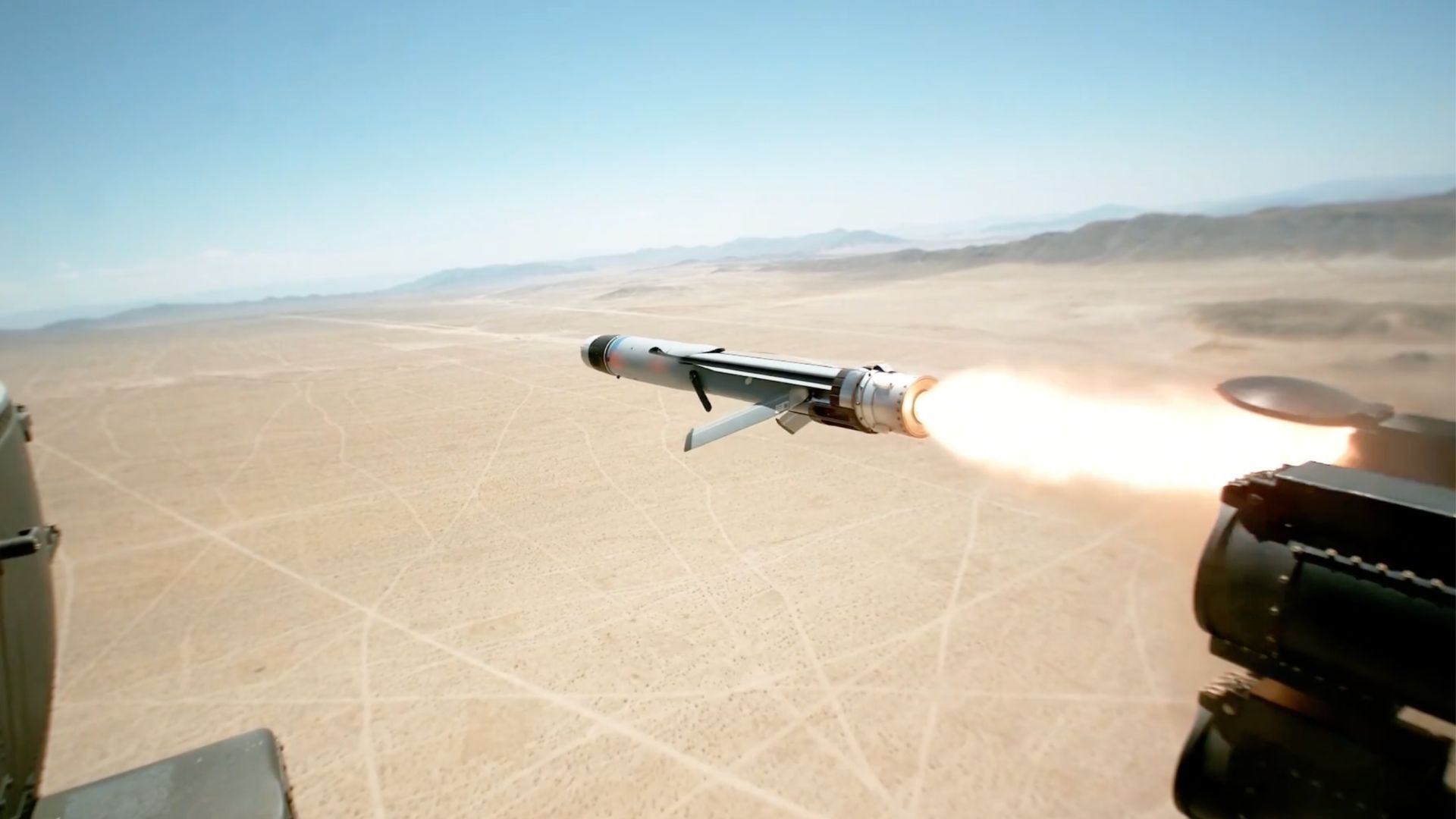
The U.S. Army has tested a new way to turn its H-60M Black Hawk utility helicopter into a launch platform for autonomous weapons. New video released by Anduril Industries on September 1, shows the helicopter launching an Altius-700 from an external pylon over California’s Mojave Desert during Project Convergence Capstone 6. The released footage shows an Altius drone flying away from the Black Hawk before multiple drones work together to locate and attack a ground target. The test points to a future where helicopters can deploy uncrewed systems well beyond the range of their own onboard weapons. Black Hawk becomes a drone carrier The H-60M Black Hawk is primarily a utility aircraft, while the AH-64 Apache serves as the Army’s dedicated attack helicopter. This test gives the Black Hawk a different battlefield role by allowing it to carry and launch autonomous systems. According to Anduril, the helicopter crew deployed an Altius-700 “hunter-killer team” that autonomously located a target, shared information across the formation, and conducted the attack. The Army had previously identified the armed Altius-700M as its Long-Range Precision Munition for Black Hawk launches. The vehicle shown striking what appears to be an armored ground vehicle is therefore likely an Altius-700M. “Successfully launching Air-Launched Effects from a Black Hawk is more than a milestone; it is a leap forward. By extending their reach and increasing lethality, we are changing the battlefield geometry and delivering a decisive advantage to our Soldiers,” said Brig. Gen. Kevin Chaney — Deputy Portfolio Acquisition Executive for Maneuver Air, U.S. Army. New Test Footage: Black Hawk executes rocket-powered launch of Altius-700.At Project Convergence Capstone 6, an H-60M Black Hawk crew employed an Altius-700 hunter-killer team to autonomously find the target, pass data across the formation, and strike. Another successful step… pic.twitter.com/Jpq1OtU4FR— Anduril Industries (@anduriltech) August 31, 2026 More reach from the air The Altius-700M is designed to provide a much longer reach than weapons traditionally carried by helicopters. It reportedly has a range of about 100 miles and can remain airborne for roughly 75 minutes. By comparison, the AGM-114 Hellfire has a range of around 7 miles. This means a Black Hawk could potentially deploy an Altius system while remaining much farther from a target. Launched effects can also perform missions such as surveillance, targeting, electronic warfare, communications relay, and precision strikes. The helicopter can therefore act as a carrier for systems that extend its sensing and attack capabilities. Desert testing pushes autonomy The Mojave test also examined how the system performs in harsh conditions. The Army used the desert environment to evaluate the technology under extreme heat while testing its networking and autonomous functions. The demonstration followed three days of flight testing at Fort A.P. Hill in Virginia in June. During those trials, H-60M crews launched and controlled multiple medium-range launched effects. Sikorsky expects future operations to involve several autonomous systems working at once. “We do not envision employing just one at a time. We expect multiple systems to be operating simultaneously, and the future battlespace will include large numbers of drones that need to communicate back to a mothership or another control node. The Black Hawk will be capable of performing that role,” said Jason Wrigley, Director of Business Development for Army and Air Force Systems, Sikorsky. Increment 1 points to bigger plans The Army describes Increment 1 of its launched-effects capability as a government-owned and designed system developed with the Utility Helicopters Project Office and DEVCOM’s Aviation and Missile Center. Anduril’s Altius family was among the systems demonstrated during Capstone 6, although the Army has not publicly identified every launched effect used during the exercise. At the same time, the unmanned U-Hawk is being developed with an internal launch system. That approach could allow autonomous aircraft to carry launched effects inside their fuselage. The broader goal is a battlefield where crewed and uncrewed aircraft can operate together, with autonomous systems moving ahead of forces and extending their ability to find and engage threats. Get the latest in engineering, tech, space & science - delivered daily to your inbox.A versatile writer, Sujita has worked with Mashable Middle East and News Daily 24. When she isn't writing, you can find her glued to the latest web series and movies.
Video: US Army tests Black Hawk launching 100-mile Altius drone over Mojave Desert
Full Article
Original Source
Read the full article at Interestingengineering →KhanList aggregates and links to publicly available news content. We do not host full articles from third-party sources. Always verify important information with original sources.