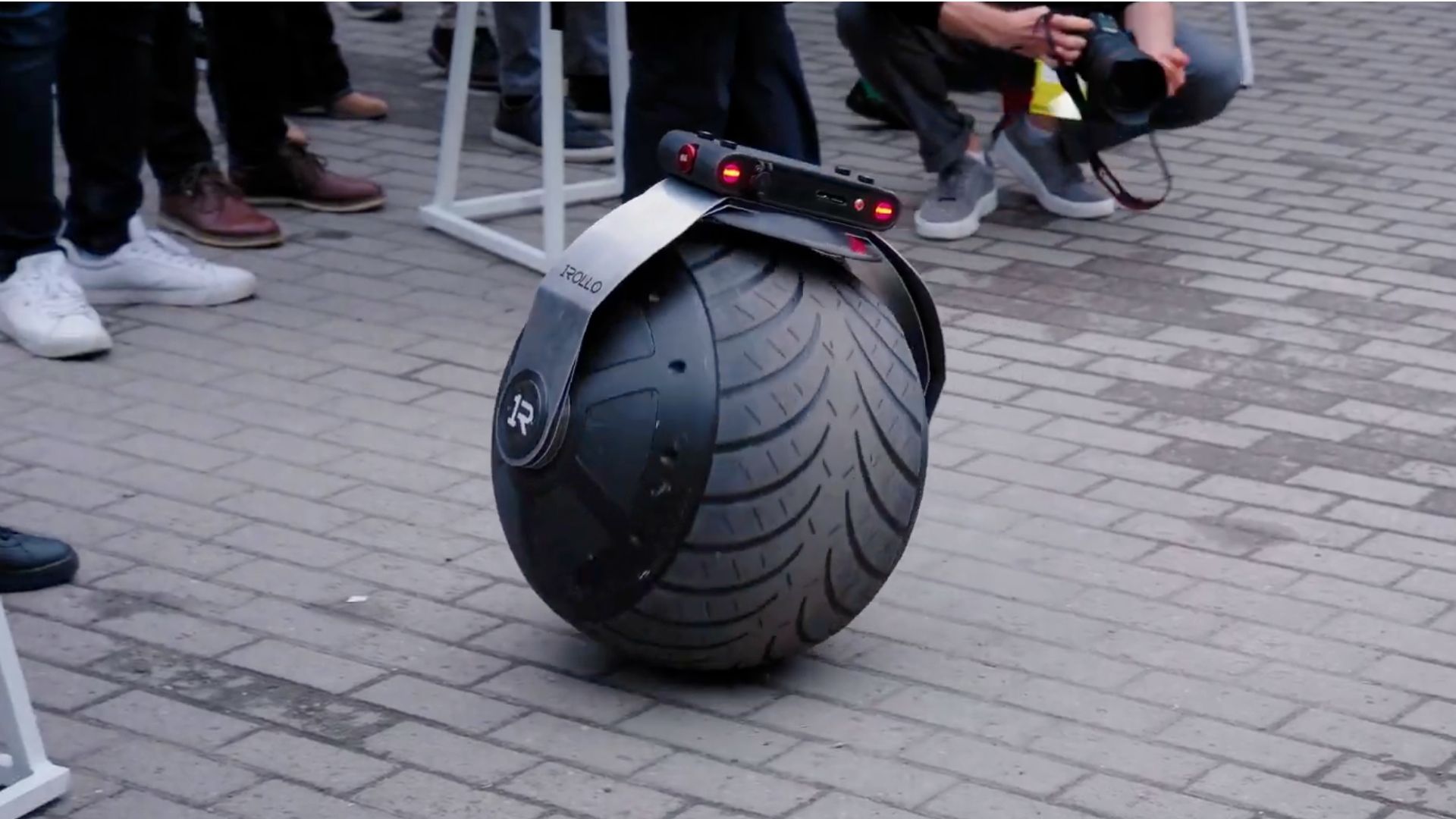
The robot navigates preset routes while balancing on a single wide wheel and continuously scanning its surroundings.Rollo Robotics/YouTube An Estonian startup has unveiled an autonomous monowheel robot it says is the world’s first stable single-wheel security robot designed for real-world patrols. Built to autonomously monitor industrial sites, campuses, and other large facilities, the robot navigates preset routes while balancing on a single wide wheel and continuously scanning its surroundings. Rollo Robotics says its IROLLO it solveed the long-standing challenge of keeping a monowheel robot stable while moving, turning, and stopping. “Our goal is to make autonomous patrolling more cost-efficient, less intrusive, and significantly more versatile by creating a modern robotic platform,” said Sebastian Agur, Co-Founder of Rollo Robotics, in a statement. Monowheel patrol robot 1ROLLO is described as the world’s first autonomous monowheel security robot capable of carrying out real-world security patrols. The Estonian startup, founded in 2025, developed the system to provide continuous autonomous surveillance across large outdoor sites while reducing the need for human patrols. Unlike conventional four-wheeled security robots, 1ROLLO balances on a single 60-centimeter (24-inch) wheel using a proprietary stabilization system. At the heart of the design is a high-speed flywheel mounted vertically inside the main wheel. The spinning flywheel generates gyroscopic forces that keep the robot upright while moving, stopping, or traversing uneven terrain, reports Techeblog. To change direction, the internal flywheel tilts, allowing the robot to lean into turns much like a motorcycle. High-frequency sensors continuously feed data to Rollo Robotics’ in-house control software, which makes constant adjustments to maintain balance even in windy conditions or on rough ground. Standing 110 centimeters (43 inches) tall and weighing about 45 kilograms (100 pounds), 1ROLLO combines a compact footprint with high mobility. The robot can travel at speeds of up to 30 km/h (19 mph), enabling it to patrol expansive facilities efficiently. Powered by a battery that delivers up to eight hours of operation, it automatically returns to a wireless charging station when power runs low, allowing around-the-clock deployment with minimal human intervention. Its IP65-rated enclosure also enables reliable operation in rain, dust, and temperatures ranging from -20°C to 55°C (-4°F to 131°F). Autonomous security platform The robot is equipped with a 360-degree vision system that uses computer vision and edge AI to monitor its surroundings in real time. It can detect people, vehicles, open doors, and other unusual activity, while an RTK-GNSS positioning system provides highly accurate navigation across pre-mapped patrol routes. When an anomaly is detected, 1ROLLO sends instant alerts to a cloud-based fleet management platform via 4G, 5G, or Wi-Fi. Operators can then access live video, communicate through the robot’s integrated microphone and speaker, or dispatch security personnel if needed. The platform also allows multiple robots to be managed simultaneously from a centralized dashboard. According to its makers, one of 1ROLLO’s biggest practical advantages is its slim, single-wheel design. Unlike larger four-wheeled robots that can struggle in narrow corridors, entrances, or crowded walkways, the monowheel platform can navigate tighter spaces while maintaining stability. The robot is designed for security patrols at industrial facilities, data centers, airports, campuses, and other critical infrastructure sites. It also features a modular architecture that supports thermal cameras, PTZ cameras, night vision systems, RFID readers, and other mission-specific payloads, reports Techeblog.Rather than selling the robot outright, Rollo Robotics will offer 1ROLLO through a subscription-based service. Customers pay a monthly fee covering the hardware, maintenance, software updates, and future hardware upgrades, reducing upfront investment while ensuring the system remains current throughout its deployment. Commercial availability is planned for 2027.Recommended ArticlesGet the latest in engineering, tech, space & science - delivered daily to your inbox.Jijo is an automotive and business journalist based in India. Armed with a BA in History (Honors) from St. Stephen's College, Delhi University, and a PG diploma in Journalism from the Indian Institute of Mass Communication, Delhi, he has worked for news agencies, national newspapers, and automotive magazines. In his spare time, he likes to go off-roading, engage in political discourse, travel, and teach languages.
Video: Self-balancing monowheel robot promises smarter and leaner security patrols
Full Article
Original Source
Read the full article at Interestingengineering →KhanList aggregates and links to publicly available news content. We do not host full articles from third-party sources. Always verify important information with original sources.