
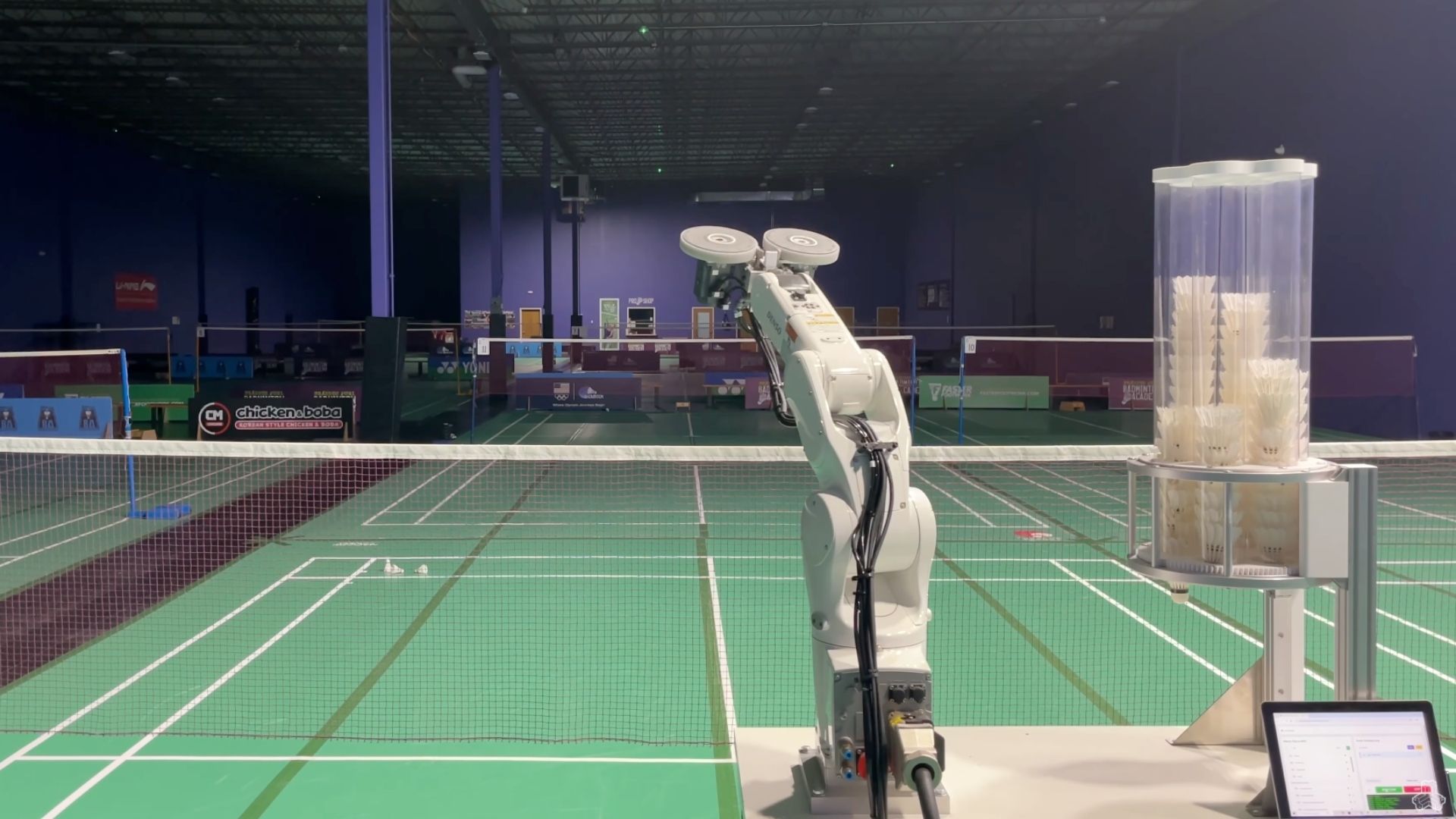
Two 400W motors spin the launch wheels, while pneumatic cylinders grip and push shuttlecocks into them.Travis Mitchell/YouTube A used industrial robot arm has been transformed into a badminton-playing machine that can serve shuttlecocks for practice. The project repurposes a Denso VS-050 robotic arm, turning it into a court-side training system that delivers repeatable shots without requiring another player. The unusual conversion was undertaken by badminton enthusiast Travis Mitchell, who spent about six months developing the system. The project demonstrates how industrial robotics can be adapted for recreational applications, combining a surplus robot arm with a custom-built launching mechanism to create an automated badminton partner. Industrial arm serves A used Denso VS-050 industrial robot arm has been transformed into an automated badminton training machine that can select, aim, and fire shuttlecocks across a court. Mitchell developed the system by repurposing a six-axis industrial arm with a custom launcher, shuttlecock magazine, pneumatic actuators, and high-speed spinning wheels. The project took about six months to develop, with much of the work focused on designing a reliable mechanism that could consistently grip and launch shuttlecocks without damaging or misdirecting them. At the heart of the machine is the Denso VS-050, a compact industrial robotic arm that provides the positioning and movement required to pick up shuttlecocks and place them into the launcher. Denso’s published 3D model of the arm allowed Mitchell to import accurate geometry into Fusion and design a custom wrist-mounted assembly around it. The resulting mechanism combines the robot’s movement capabilities with a dedicated shuttlecock-feeding system. The launcher uses two 400-watt AC servo motors to drive a pair of spinning wheels. When a shuttlecock is positioned between the wheels, friction between the rotating surfaces accelerates it and sends it over the net. Two pneumatic cylinders handle the feeding process: one grips and holds the shuttlecock, while the other pushes it toward the spinning wheels. The entire assembly is mounted to an aluminum frame attached directly to the robot’s wrist. Automated badminton coach Building the launcher required extensive experimentation with the materials used for the high-speed wheels. The wheels need to remain lightweight and precisely balanced while rotating at speeds of up to 6,000 rpm. They must also provide enough grip on the shuttlecock’s nylon skirt to generate consistent launches without deforming or expanding at high rotational speeds. Several materials were tested, including EVA foam, gum rubber, silicone sheets, and 3D-printed components coated with Flex Seal. These approaches either failed to provide sufficient grip or stretched excessively under rotation. The final design uses a 3D-printed plastic wheel hub with a narrow silicone strip serving as the contact surface. This combination provided a better balance between grip, weight, and high-speed stability. The system also includes an automated ammunition system. A motorized carousel holds six tubes, each capable of storing roughly 20 shuttlecocks, giving the machine a capacity of about 120 shots before reloading. A time-of-flight sensor checks whether a shuttlecock is correctly positioned in the active tube. If the tube is empty, the carousel advances to the next one; if it is loaded, the system waits for the robotic arm to retrieve the shuttlecock. The software stores different robot positions and launch configurations and can repeat them. Up to 127 programmed positions can be used, allowing the machine to vary where and how it serves shuttlecocks. The arm can therefore function as more than a simple launcher, providing repeatable shots from different positions and trajectories. The completed system is mounted on a height-adjustable base and transported on a wheeled cart carrying the compressor and electronics. The setup operates from a 240-volt supply and was first tested in the workshop before being moved onto a badminton court. After refining the pneumatic feeding mechanism and launcher wheels, the converted industrial robot could repeatedly serve shuttlecocks for training without requiring another player to feed them.Get the latest in engineering, tech, space & science - delivered daily to your inbox.Jijo is an automotive and business journalist based in India. Armed with a BA in History (Honors) from St. Stephen's College, Delhi University, and a PG diploma in Journalism from the Indian Institute of Mass Communication, Delhi, he has worked for news agencies, national newspapers, and automotive magazines. In his spare time, he likes to go off-roading, engage in political discourse, travel, and teach languages.
Video: Robot arm gets new job, serves shuttlecocks for badminton practice sessions
Full Article
Original Source
Read the full article at Interestingengineering →KhanList aggregates and links to publicly available news content. We do not host full articles from third-party sources. Always verify important information with original sources.