
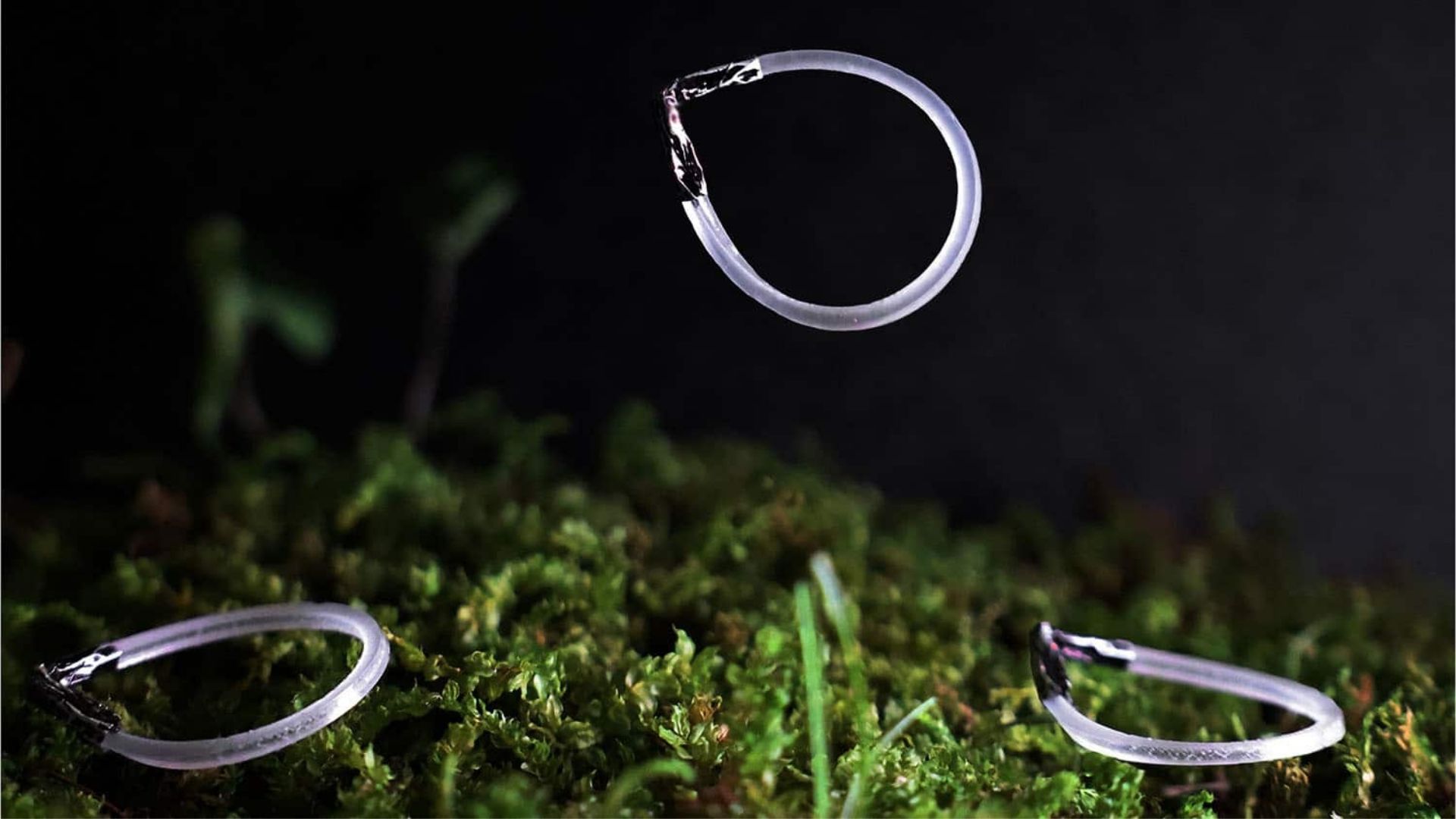
Researchers at North Carolina State University have developed soft robots that can repeatedly jump when exposed to infrared light. The teardrop-shaped devices can leap upward or move forward, continuing to jump for as long as the light remains on. Unlike conventional jumping robots, the new design does not require an external mechanism to reset after each jump, allowing it to repeat the motion autonomously. The researchers say the work could enable light-powered soft robots to repeat movements without motors or complex controls. Light-powered jumping robot The soft robot can repeatedly jump under infrared light, using a simple mechanical design to store, release and recycle energy without motors, batteries or external resetting. The system is built around a photothermally responsive liquid crystal elastomer ring combined with a rigid V-shaped tail, creating a compact robot capable of autonomous continuous leaping across challenging terrain. When exposed to infrared light, the liquid crystal elastomer contracts and causes the soft ring to twist. The V-shaped tail constrains this motion, forcing the structure to bend and store elastic energy as the twisting increases. Once the stored energy reaches a critical threshold, the tail snaps against the ground, rapidly releasing the energy and launching the robot into the air. The key feature is what happens after each jump. During flight, the ring naturally untwists and returns to its original configuration, effectively resetting itself without any external mechanism. Once it lands, the same light-driven process begins again, allowing the robot to repeat the cycle continuously for as long as suitable infrared illumination is maintained. The design also allows the robot’s movement to be controlled through geometry rather than complex software or mechanical systems. Changing the angle of the V-shaped tail can switch the robot between different forms of locomotion. A wider 120-degree angle produces crawling motion, while reducing the angle to 90 degrees enables forward jumping. At around 50 degrees, the robot can leap vertically. Researchers also found that modifying the robot’s center of mass can improve its directional jumping performance. Adding a small amount of weight to the rounded end of the structure shifts the center of mass and produces more powerful and stable forward motion. The intensity of the infrared light provides another control parameter. The illumination must be strong enough to trigger the twisting and jumping cycle, but excessive intensity can make the robot jump unpredictably and in different directions. Testing showed that the soft robots can move across a range of surfaces and obstacles, including slopes, hurdles, grass, sand, rocks, and mulch. The system also demonstrated locomotion across water-land interfaces, highlighting the potential of the mechanism for environments where conventional wheeled or rigid robots could have difficulty operating. According to the team, the optimized designs achieved vertical jumps exceeding 80 times the robot’s body height and directional leaps of more than three body lengths. The researchers used mechanical models to capture the twisting, snapping, and jumping dynamics of the system. By combining light-powered actuation with a self-resetting mechanical structure, the technology offers a way to produce repetitive robotic movement without conventional motors or complicated control systems. The approach could eventually be explored for environmental navigation, swarm robotics, and autonomous movement across unstructured terrain. Get the latest in engineering, tech, space & science - delivered daily to your inbox.Jijo is an automotive and business journalist based in India. Armed with a BA in History (Honors) from St. Stephen's College, Delhi University, and a PG diploma in Journalism from the Indian Institute of Mass Communication, Delhi, he has worked for news agencies, national newspapers, and automotive magazines. In his spare time, he likes to go off-roading, engage in political discourse, travel, and teach languages.
Video: New soft robot uses infrared light to power continuous, self-resetting jumps
Full Article
Original Source
Read the full article at Interestingengineering →KhanList aggregates and links to publicly available news content. We do not host full articles from third-party sources. Always verify important information with original sources.