
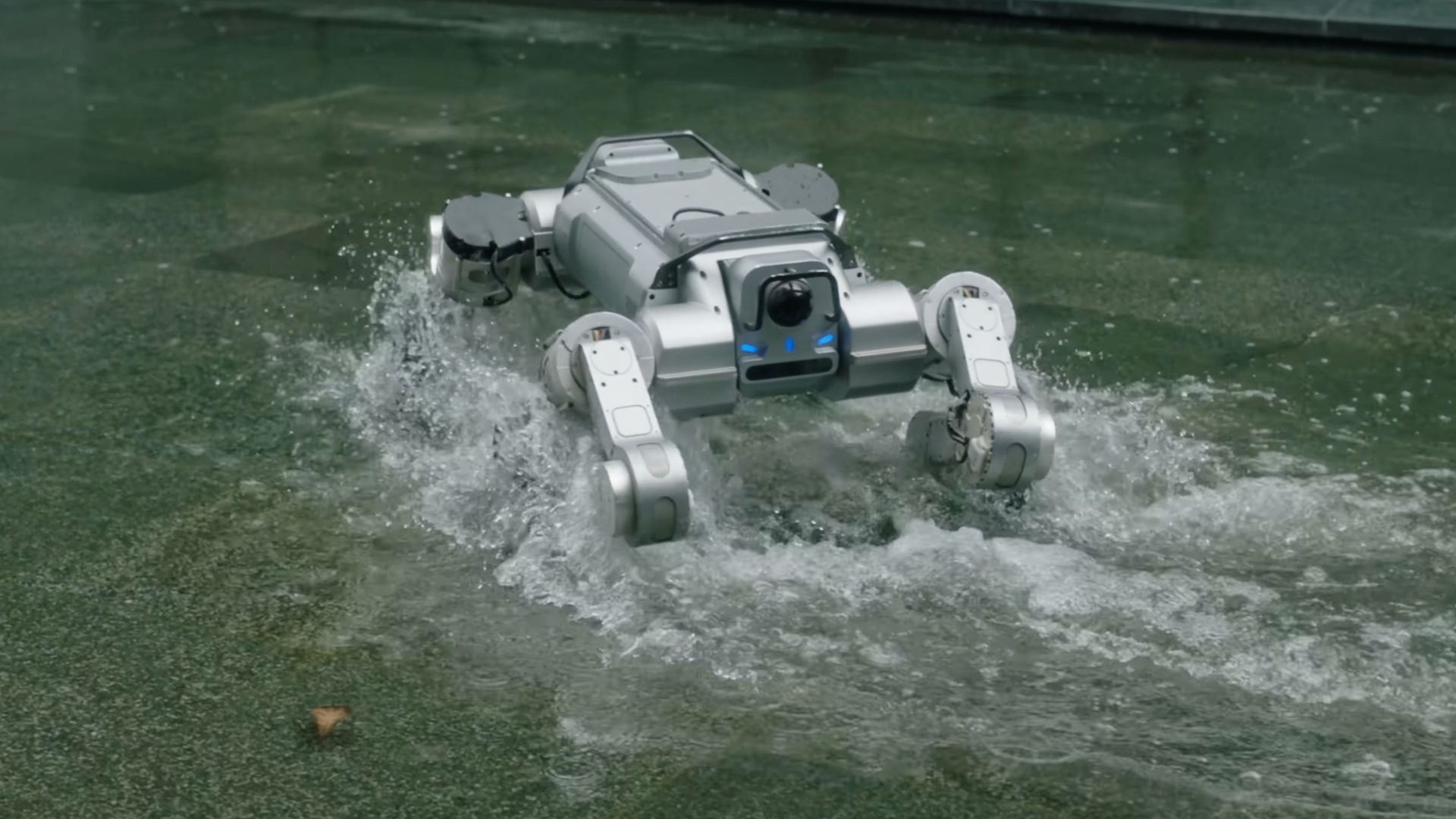
Chinese robotics company Galileo has unveiled Galileo X, a new ground mobility platform designed to combine capabilities traditionally found in different types of robots. The company introduced the system at the 2026 World Robot Conference (WRC) in Beijing, positioning it as a general-purpose platform for a range of operational environments. Galileo says the platform is designed to bridge the gap between wheeled automated guided vehicles, off-road vehicles, and legged robots. The company claims the approach could allow Galileo X to handle precise indoor transport, long-range off-road travel, and complex terrain using a unified robotic architecture and control system. Tackles any terrain Galileo X is a new ground mobility platform that aims to combine the capabilities of wheeled, vehicle-based, and legged robots in a single system. Revealed at the 2026 WRC, the platform is built around what Galileo calls its Unified Embodied Ground Mobility System. The technology is designed to overcome the limitations created by separate hardware architectures, kinematic models, and control systems traditionally used across different types of ground robots. Though details are not made available, at the core of Galileo X is an integrated hardware architecture and unified control framework that connects mechanical systems, actuation, perception, and motion control. Rather than developing separate platforms for indoor transport, off-road travel, and difficult terrain, Galileo has designed a system intended to coordinate these capabilities through a common technological foundation. According to the firm, the approach allows Galileo X to move beyond the conventional boundaries separating automated guided vehicles (AGVs), off-road platforms, and quadruped robots. The company says the platform can combine the precise movement and transport capabilities associated with wheeled AGVs with the longer-range mobility of vehicle platforms and the terrain adaptability of legged robots. The underlying architecture is particularly significant because different ground-robot configurations typically require their own mechanical designs, movement models, and control algorithms. Galileo’s unified approach brings these elements together, allowing the same platform architecture to support different mobility requirements while coordinating its mechanical and software systems as a whole. Reimagining mobility The platform is designed for environments where conventional wheeled robots can struggle with terrain or where deploying several specialized machines would add complexity. The company claims Galileo X can serve as a heavy-duty off-road handling platform, a warehouse logistics system, a directional transfer vehicle, or a mobile base for humanoid robots. It can also be configured for inspection, perception, and other mobile-operation tasks. By combining multiple mobility concepts, the system could reduce the need for organizations to deploy and maintain separate robotic platforms for different environments. Galileo also argues that integrating hardware and control technologies can simplify deployment and reduce the complexity of coordinating multiple machines throughout their operating lifecycles. The development reflects Galileo’s broader focus on embodied intelligence, with the company maintaining in-house capabilities spanning robot platforms, core components, motion control, and systems engineering. Rather than relying solely on third-party components, Galileo says it has developed its core hardware and underlying technologies as part of a full-stack robotics approach. According to the company, Galileo X also represents the foundation of its broader all-terrain mobile robotics strategy. It plans to open core hardware and software interfaces around the platform, allowing algorithm developers, application providers, and industry partners to build specialized capabilities on top of the mobility system. The move could turn Galileo X from a standalone robot into a broader robotics platform, with the underlying mobility architecture serving as a common base for different applications. Galileo says it will also expand its overseas distribution network as it seeks to commercialize the technology internationally. Get the latest in engineering, tech, space & science - delivered daily to your inbox.Jijo is an automotive and business journalist based in India. Armed with a BA in History (Honors) from St. Stephen's College, Delhi University, and a PG diploma in Journalism from the Indian Institute of Mass Communication, Delhi, he has worked for news agencies, national newspapers, and automotive magazines. In his spare time, he likes to go off-roading, engage in political discourse, travel, and teach languages.
Video: New robot platform unites wheeled, off-road and legged mobility in one system
Full Article
Original Source
Read the full article at Interestingengineering →KhanList aggregates and links to publicly available news content. We do not host full articles from third-party sources. Always verify important information with original sources.